. 2013 Feb;33(2):293-9.
doi: 10.1038/jcbfm.2012.169. Epub 2012 Nov 21.

Purinergic receptors regulate myogenic tone in cerebral parenchymal arterioles

Affiliations

Purinergic receptors regulate myogenic tone in cerebral parenchymal arterioles

Joseph E Brayden et al. J Cereb Blood Flow Metab. 2013 Feb.

Abstract

Myogenic tone is a fundamental aspect of vascular behavior in resistance arteries. This contractile response to changes in intravascular pressure is critically involved in blood flow autoregulation in tissues such as the brain, kidneys, and heart. Myogenic tone also helps regulate precapillary pressure and provides a level of background tone upon which vasodilator stimuli act to increase tissue perfusion when appropriate. Despite the importance of these processes in the brain, little is known about the mechanisms involved in control of myogenic tone in the cerebral microcirculation. Here, we report that pharmacological inhibition of P2Y4 and P2Y6 pyrimidine receptors nearly abolished myogenic tone in cerebral parenchymal arterioles (PAs). Molecular suppression of either P2Y4 or P2Y6 receptors using antisense oligodeoxynucleotides reduced myogenic tone by 44%±8% and 45%±7%, respectively. These results indicate that both receptor isoforms are activated by increased intravascular pressure, which enhances the activity of voltage-dependent calcium channels and increases myogenic tone in PAs. Enhancement or inhibition of ectonucleotidase activity had no effect on parenchymal arteriolar myogenic tone, indicating that this response is not mediated by local release of nucleotides, but rather may involve direct mechanical activation of P2Y receptors in the smooth muscle cells.


Figures
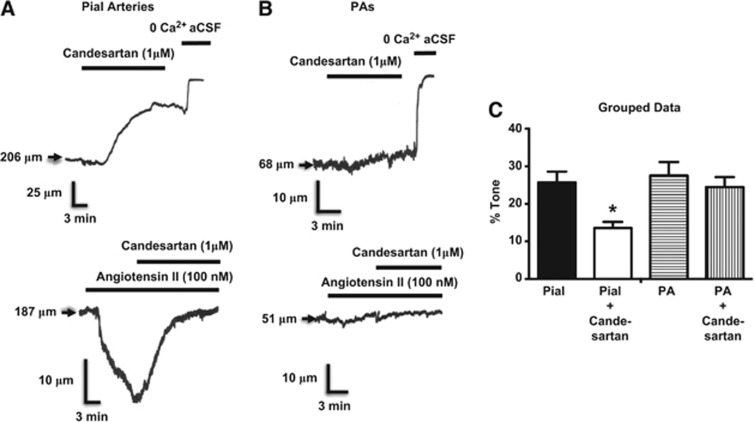
Figure 1
Figure 1
Effects of the AT1 receptor inverse agonist candesartan on myogenic tone in cerebral arteries. (A) Candesartan inhibits myogenic tone and Ang II constricts pial arteries, but these Ang II receptor modulators have no significant effects on parenchymal arterioles (PAs) (B). (C) Grouped data show significant effect of cadesartan on pial artery myogenic tone and the absence of effect on myogenic tone in PAs. *P<0.05 versus response without candesartan. N=4 for pial and parenchymal artery groups. Pial arteries and PAs were pressurized to 80 and 40 mm Hg, respectively, to induce myogenic tone, and to 10 and 5 mm Hg, respectively, where myogenic tone is very low or absent, for assessment of Ang II-induced vasoconstrictions.
Figure 2
Figure 2
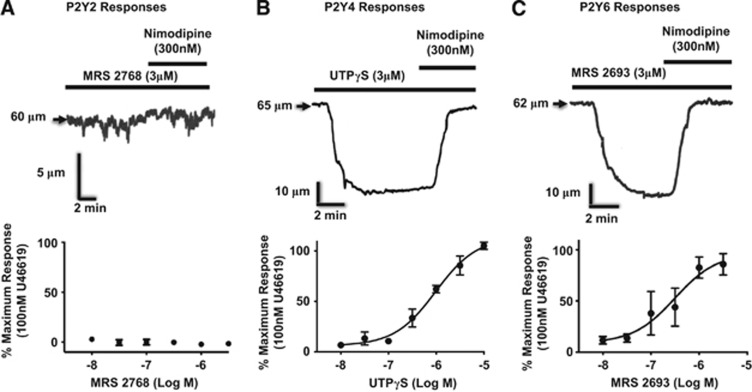
Responses of parenchymal arterioles (PAs) to P2Y receptor agonists. (A) Although a P2Y2 ligand (n=3) does not constrict PAs, (B) P2Y4 (n=3), and (C) P2Y6 (n=4) ligands cause robust, dihydropyridine-sensitive constrictions of isolated PAs without endothelium. PAs were pressurized to 5 mm Hg, where myogenic tone is very low or absent.
Figure 3
Figure 3
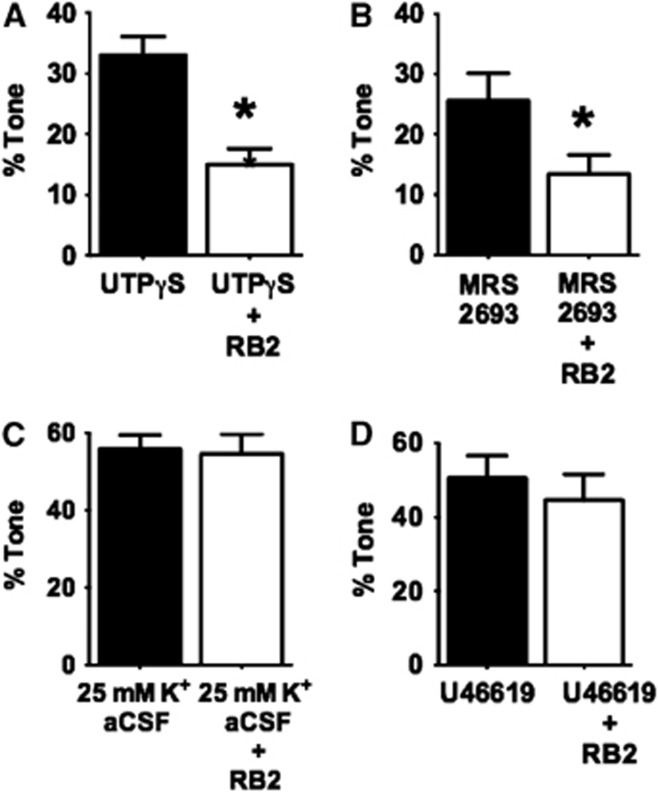
Reactive Blue 2 (RB2, 10 μmol/L) inhibits (A) P2Y4 (n=4) and (B) P2Y6 (n=4) receptor-induced constrictions, but not (C) depolarization (K+)-mediated (n=8) or (D) U46619-induced (n=5) responses in parenchymal arterioles (PAs) pressurized to 5 mm Hg. *P<0.05 versus response without RB2.
Figure 4
Figure 4
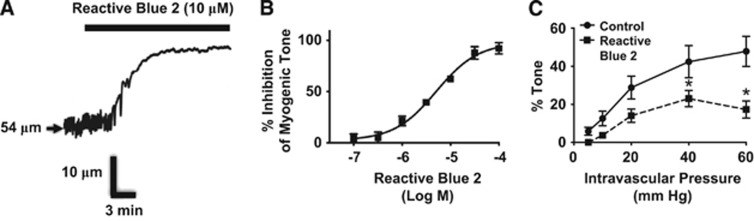
Reactive Blue 2 inhibits myogenic tone. (A) RB2 (10 μmol/L) substantially reduces myogenic tone in a parenchymal arteriole (PA) held at 40 mm Hg intravascular pressure. (B) RB2 concentration/response relationship in PAs with tone (P=40 mm Hg) (n=3). (C) Effects of RB2 (10 μmol/L) on myogenic tone over the full pressure/diameter relationship in PAs. *P<0.05 versus Control (n=5).
Figure 5
Figure 5
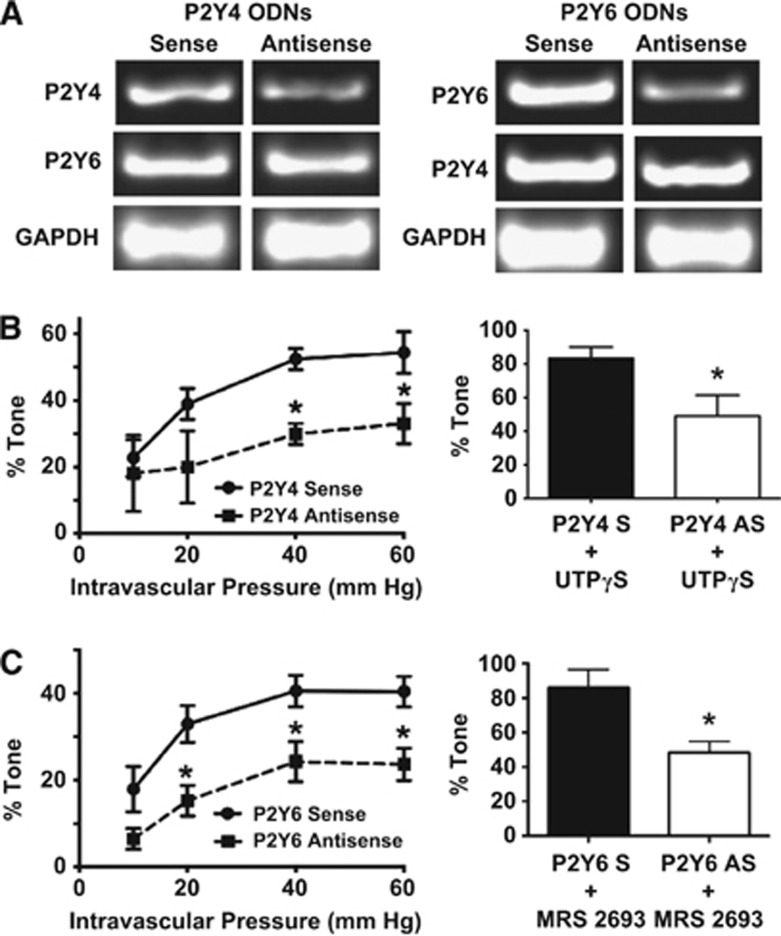
Effects of antisense oligonucleotides on P2Y receptor message levels, myogenic tone, and responses to P2Y4- and P2Y6-specific ligands. (A) Semiquantitative PCR indicates a specific and substantial decrease in P2Y4- or P2Y6- message levels in arteries exposed to antisense versus sense oligodeoxynucleotides (ODNs) (sense or antisense ODN-treated parenchymal arterioles (PAs) from three animals were pooled in each case to assess relative message abundance). Myogenic tone and constrictions to receptor-specific ligands were significantly reduced in arterial samples treated with (B) P2Y4 (n=4 to 5) and (C) P2Y6 (n=8) receptor antisense ODNs. *P<0.05 versus sense-treated.
Figure 6
Figure 6
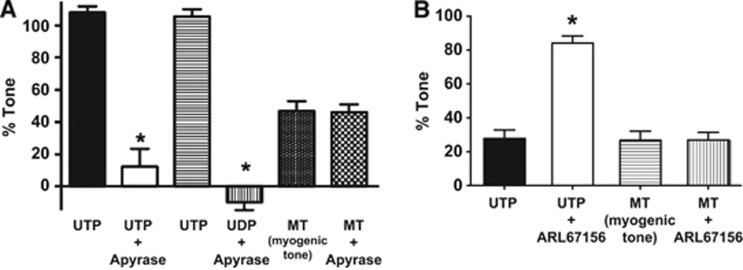
Effects of exogenous ectonucleotidase (apyrase) and an ectonucleotidase inhibitor (ARL67156) on pyrimidine nucleotide-induced constrictions and myogenic tone in isolated parenchymal arterioles (PAs). (A) Apyrase inhibits responses to UTP and UDP but has no effect on myogenic tone (n=4). (B) The ectonucleotidase inhibitor ARL67156 enhances UTP-induced constrictions, but not myogenic tone (n=4). For UTP and UDP-induced responses, arteries were held at 5 mm Hg to minimize myogenic tone; myogenic tone was induced by increasing intravascular pressure to 60 mm Hg. *P<0.05 versus responses without apyrase or ARL67156.

References

    1. Harder DR. Pressure-dependent membrane depolarization in cat middle cerebral artery. Circ Res. 1984;55:197–202. - PubMed
    1. Brayden JE, Nelson MT. Regulation of arterial tone by activation of calcium-dependent potassium channels. Science. 1992;256:532–535. - PubMed
    1. Earley S, Waldron BJ, Brayden JE. Critical role for transient receptor potential channel TRPM4 in myogenic constriction of cerebral arteries. Circ Res. 2004;95:922–929. - PubMed
    1. Osol G, Laher I, Cipolla M. Protein kinase C modulates basal myogenic tone in resistance arteries from the cerebral circulation. Circ Res. 1991;68:359–367. - PubMed
    1. Dabertrand F, Nelson MT, Brayden JE. Acidosis dilates brain parenchymal arterioles by conversion of calcium waves to sparks to activate BK channels. Circ Res. 2012;110:285–294. - PMC - PubMed

Publication types

MeSH terms

LinkOut - more resources