


Early detection of cancer in the general population: a blinded case-control study of p53 autoantibodies in colorectal cancer
- PMID: 23169294
- PMCID: PMC3553520
- DOI: 10.1038/bjc.2012.517
Early detection of cancer in the general population: a blinded case-control study of p53 autoantibodies in colorectal cancer
Abstract
Background: Recent reports from cancer screening trials in high-risk populations suggest that autoantibodies can be detected before clinical diagnosis. However, there is minimal data on the role of autoantibody signatures in cancer screening in the general population.
Methods: Informative p53 peptides were identified in sera from patients with colorectal cancer using an autoantibody microarray with 15-mer overlapping peptides covering the complete p53 sequence. The selected peptides were evaluated in a blinded case-control study using stored serum from the multimodal arm of the United Kingdom Collaborative Trial of Ovarian Cancer Screening where women gave annual blood samples. Cases were postmenopausal women who developed colorectal cancer following recruitment, with 2 or more serum samples preceding diagnosis. Controls were age-matched women with no history of cancer.
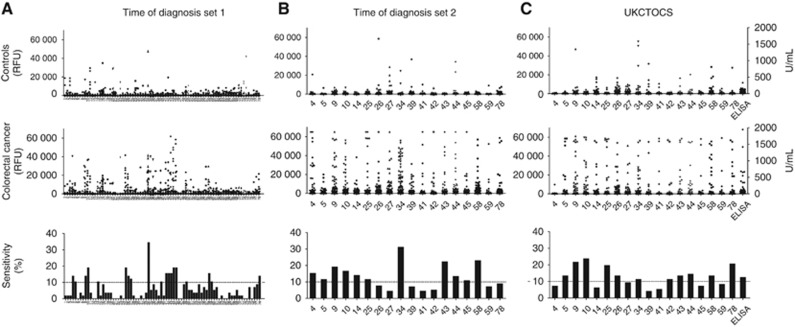
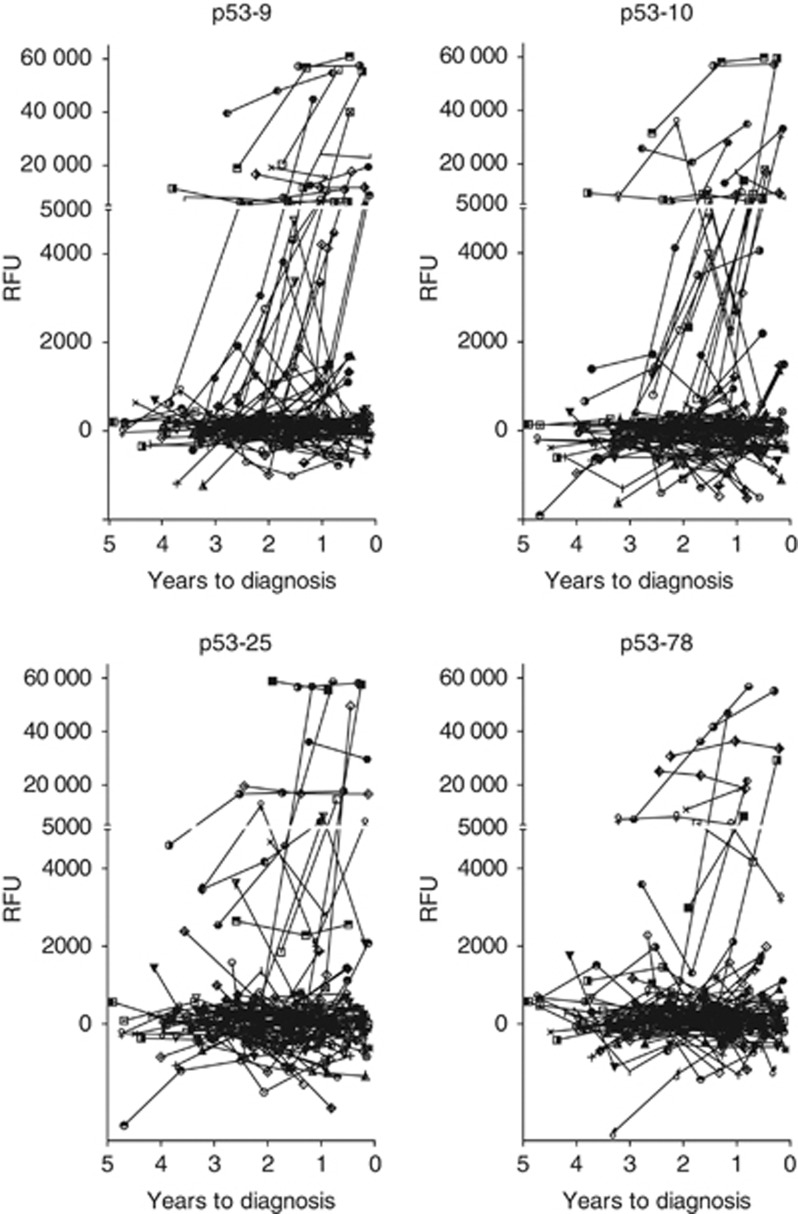
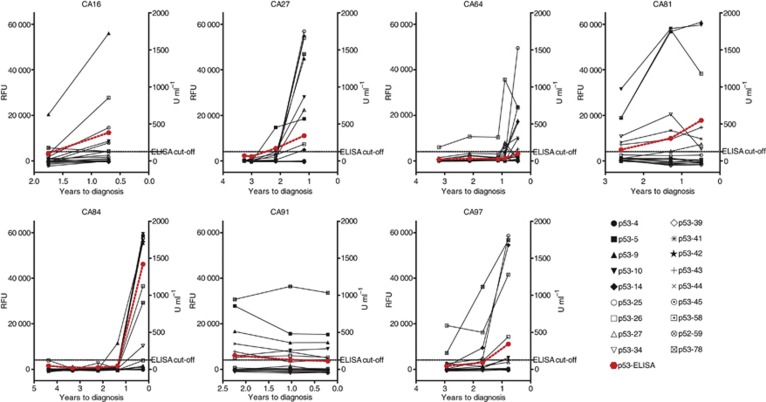
Results: The 50 640 women randomised to the multimodal group were followed up for a median of 6.8 (inter-quartile range 5.9-8.4) years. Colorectal cancer notification was received in 101 women with serial samples of whom 97 (297 samples) had given consent for secondary studies. They were matched 1 : 1 with 97 controls (296 serial samples). The four most informative peptides identified 25.8% of colorectal cancer patients with a specificity of 95%. The median lead time was 1.4 (range 0.12-3.8) years before clinical diagnosis.
Conclusion: Our findings suggest that in the general population, autoantibody signatures are detectable during preclinical disease and may be of value in cancer screening. In colorectal cancer screening in particular, where the current need is to improve compliance, it suggests that p53 autoantibodies may contribute towards risk stratification.
Conflict of interest statement
UM and IJ have a financial interest through UCL Business and Abcodia Ltd in the third-party exploitation of clinical trials biobanks, which have been developed through the research at UCL. IJ has consultancy arrangements with Becton Dickinson, who have provided consulting fees, funds for research, and staff but not directly related to this study. The remaining authors declare no conflict of interest.
Figures
References
-
- Burnell M, Gentry-Maharaj A, Ryan A, Apostolidou S, Habib M, Kalsi J, Skates S, Parmar M, Seif MW, Amso NN, Godfrey K, Oram D, Herod J, Williamson K, Jenkins H, Mould T, Woolas R, Murdoch J, Dobbs S, Leeson S, Cruickshank D, Campbell S, Fallowfield L, Jacobs I, Menon U (2011) Impact on mortality and cancer incidence rates of using random invitation from population registers for recruitment to trials. Trials 12: 61. - PMC - PubMed
-
- Casey G, Lopez ME, Ramos JC, Plummer SJ, Arboleda MJ, Shaughnessy M, Karlan B, Slamon DJ (1996) DNA sequence analysis of exons 2 through 11 and immunohistochemical staining are required to detect all known p53 alterations in human malignancies. Oncogene 13: 1971–1981 - PubMed
-
- Chatterjee M, Mohapatra S, Ionan A, Bawa G, Ali-Fehmi R, Wang X, Nowak J, Ye B, Nahhas FA, Lu K, Witkin SS, Fishman D, Munkarah A, Morris R, Levin NK, Shirley NN, Tromp G, Abrams J, Draghici S, Tainsky MA (2006) Diagnostic markers of ovarian cancer by high-throughput antigen cloning and detection on arrays. Cancer Res 66: 1181–1190 - PMC - PubMed
-
- Fourkala EO, Gentry-Maharaj A, Burnell M, Ryan A, Manchanda R, Dawnay A, Jacobs I, Widschwendter M, Menon U (2012) Histological confirmation of breast cancer registration and self-reporting in England and Wales: a cohort study within the UK Collaborative Trial of Ovarian Cancer Screening. Br J Cancer 106: 1910–1916 - PMC - PubMed
Publication types
MeSH terms
Substances
Grants and funding
LinkOut - more resources
Full Text Sources
Other Literature Sources
Medical
Research Materials
Miscellaneous
