


Case/control studies with follow-up: Constructing the source population to estimate effects of risk factors on development, disease, and survival
- PMID: 23169939
- PMCID: PMC3502318
- DOI: 10.1093/cid/cis802
Case/control studies with follow-up: Constructing the source population to estimate effects of risk factors on development, disease, and survival
Abstract
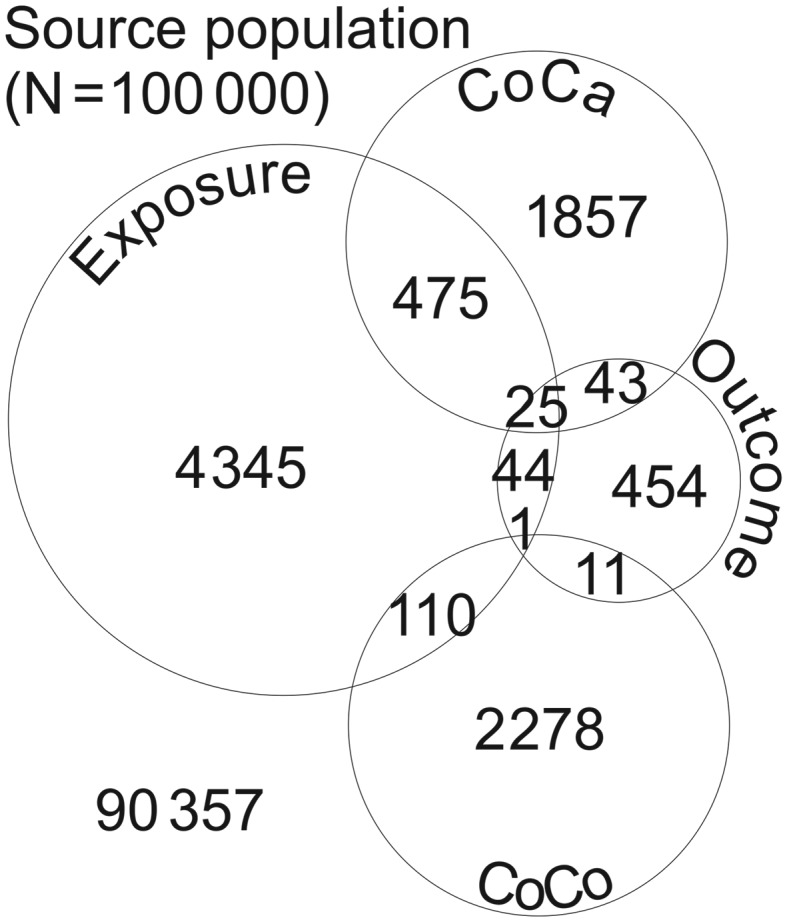
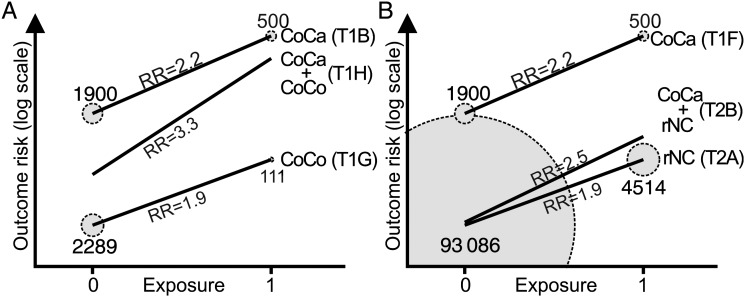
If individuals in a case/control study are subsequently observed as a cohort of cases and a cohort of controls, weighted regression analyses can be used to estimate the association between the exposures initially recorded and events occurring during the follow-up of the 2 cohorts. Such analyses can be conceptualized as being undertaken on a reconstructed source population from which cases and controls stem. To simulate this population, the cohort of cases is added to the cohort of controls expanded with the reciprocal of the case disease incidence odds (the sampling weight) to include all individuals in the source population who did not develop the case disease. We use a simulated dataset to illustrate how weighted generalized linear model regression can be used to estimate the association between an exposure captured during the case/control study component and an outcome that occurs during follow-up.
Figures
References
-
- Breslow NE. Statistics in epidemiology: the case-control study. J Am Stat Assoc. 1996;91:14–28. - PubMed
-
- Rothman KJ. Epidemiology: an introduction. 2nd ed. New York, NY: Oxford University Press; 2012.
-
- Rothman KJ, Greenland S, Lash TL. Modern epidemiology. 3rd ed. Philadelphia: Wolters Kluwer Health/Lippincott Williams & Wilkins; 2008.
-
- Nagelkerke N, Smits J, le Cessie S, van Houwelingen H. Testing goodness-of-fit of the logistic regression model in case-control studies using sample reweighting. Stat Med. 2005;24:121–30. - PubMed
-
- Richardson DB, Rzehak P, Klenk J, Weiland SK. Analyses of case-control data for additional outcomes. Epidemiology. 2007;18:441–5. - PubMed
