


2009 Pandemic influenza A virus subtype H1N1 in Morocco, 2009-2010: epidemiology, transmissibility, and factors associated with fatal cases
- PMID: 23169979
- PMCID: PMC3572880
- DOI: 10.1093/infdis/jis547
2009 Pandemic influenza A virus subtype H1N1 in Morocco, 2009-2010: epidemiology, transmissibility, and factors associated with fatal cases
Abstract
Background: Following the emergence of 2009 pandemic influenza A virus subtype H1N1 (A[H1N1]pdm09) in the United States and Mexico in April 2009, A(H1N1)pdm09 spread rapidly all over the world. There is a dearth of information about the epidemiology of A(H1N1)pdm09 in Africa, including Morocco. We describe the epidemiologic characteristics of the A(H1N1)pdm09 epidemic in Morocco during 2009-2010, including transmissibility and risk factors associated with fatal disease.
Methods: We implemented influenza surveillance for patients presenting with influenza-like illness (ILI) at 136 private and public clinics for patients with severe acute respiratory illness (SARI) at 16 regional public hospitals from June 2009 through February 2010. Respiratory samples and structured questionnaires were collected from all enrolled patients, and samples were tested by real-time reverse-transcription polymerase chain reaction for influenza viruses. We estimated the risk factors associated with fatal disease as well as the basic reproduction number (R(0)) and the serial interval of the pandemic virus.
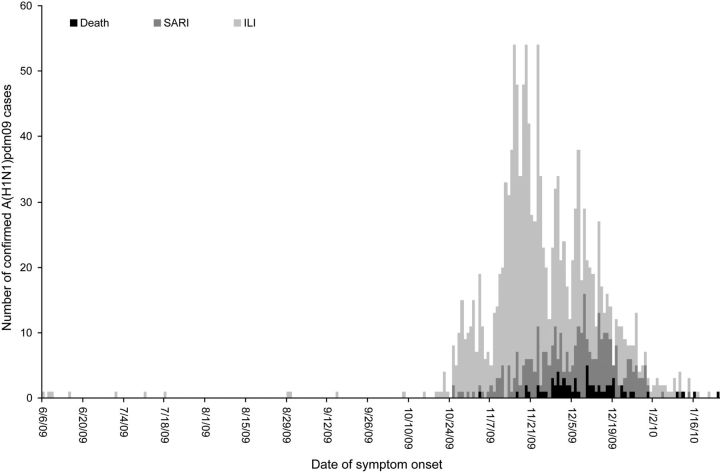
Results: From June 2009 through February 2010, we obtained 3937 specimens, of which 1452 tested positive for influenza virus. Of these, 1398 (96%) were A(H1N1)pdm09. Forty percent of specimens from ILI cases (1056 of 2646) and 27% from SARI cases (342 of 1291) were positive for A(H1N1)pdm09. Sixty-four deaths occurred among laboratory-confirmed A(H1N1)pdm09 SARI cases. Among these cases, those who had hypertension (age-adjusted odd ratio [aOR], 28.2; 95% confidence interval [CI], 2.0-398.7), had neurological disorders (aOR, 7.5; 95% CI, 1.5-36.4), or were obese (aOR, 7.1; 95% CI, 1.6-31.1), as well as women of gestational age who were pregnant (aOR, 2.5; 95% CI, 1.1-5.6), were at increased risk of death. Across the country, elevated numbers of locally acquired infections were detected 4 months after the detection of the first laboratory-confirmed case and coincided with the expected influenza season (October-January) in Morocco. We obtained an R(0) estimate of 1.44 (95% CI, 1.32-1.56) and a mean serial interval (±SD) of 2.3 ± 1.4 days (95% CI, 1.6-3.0).
Conclusion: Widespread but delayed community transmission of A(H1N1)pdm09 occurred in Morocco in 2009, and A(H1N1)pdm09 became the dominant influenza virus subtype during the 2009-2010 influenza season. The transmissibility characteristics were similar to those observed in other countries.
Figures
References
-
- Dawood FS, Jain S, Finelli L, et al. Emergence of a novel swine-origin influenza A (H1N1) virus in humans. N Engl J Med. 2009;360:2605–15. - PubMed
-
- Chan M. World now at the start of 2009 influenza pandemic. http://www.who.int/mediacentre/news/statements/2009/h1n1_pandemic_phase6.... Accessed 9 December 2009.
-
- Kwan-Gett TS, Baer A, Duchin JS. Spring 2009 H1N1 influenza outbreak in King County, Washington. Disaster Med Public Health Prep. 2009;3(Suppl 2):S109–16. - PubMed
-
- Louie JK, Acosta M, Samuel MC, et al. A novel risk factor for a novel virus: obesity and 2009 pandemic influenza A (H1N1) Clin Infect Dis. 2011;52:301–12. - PubMed
-
- World Health Organization. Human infection with new influenza A (H1N1) virus: clinical observations from Mexico and other affected countries, May 2009. Wkly Epidemiol Rec. 2009;84:185–9. - PubMed
Publication types
MeSH terms
Grants and funding
LinkOut - more resources
Full Text Sources
Medical
Molecular Biology Databases
Miscellaneous
