. 2013 Jan;6(1):118-26.
doi: 10.1161/CIRCHEARTFAILURE.112.969576. Epub 2012 Nov 20.

Glucose 6-phosphate dehydrogenase deficiency increases redox stress and moderately accelerates the development of heart failure

Affiliations

Glucose 6-phosphate dehydrogenase deficiency increases redox stress and moderately accelerates the development of heart failure

Peter A Hecker et al. Circ Heart Fail. 2013 Jan.

Abstract

Background: Glucose 6-phosphate dehydrogenase (G6PD) is the most common deficient enzyme in the world. In failing hearts, G6PD is upregulated and generates reduced nicotinamide adenine dinucleotide phosphate (NADPH) that is used by the glutathione pathway to remove reactive oxygen species but also as a substrate by reactive oxygen species-generating enzymes. Therefore, G6PD deficiency might prevent heart failure by decreasing NADPH and reactive oxygen species production.

Methods and results: This hypothesis was evaluated in a mouse model of human G6PD deficiency (G6PDX mice, ≈40% normal activity). Myocardial infarction with 3 months follow-up resulted in left ventricular dilation and dysfunction in both wild-type and G6PDX mice but significantly greater end diastolic volume and wall thinning in G6PDX mice. Similarly, pressure overload induced by transverse aortic constriction (TAC) for 6 weeks caused greater left ventricular dilation in G6PDX mice than wild-type mice. We further stressed transverse aortic constriction mice by feeding a high fructose diet to increase flux through G6PD and reactive oxygen species production and again observed worse left ventricular remodeling and a lower ejection fraction in G6PDX than wild-type mice. Tissue content of lipid peroxidation products was increased in G6PDX mice in response to infarction and aconitase activity was decreased with transverse aortic constriction, suggesting that G6PD deficiency increases myocardial oxidative stress and subsequent damage.

Conclusions: Contrary to our hypothesis, G6PD deficiency increased redox stress in response to infarction or pressure overload. However, we found only a modest acceleration of left ventricular remodeling, suggesting that, in individuals with G6PD deficiency and concurrent hypertension or myocardial infarction, the risk for developing heart failure is higher but limited by compensatory mechanisms.


Figures
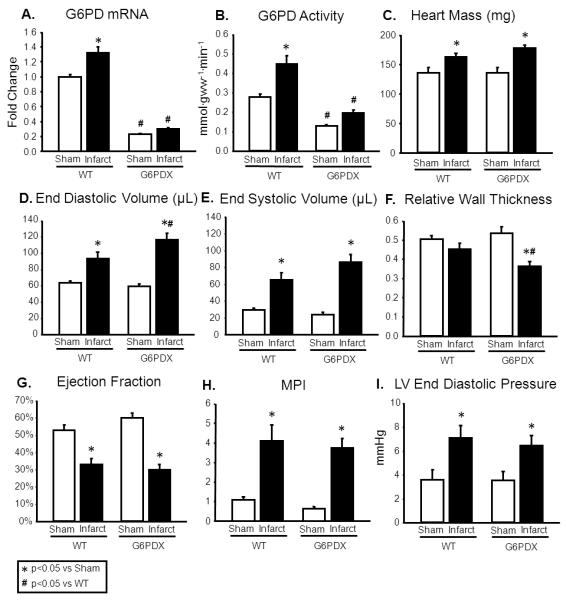
Figure 1
Figure 1. G6PD deficiency exacerbates LV dilation, but does not affect function after myocardial infarction
A-B. Myocardial G6PD mRNA expression and enzymatic activity were increased by LAD ligation in WT mice, but not in G6PD deficient mice. C. Myocardial infarction increased heart mass. D-F. Myocardial infarction increased LV end diastolic and end systolic volume. LV end diastolic volume was increased further by G6PD deficiency, and myocardial infarction resulted in decreased relative wall thickness in G6PDX mice, indicating that G6PD deficiency increased susceptibility to dilation. G-I. Myocardial infarction decreased ejection fraction indicating systolic dysfunction, and increased MPI and LV end diastolic pressure indicating diastolic dysfunction. These functional parameters were unaffected by G6PD deficiency. Data were obtained using mice at 11-12 weeks after LAD ligation or sham surgery. For echocardiography measurements, mice were anesthetized with 1.5% isoflurane. *P <0.05 vs. Sham; #P <0.05 vs. WT; Sham n=9-10/group, WT infarct n=19, G6PDX infarct n=27-28.
Figure 2
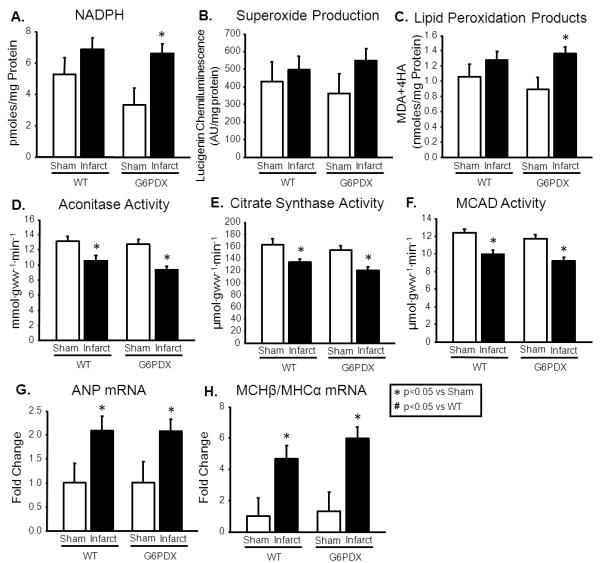
Figure 2. Infarct - Biochemical Data
A. Infarction increased myocardial [NADPH] in G6PDX mice. B. Myocardial superoxide production was unaffected by infarction or G6PD deficiency. C. Infarction increased myocardial lipid peroxidation products in G6PDX mice. D-F. Infarction decreased myocardial aconitase activity, citrate synthase activity, and MCAD activity to the same extent in G6PDX and WT mice. G-H. Myocardial ANP and MHCβ/MHCα mRNA were also increased by infarction and unaffected by G6PD deficiency. Data were obtained using myocardium from mice at 12 weeks after LAD ligation or sham surgery. *P <0.05 vs. Sham; #P <0.05 vs. WT; Sham n=9-10/group, WT infarct n=19, G6PDX infarct n=27-28.
Figure 3
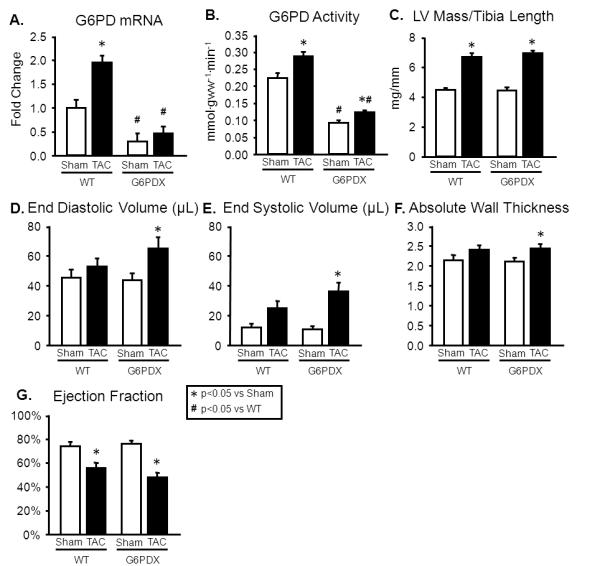
Figure 3. G6PD deficiency increases propensity for LV dilation after TAC
A-B. TAC increased G6PD mRNA and G6PD activity in WT mice, but not in G6PDX mice. C. TAC increased LV mass to the same extent in WT and G6PDX mice. D-F. TAC increased LV end diastolic volume, end systolic volume, and absolute wall thickness in G6PDX mice. G. TAC decreased systolic function to the same extent in G6PDX and WT mice. Data were obtained using mice at 6 weeks after Sham or TAC surgery with a 28 gauge needle. For echocardiography measurements, mice were anesthetized with 1% isoflurane.*P <0.05 vs. Sham; #P <0.05 vs. WT; Sham n=7/group, TAC=10-12/group.
Figure 4
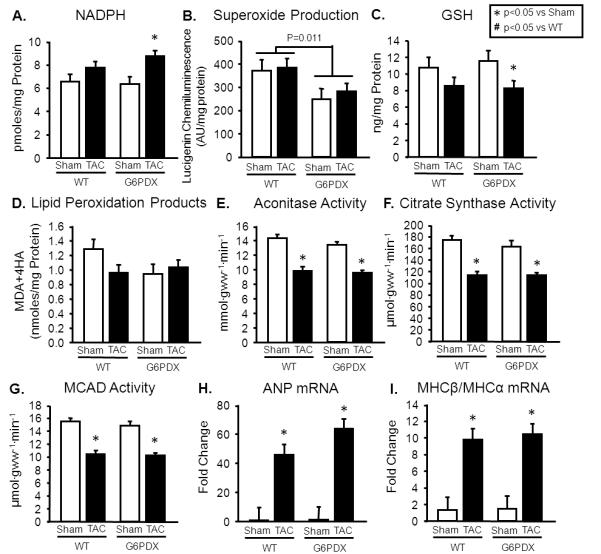
Figure 4. TAC - Biochemical Data
A. LV NADPH was increased by TAC in G6PDX mice. B. Superoxide production was decreased by G6PD deficiency. C. GSH was decreased in response to TAC in G6PDX mice. D. Lipid peroxidation products were unaffected by G6PD deficiency or TAC. E-G. TAC decreased myocardial aconitase activity, citrate synthase activity, and MCAD activity to the same extent in G6PDX and WT mice H-I. TAC increased ANP and MHCβ/MHCα in WT and G6PDX mice to the same extent. Data were obtained using LV myocardium from mice at 6 weeks after Sham or TAC surgery with a 28 gauge needle. *P <0.05 vs. Sham; #P <0.05 vs. WT; Sham n=7/group, TAC=10-12/group.
Figure 5
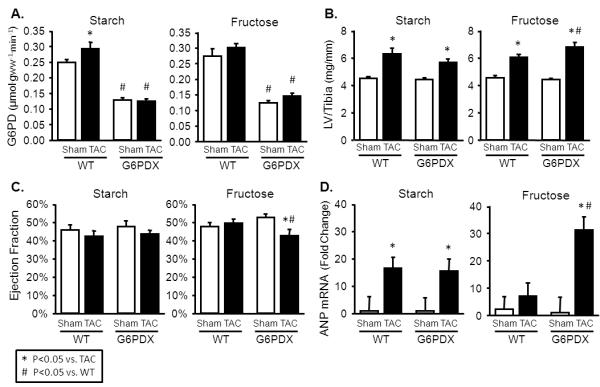
Figure 5. G6PD deficiency exacerbates the cardiac effects of pressure overload with high fructose intake
A. LV G6PD activity was increased by TAC in the high starch diet, and was decreased in G6PDX mice. B. LV mass was increased by TAC in all groups, and was increased to the greatest extent in G6PDX mice with high fructose intake. C. Ejection Fraction was decreased in G6PDX mice with the high fructose diet. D. LV ANP mRNA expression was increased by TAC to the greatest extent in G6PD deficient animals with high fructose intake. Data were obtained 16-17 weeks post-TAC. For echocardiography measurements, mice were anesthetized with 2.5% isoflurane.*P <0.05 vs. TAC; #P <0.05 vs. WT; Sham n=9-16/group, TAC n=12-16/group.
Figure 6
Figure 6. Fructose/TAC - Biochemical and Metabolic Data
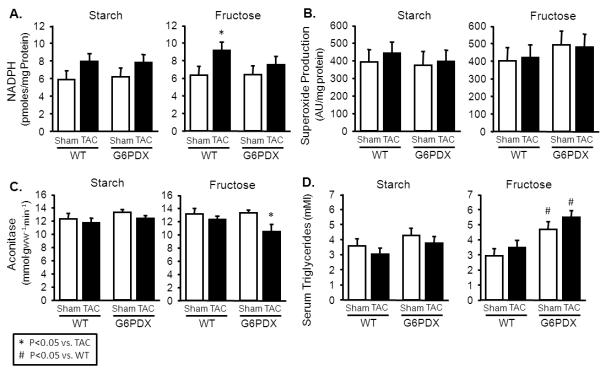
A. TAC increased LV [NADPH] after high fructose intake in WT mice, but not in G6PDX mice. B. Superoxide production was unchanged by TAC or G6PD deficiency among animals that received the high fructose diet or the high starch diet. C. Aconitase activity, an index of oxidative stress, was decreased by TAC in G6PDX mice after high fructose intake. D. G6PD deficiency increased serum triglycerides compared to WT mice with high fructose intake. Data were obtained 17 weeks post-TAC. *P <0.05 vs. TAC; #P <0.05 vs. WT; Sham n=9-16/group, TAC n=12-16/group.

References

    1. Gupte SA, Levine RJ, Gupte RS, Young ME, Lionetti V, Labinskyy V, Floyd BC, Ojaimi C, Bellomo M, Wolin MS, Recchia FA. Glucose-6-phosphate dehydrogenase-derived NADPH fuels superoxide production in the failing heart. J Mol Cell Cardiol. 2006;41:340–9. - PubMed
    1. Frederiks WM, Kummerlin IP, Bosch KS, Vreeling-Sindelarova H, Jonker A, Van Noorden CJ. NADPH production by the pentose phosphate pathway in the zona fasciculata of rat adrenal gland. J Histochem Cytochem. 2007;55:975–80. - PubMed
    1. Jain M, Brenner DA, Cui L, Lim CC, Wang B, Pimentel DR, Koh S, Sawyer DB, Leopold JA, Handy DE, Loscalzo J, Apstein CS, Liao R. Glucose-6-phosphate dehydrogenase modulates cytosolic redox status and contractile phenotype in adult cardiomyocytes. Circ Res. 2003;93:e9–16. - PubMed
    1. Jain M, Cui L, Brenner DA, Wang B, Handy DE, Leopold JA, Loscalzo J, Apstein CS, Liao R. Increased myocardial dysfunction after ischemia-reperfusion in mice lacking glucose-6-phosphate dehydrogenase. Circulation. 2004;109:898–903. - PubMed
    1. Luzzatto L, Notaro R. Malaria. Protecting against bad air. Science. 2001;293:442–3. - PubMed

Publication types

Substances