. 2012;4(1):e2012065.
doi: 10.4084/MJHID.2012.065. Epub 2012 Oct 3.

Sickle cell anaemia and malaria

Affiliations

Sickle cell anaemia and malaria

Lucio Luzzatto. Mediterr J Hematol Infect Dis. 2012.

Abstract

Sickle cell anaemia is a major chapter within haemolytic anaemias; at the same time, its epidemiology is a remarkable signature of the past and present world distribution of Plasmodium falciparum malaria. In this brief review, in keeping with the theme of this journal, we focus on the close and complex relationship betweeen this blood disease and this infectious disease. On one hand, heterozygotes for the sickle gene (AS) are relatively protected against the danger of dying of malaria, as now firmly established through a number of clinical field studies from different parts of Africa. In addition, experimental work is consistent with a plausibile mechanism: namely, that in AS heterozygotes P falciparum-infected red cells sickle preferentially and are then removed by macrophages. On the other hand, patients who are homozygous for the sickle gene and therefore suffer from sickle cell anaemia (SCA) are highly susceptible to the lethal effects of malaria. The simplest explanation of this fact is that malaria makes the anaemia of SCA more severe; in addition, in SCA there is often hyposplenism, which reduces clearance of parasites. From the point of view of public health it is important that in malaria-endemic countries patients with SCA, and particularly children, be protected from malaria by appropriate prophylaxis.


Figures
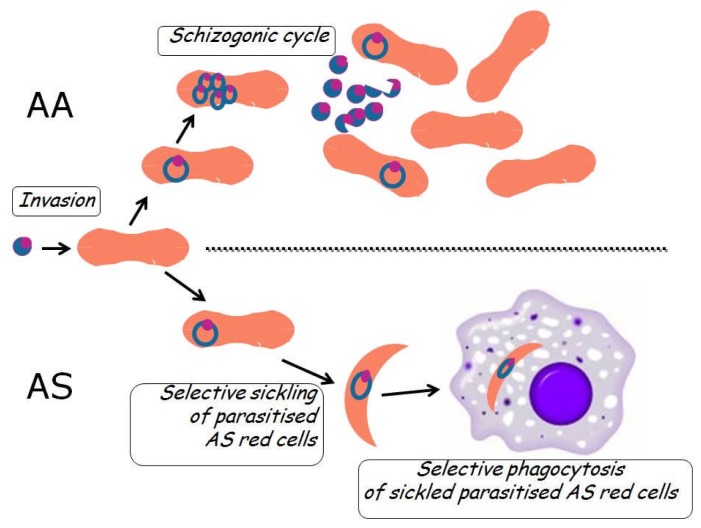
Figure 1
Figure 1
Cartoon illustration of how AS heterozygotes are relatively protected from severe P falciparum malaria. The upper part of the cartoon is a schematic diagram of what happens in red cells in a normal (Hb AA) person with malaria: after invasion of a red cell by a merozoite, this becomes a ring form, and this starts multiplying (schizogony) ; when a schizont is mature the infected red cell essentially bursts and releases new merozoites, each one of which can invade a new red cell. The lower part of the cartoon is a schematic diagram of what happens in red cells in an AS heterozygote with malaria: the red cell, which appears normal at the time of invasion, once infected undergoes sickling (probably as a result of deoxygenation and lowering pH caused by the parasite), and thus it falls easy prey to macrophages in the spleen, in other organs and even in the peripheral blood. Phagocytosis of a parasitized red cells clearly interrupts the schizogonic cycle and thus the parasitaemia can be kept under control.
Figure 2
Figure 2
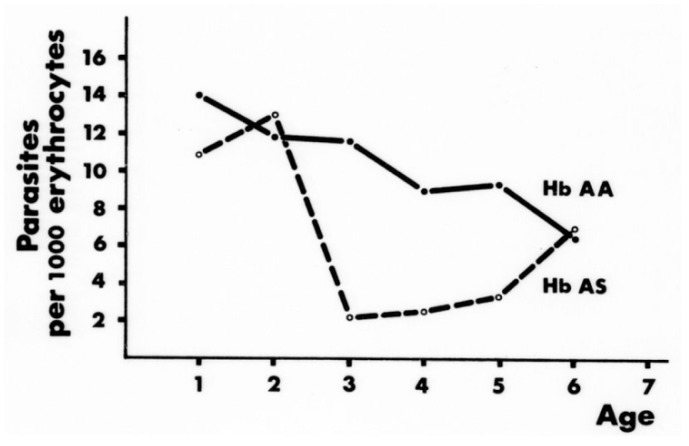
In an area of heavy malaria (Abeokuta, SW Nigeria) the P falciparum parasite density is significantly reduced in AS versus AA children, specifically between the age of 3 and 5. Protection from life-threatening levels of parasitaemia is crucially important in this age group for the survival of AS heterozygotes, because subsequently acquired immunity can protect AA subjects as well. From.

References

    1. Pauling L, Itano HA, Singer SJ, Wells IC. Sickle cell anemia, a molecular disease. Science. 1949;110:543–546. doi: 10.1126/science.110.2865.543. - DOI - PubMed
    1. Ingram VM. A specific chemical difference between the globins of normal human and sickle cell anaemia haemoglobin. Nature. 1956;178:792–794. doi: 10.1038/178792a0. - DOI - PubMed
    1. Muirhead H, Perutz MF. Structure of Haemoglobin. A Three-Dimensional Fourier Synthesis of Reduced Human Haemoglobin at 5-5 a Resolution. Nature. 1963;199:633–638. doi: 10.1038/199633a0. - DOI - PubMed
    1. Perutz MF, Lehmann H. Molecular pathology of human hemoglobin. Nature. 1968;219:902–909. doi: 10.1038/219902a0. - DOI - PubMed
    1. Wishner BC, Ward KB, Lattman EE, Love WE. Crystal structure of sickle-cel deoxyhemoglobin at 5 resolution. Journal of Molecular Biology. 1996;98:179–191. doi: 10.1016/S0022-2836(75)80108-2. - DOI - PubMed