. 2012 Nov 21:12:535.
doi: 10.1186/1471-2407-12-535.

Aberrant expression of CD133 in non-small cell lung cancer and its relationship to vasculogenic mimicry

Affiliations

Aberrant expression of CD133 in non-small cell lung cancer and its relationship to vasculogenic mimicry

Shiwu Wu et al. BMC Cancer. .

Abstract

Background: To investigate on expressions and clinical significances of CD133 protein and vasculogenic mimicry (VM) in primary non-small cell lung cancer (NSCLC).

Methods: The specimens of NSCLC from 305 Chinese patients with follow-up were analyzed for CD133 protein expression and VM by immunohistochemical and histochemical staining.

Results: In NSCLC, positive rates of 48.9% and 35.7% were obtained for CD133 and VM, respectively. The VM and expression of CD133 were significantly higher in carcinoma than in normal. There were a positive relationship between the VM and expression of CD133 and the tumor grade, lymph node metastasis and clinical stage (all P<0.05). The overall mean survival time of the patients with CD133 and VM positive expression was lower than that of patients with negative expression. Microvessel density (MVD) was positive corresponded with the grade, lymph node metastasis and clinical stage (all P<0.05). The overall mean survival time of the patients with MVD≥22's group was shorter than that of patients with MVD<22's group. Pathological-tumor-node-metastasis (pTNM) stage, positive expression of CD133 and VM, postoperative therapy and MVD were independent prognostic factors of NSCLC (P<0.05). Immunohistochemistry revealed an important intratumoral heterogeneity in all four CD133 expression profiles.

Conclusions: VM, MVD and expression of CD133 are related to differentiation, lymph node metastasis, clinical stage, and prognosis. It is suggested that CD133, VM and MVD should be considered as a potential marker for the prognosis.


Figures
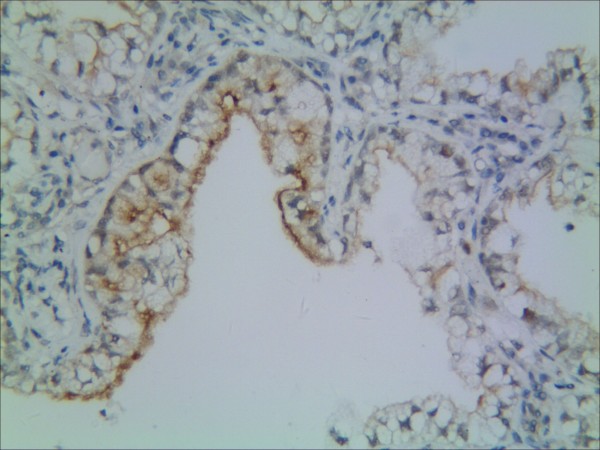
Figure 1
Figure 1
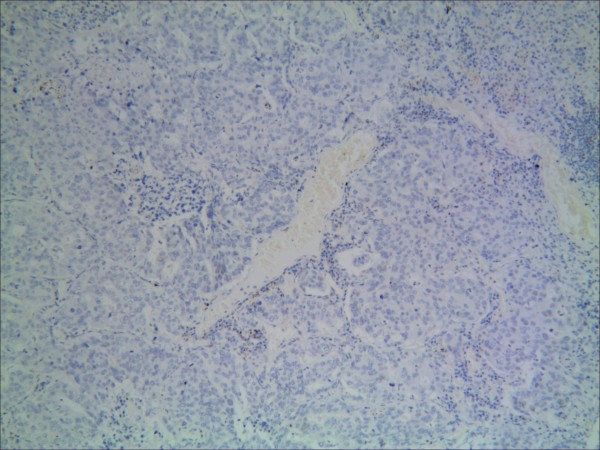
Representative results of CD133 protein in non-small cell lung cancer and control group. Control bronchiolar epithelial cells expressed CD133 in the membrane and cytoplasm.
Figure 2
Figure 2
Representative results of CD133 protein in non-small cell lung cancer and control group. NSCLC cells did not express a detectable level of CD133.
Figure 3
Figure 3
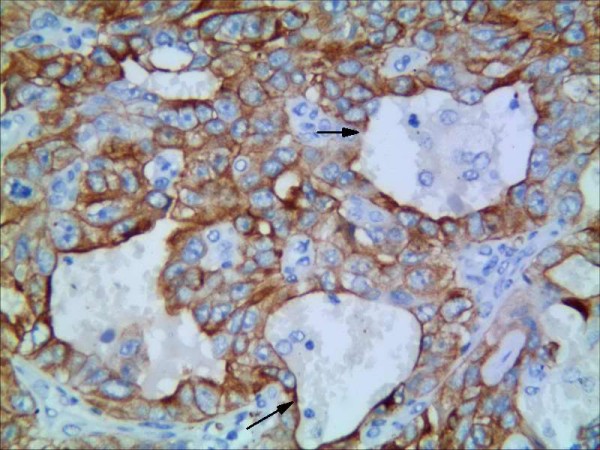
Representative results of CD133 protein in non-small cell lung cancer and control group. CD133 predominantly localized in the membrane and cytoplasm in moderately differentiated squamous cell carcinoma (grade 2) (CD133×400)(black arrow is VM).
Figure 4
Figure 4
Representative results of VM in non-small cell lung cancer and control group. No VM’s phenomenon in the control group.
Figure 5
Figure 5
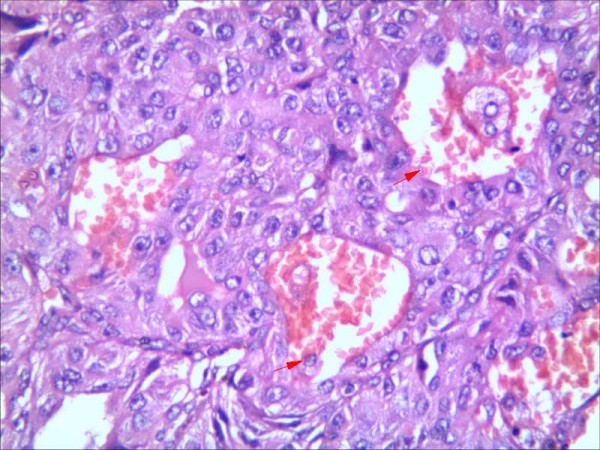
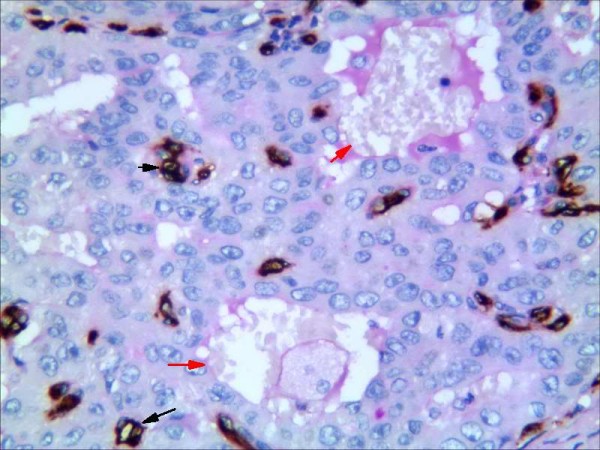
Representative results of VM in non-small cell lung cancer and control group. H&E staining in moderately differentiated squamous cell carcinoma, red arrow is VM (Figure 3, Figure 5 and Figure 6 are serial sections)(grade 2).
Figure 6
Figure 6
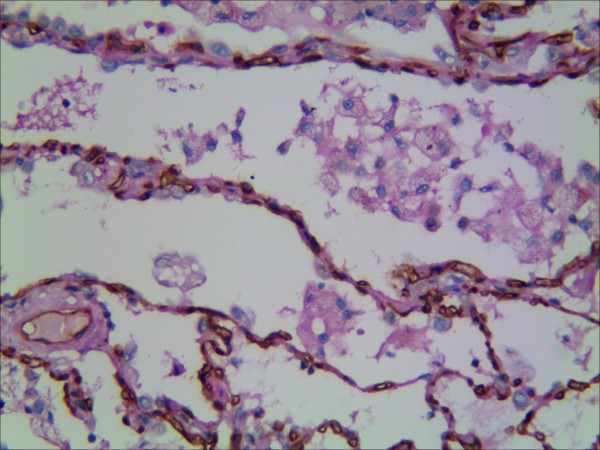
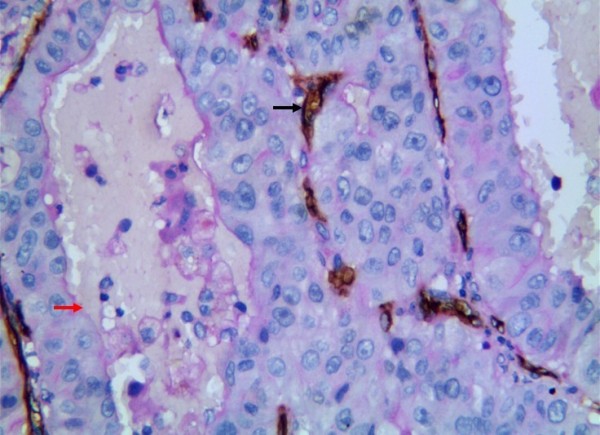
Representative results of VM in non-small cell lung cancer and control group. Endothelial cells are detected with anti-CD34 immunhistochemistry staning (dark brown) and vascular basement membrane with PAS staining (purple magenta) (red arrow: vessel stained positively with PAS but negatively with CD34; black arrow: vessel stained positively with CD34).
Figure 7
Figure 7
Representative results of VM in non-small cell lung cancer and control group. VM in moderately differentiated squamous cell carcinoma (red arrow is vessel, black arrow is VM) (grade 2) (CD34+PAS×400).
Figure 8
Figure 8
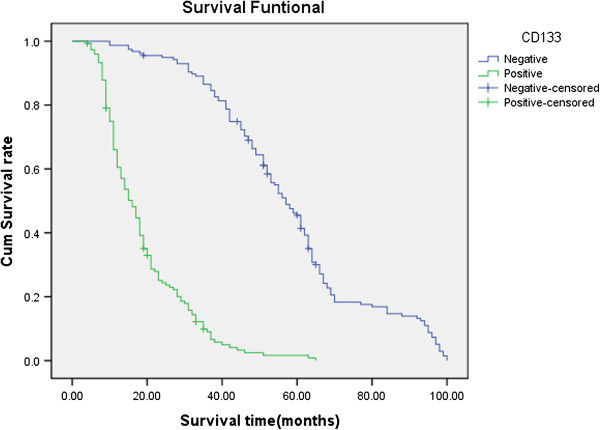
Kaplan-Meier survival analysis by CD133, VM and MVD status (A is CD133; B is VM; C is MVD). (n=305). The y-axis represents the percentage of patients; the x-axis, their survival in months. the green line represents CD133+ patients with a trend of worse survival than the blue line representing CD133- non-small cell lung cancer patients (P<0.001). Mean survival times were 19.0 months for the CD133+ group and 58.1 months for the CD133- group.
Figure 9
Figure 9
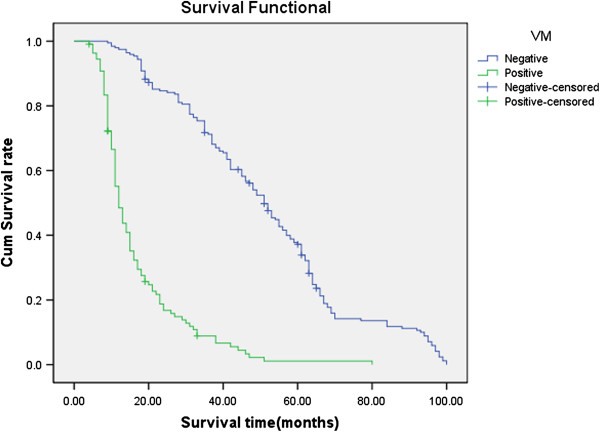
Kaplan-Meier survival analysis by CD133, VM and MVD status (A is CD133; B is VM; C is MVD). (n=305). The y-axis represents the percentage of patients; the x-axis, their survival in months. The green line represents VM positive patients with a trend of worse survival than the blue line representing VM negative NSCLC patients (P<0.001). Mean survival times were 16.9 months for the VM positive group and 51.4 months for the VM negative group.
Figure 10
Figure 10
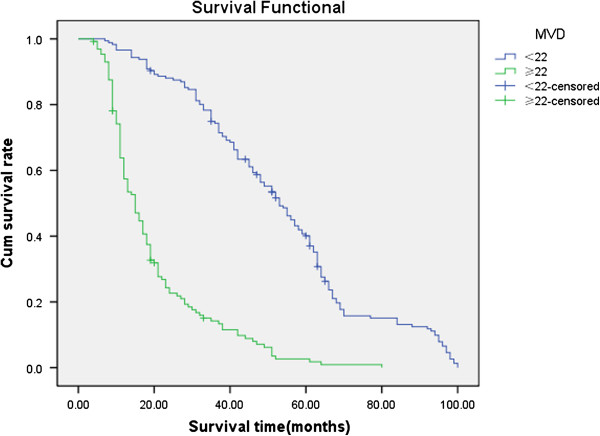
Kaplan-Meier survival analysis by CD133, VM and MVD status (A is CD133; B is VM; C is MVD). (n=305). The y-axis represents the percentage of patients; the x-axis, their survival in months. The green line represents MVD≥22 group(because the mean score of MVD is 22.0) with a trend of worse survival than the blue line representing MVD<22 group NSCLC patients (P<0.001). Mean survival times were 19.8 months for MVD≥22 group and 53.2 months for MVD<22 group.

References

    1. Jemal A, Center MM, DeSantis C, Ward EM. Global patterns of cancer incidence and mortality rates and trends. Cancer Epidemiol Biomarkers Prev. 2010;19:1893–1907. doi: 10.1158/1055-9965.EPI-10-0437. - DOI - PubMed
    1. Ramalingam SS, Owonikoko TK, Khuri FR. Lung cancer: new biological insights and recent therapeutic advances. CA Cancer J Clin. 2011;61:91–112. doi: 10.3322/caac.20102. - DOI - PubMed
    1. Reya T, Morrison SJ, Clarke MF, Weissman IL. Stem cells, cancer, and cancer stem cells. Nature. 2001;414:105–111. doi: 10.1038/35102167. - DOI - PubMed
    1. Monk M, Holding C. Human embryonic genes re-expressed in cancer cells. Oncogene. 2001;20:8085–8091. doi: 10.1038/sj.onc.1205088. - DOI - PubMed
    1. Singh SK, Hawkins C, Clarke ID, Squire JA, Bayani J, Hide T, Henkelman RM, Cusimano MD, Dirks PB. Identification of human brain tumour initiating cells. Nature. 2004;432:396–401. doi: 10.1038/nature03128. - DOI - PubMed

Publication types

MeSH terms