


Thought disorder in the meta-structure of psychopathology
- PMID: 23171498
- PMCID: PMC3767418
- DOI: 10.1017/S0033291712002292
Thought disorder in the meta-structure of psychopathology
Abstract
Background: Dimensional models of co-morbidity have the potential to improve the conceptualization of mental disorders in research and clinical work, yet little is known about how relatively uncommon disorders may fit with more common disorders. The present study estimated the meta-structure of psychopathology in the US general population focusing on the placement of five under-studied disorders sharing features of thought disorder: paranoid, schizoid, avoidant and schizotypal personality disorders, and manic episodes as well as bipolar disorder.
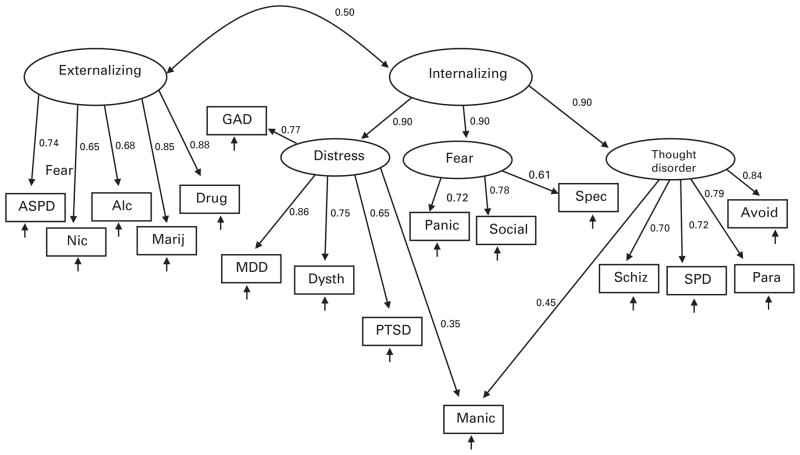
Method: Data were drawn from the National Epidemiologic Survey on Alcohol and Related Conditions, a face-to-face interview of 34 653 non-institutionalized adults in the US general population. The meta-structure of 16 DSM-IV Axis I and Axis II psychiatric disorders, as assessed by the Alcohol Use Disorder and Associated Disabilities Interview Schedule DSM-IV version (AUDADIS-IV), was examined using exploratory and confirmatory factor analysis.
Results: We document an empirically derived thought disorder factor that is a subdomain of the internalizing dimension, characterized by schizoid, paranoid, schizotypal and avoidant personality disorders as well as manic episodes. Manic episodes exhibit notable associations with both the distress subdomain of the internalizing dimension as well as the thought disorder subdomain. The structure was replicated for bipolar disorder (I or II) in place of manic episodes.
Conclusions: As our understanding of psychopathological meta-structure expands, incorporation of disorders characterized by detachment and psychoticism grows increasingly important. Disorders characterized by detachment and psychoticism may be well conceptualized, organized and measured as a subdimension of the internalizing spectrum of disorders. Manic episodes and bipolar disorder exhibit substantial co-morbidity across both distress and thought disorder domains of the internalizing dimension. Clinically, these results underscore the potential utility of conceptualizing patient treatment needs using an approach targeting psychopathological systems underlying meta-structural classification rubrics.
Conflict of interest statement
None.
Figures
References
-
- Barlow D, Farchione T, Fairholme C, Ellard K, Boisseau C, Allen L, Ehrenreich-May J. Unified Protcol for Transdiagnostic Treatment of Emotional Disorders: Therapist Guide. Oxford University Press; New York: 2011.
-
- Batel P. Addiction and schizophrenia. European Psychiatry. 2000;15:115–122. - PubMed
-
- Carpenter WT, Bustillo JR, Thaker GK, van Os J, Krueger RF, Green MJ. The psychoses: cluster 3 of the proposed meta-structure for DSM-V and ICD-11. Psychological Medicine. 2009;39:2025–2042. - PubMed
-
- Cox BJ, Clara IP, Enns MW. Posttraumatic stress disorder and the structure of common mental disorders. Depression and Anxiety. 2002;15:168–171. - PubMed
Publication types
MeSH terms
Grants and funding
LinkOut - more resources
Full Text Sources
Medical
Research Materials
