


Urinary follicle-stimulating hormone as a measure of natural fertility in a community cohort
- PMID: 23171685
- PMCID: PMC3635071
- DOI: 10.1177/1933719112459226
Urinary follicle-stimulating hormone as a measure of natural fertility in a community cohort
Abstract
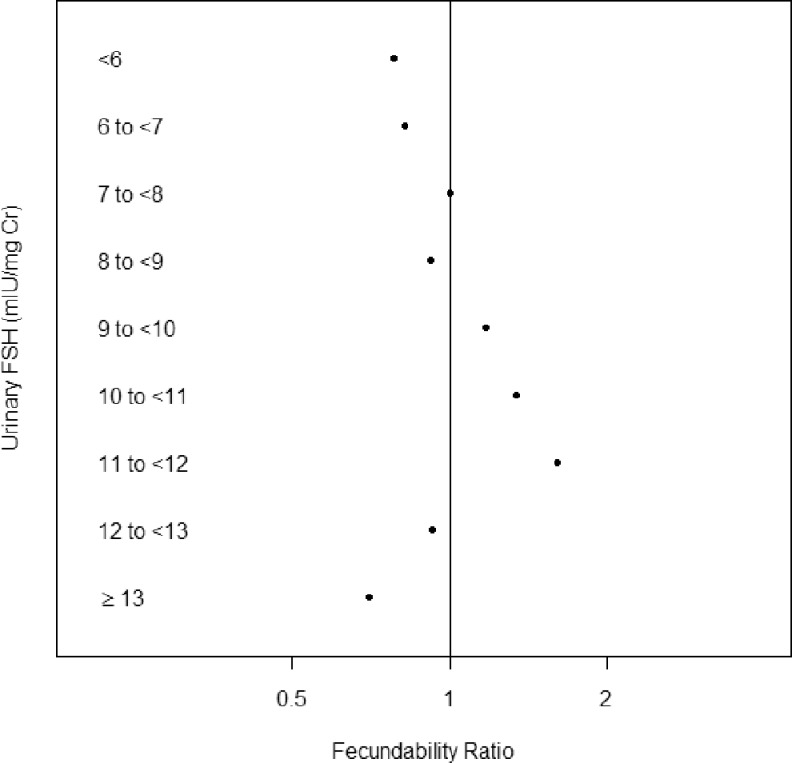
High serum follicle-stimulating hormone (FSH) levels have been associated with diminished ovarian reserve; however, the association between high urinary FSH and reduced natural fertility has yet to be established. We sought to characterize the relationship between a single or multiple measurements of early follicular phase urinary FSH and fertility. Women (n = 209), 30 to 44 years old with no history of infertility, who had been trying to conceive for less than 3 months, provided early follicular phase urine. Participants subsequently kept a diary to record bleeding and intercourse and conducted standardized pregnancy testing for up to 6 months. A subset of women (N = 95) collected urine on cycle day 3 for up to 6 cycles. Urine was analyzed for FSH and creatinine (cr) corrected. Proportional hazard models were used to calculate fecundability ratios (FRs). Urinary FSH levels across cycles from the same woman were highly correlated (adjusted intraclass correlation = .77); within-woman variance was 3-fold lower than variance among women. Women with an initial urinary FSH level <7 mIU/mg cr exhibited a nonsignificant reduction in the probability of pregnancy (adjusted FR 0.71, 95% confidence interval [CI]: 0.45-1.13), as did women with elevated urinary FSH (≥12 mIU/mg cr; adjusted FR 0.78, 95% CI: 0.46-1.32). Using the most recent or maximum urinary FSH value did not strengthen the association. In the general population, urinary FSH levels appear to be nonlinearly associated with fertility; however, broad CIs indicate a lack of statistical significance. Repetitive testing appears to be of little benefit.
Conflict of interest statement
Figures
References
-
- Abma JC, Chandra A, Mosher WD, Peterson LS, Piccinino LJ. Fertility, family planning, and women’s health: new data from the 1995 National Survey of Family Growth. Vital Health Stat 23 1997;(19):1–114. - PubMed
-
- Hansen KR, Thyer AC, Sluss PM, Bremner WJ, Soules MR, Klein NA. Reproductive ageing and ovarian function: is the early follicular phase FSH rise necessary to maintain adequate secretory function in older ovulatory women? Hum Reprod. 2005;20(1):89–95. - PubMed
-
- Gougeon A, Chainy GB. Morphometric studies of small follicles in ovaries of women at different ages. J Reprod Fertil. 1987;81(2):433–442. - PubMed
-
- Faddy MJ, Gosden RG, Gougeon A, Richardson SJ, Nelson JF. Accelerated disappearance of ovarian follicles in mid-life: implications for forecasting menopause. Hum Reprod. 1992;7(10):1342–1346. - PubMed
-
- Henderson SA, Edwards RG. Chiasma frequency and maternal age in mammals. Nature. 1968;218(5136):22–28. - PubMed
Publication types
MeSH terms
Substances
Grants and funding
LinkOut - more resources
Full Text Sources
Medical
