


Mast cell inhibition attenuates myocardial damage, adverse remodeling, and dysfunction during fulminant myocarditis in the rat
- PMID: 23172937
- PMCID: PMC3968541
- DOI: 10.1177/1074248412458975
Mast cell inhibition attenuates myocardial damage, adverse remodeling, and dysfunction during fulminant myocarditis in the rat
Abstract
Background: Myocarditis is a life-threatening heart disease characterized by myocardial inflammation, necrosis, and chronic fibrosis. While mast cell inhibition has been suggested to prevent fibrosis in rat myocarditis, little is known about its effectiveness in attenuating cardiac remodeling and dysfunction in myocarditis. Thus, we sought to test the hypothesis that mast cell inhibition will attenuate the inflammatory reaction and associated left ventricular (LV) remodeling and dysfunction after fulminant autoimmune myocarditis. Methods and
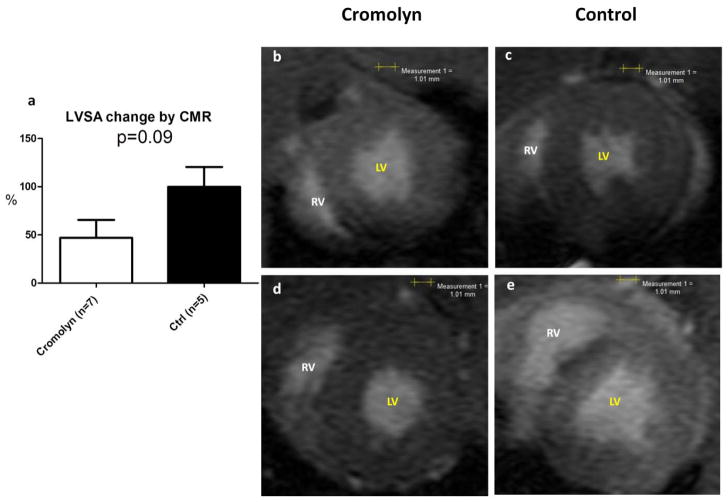
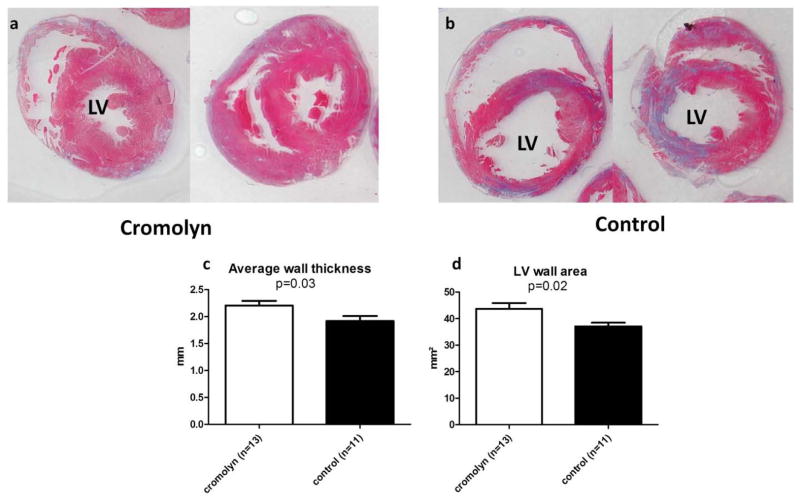
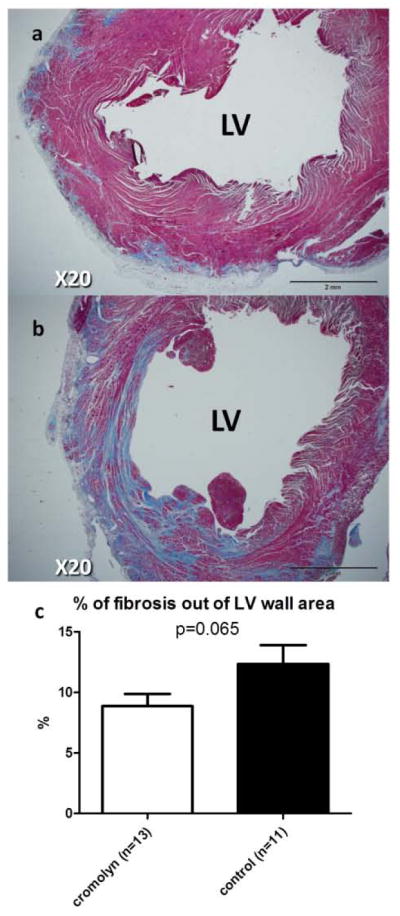
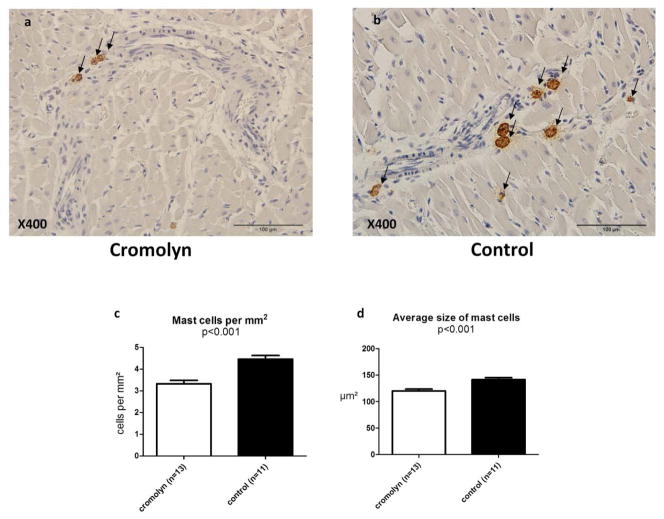
Results: To induce experimental autoimmune myocarditis, we immunized 30 rats with porcine cardiac myosin (PCM) twice at a 7-day interval. On day 8 animals were randomized into treatment with either an intraperitoneal (IP) injection of 25mg/kg of cromolyn sodium (n = 13) or an equivalent volume (∼0.5 mL IP) of normal saline (n = 11). All animals were scanned by serial echocardiography studies before treatment (baseline echocardiogram) and after 20 days of cromolyn sodium (28 days after immunization). Furthermore, serial cardiac magnetic resonance was performed in a subgroup of 12 animals. After 20 days of treatment (28 days from first immunization), hearts were harvested for histopathological analysis. By echocardiography, cromolyn sodium prevented LV dilatation and attenuated LV dysfunction, compared with controls. Postmortem analysis of hearts showed that cromolyn sodium reduced myocardial fibrosis, as well as the number and size of cardiac mast cells in the inflamed myocardium, compared with controls.
Conclusions: Our study suggests that mast cell inhibition with cromolyn sodium attenuates adverse LV remodeling and dysfunction in myocarditis. This mechanism-based therapy is clinically relevant and could improve the outcome of patients at risk for inflammatory cardiomyopathy and heart failure.
Conflict of interest statement
Yair Mina - None
Shunit Rinkevich-Shop – None
Eli Konen - None
Orly Goitein – None
Tammar Kushnir – None
Frederick H. Epstein – None
Micha S. Feinberg – None
Jonathan Leor- None
Natalie Landa-Rouben - None
The authors declare no potential conflicts of interest with respect to the research, authorship, and/or publication of this article.
Figures
References
-
- Maron BJ, Doerer JJ, Haas TS, Tierney DM, Mueller FO. Sudden deaths in young competitive athletes: analysis of 1866 deaths in the United States, 1980–2006. Circulation. 2009;119(8):1085–1092. - PubMed
-
- Grun S, Schumm J, Greulich S, et al. Long-Term Follow-Up of Biopsy-Proven Viral Myocarditis: Predictors of Mortality and Incomplete Recovery. J Am Coll Cardiol. 2012 - PubMed
-
- Kawai C. From myocarditis to cardiomyopathy: mechanisms of inflammation and cell death: learning from the past for the future. Circulation. 19.1091–1100(8):99. - PubMed
-
- Caforio AL, Mahon NJ, Tona F, McKenna WJ. Circulating cardiac autoantibodies in dilated cardiomyopathy and myocarditis: pathogenetic and clinical significance. Eur J Heart Fail. 2002;4(4):411–417. - PubMed
Publication types
MeSH terms
Substances
Grants and funding
LinkOut - more resources
Full Text Sources
Other Literature Sources
