


Changing physical activity behavior in type 2 diabetes: a systematic review and meta-analysis of behavioral interventions
- PMID: 23173137
- PMCID: PMC3507564
- DOI: 10.2337/dc11-2452
Changing physical activity behavior in type 2 diabetes: a systematic review and meta-analysis of behavioral interventions
Abstract
Objective: Behavioral interventions targeting "free-living" physical activity (PA) and exercise that produce long-term glycemic control in adults with type 2 diabetes are warranted. However, little is known about how clinical teams should support adults with type 2 diabetes to achieve and sustain a physically active lifestyle.
Research design and methods: We conducted a systematic review of randomized controlled trials (RCTs) (published up to January 2012) to establish the effect of behavioral interventions (compared with usual care) on free-living PA/exercise, HbA(1c), and BMI in adults with type 2 diabetes. Study characteristics, methodological quality, practical strategies for increasing PA/exercise (taxonomy of behavior change techniques), and treatment fidelity strategies were captured using a data extraction form.
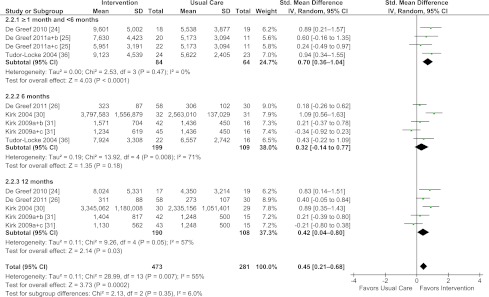
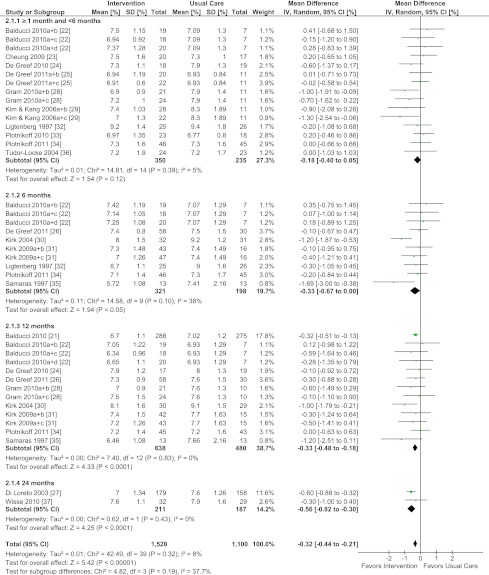
Results: Seventeen RCTs fulfilled the review criteria. Behavioural interventions showed statistically significant increases in objective (standardized mean difference [SMD] 0.45, 95% CI 0.21-0.68) and self-reported PA/exercise (SMD 0.79, 95% CI 0.59-0.98) including clinically significant improvements in HbA(1c) (weighted mean difference [WMD] -0.32%, 95% CI -0.44% to -0.21%) and BMI (WMD -1.05 kg/m(2), 95% CI -1.31 to -0.80). Few studies provided details of treatment fidelity strategies to monitor/improve provider training. Intervention features (e.g., specific behavior change techniques, interventions underpinned by behavior change theories/models, and use of ≥10 behaviour change techniques) moderated effectiveness of behavioral interventions.
Conclusions: Behavioral interventions increased free-living PA/exercise and produced clinically significant improvements in long-term glucose control. Future studies should consider use of theory and multiple behavior change techniques associated with clinically significant improvements in HbA(1c), including structured training for care providers on the delivery of behavioural interventions.
Figures
Comment in
-
Behavioural interventions targeting physical activity to increase activity and improve glucose control in adults with type 2 diabetes.Evid Based Med. 2013 Dec;18(6):213-4. doi: 10.1136/eb-2013-101224. Epub 2013 Feb 16. Evid Based Med. 2013. PMID: 23416415 No abstract available.
References
-
- Wild S, Roglic G, Green A, Sicree R, King H. Global prevalence of diabetes: estimates for the year 2000 and projections for 2030. Diabetes Care 2004;27:1047–1053 - PubMed
-
- Lazar MA. How obesity causes diabetes: not a tall tale. Science 2005;307:373–375 - PubMed
-
- Hill JO, Wyatt HR, Reed GW, Peters JC. Obesity and the environment: where do we go from here? Science 2003;299:853–855 - PubMed
-
- Taylor R. Pathogenesis of type 2 diabetes: tracing the reverse route from cure to cause. Diabetologia 2008;51:1781–1789 - PubMed
-
- Morrato EH, Hill JO, Wyatt HR, Ghushchyan V, Sullivan PW. Physical activity in U.S. adults with diabetes and at risk for developing diabetes, 2003. Diabetes Care 2007;30:203–209 - PubMed
