


Associations between vaginal bacteria and levels of vaginal defensins in pregnant women
- PMID: 23174285
- PMCID: PMC3623553
- DOI: 10.1016/j.ajog.2012.11.019
Associations between vaginal bacteria and levels of vaginal defensins in pregnant women
Abstract
Objective: We evaluated vaginal defensin concentrations and levels of bacterial vaginosis-associated bacterial species in pregnant women.
Study design: Self-collected vaginal swabs from 2 visits during pregnancy were tested with quantitative polymerase chain reaction for 9 bacterial species. Beta defensins 2-3 and alpha defensins 1-3 were measured by enzyme-linked immunosorbent assay.
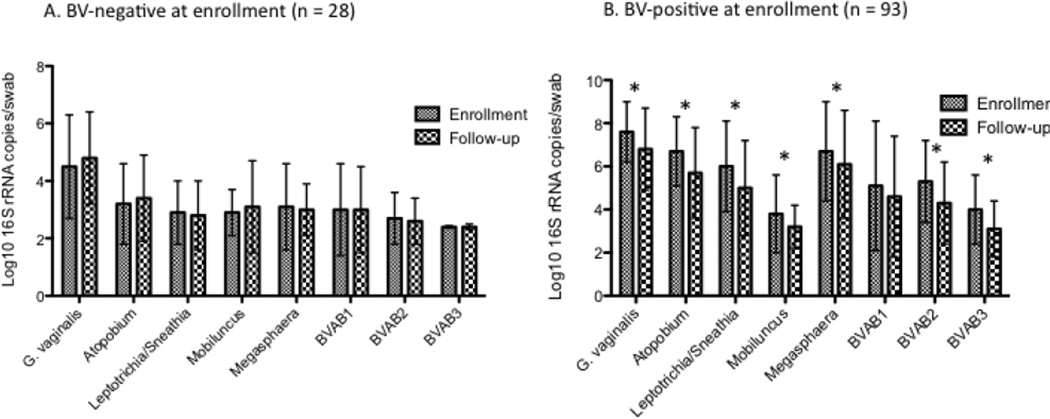
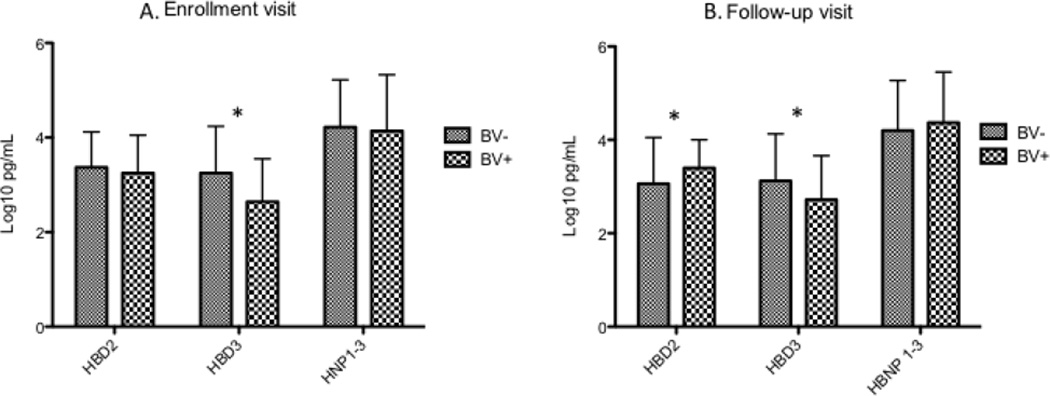
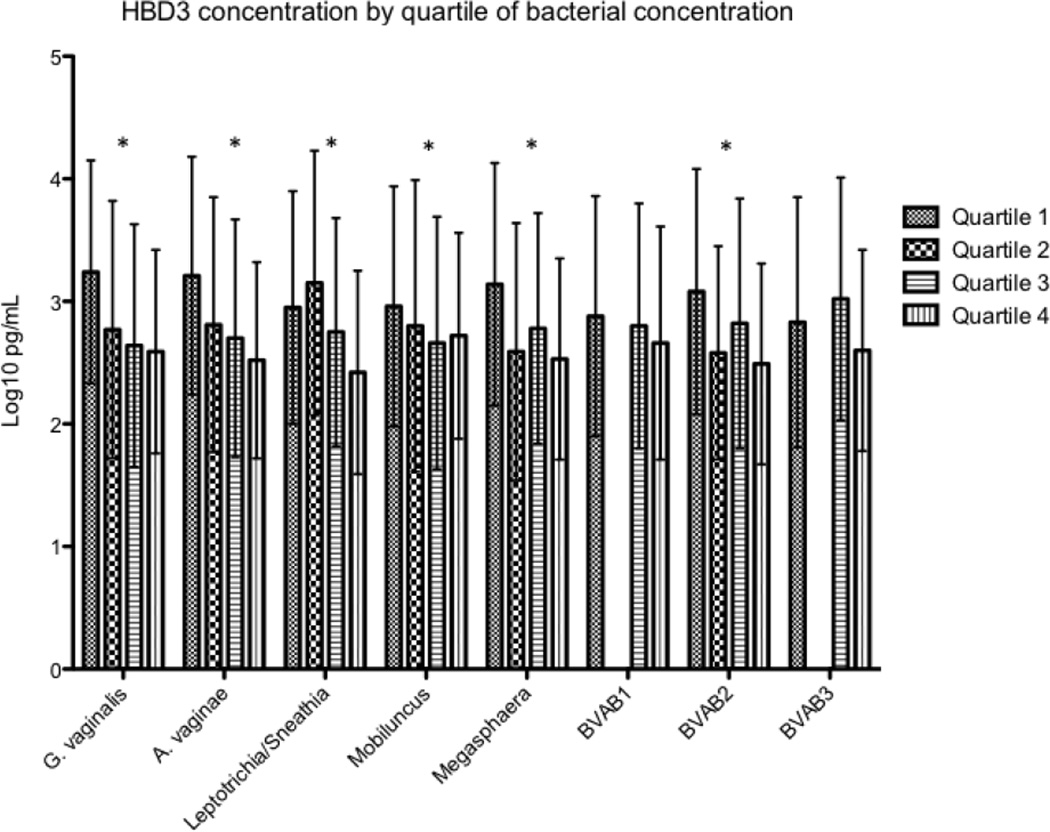
Results: Our 126 participants were primarily African American (60%), had a mean gestational age at enrollment of 10 ± 3 weeks and at follow-up visit of 25 ± 6 weeks. At enrollment, the prevalence of bacterial vaginosis was 74% (94/126 women), which decreased to 60% (75/126 specimens) at follow-up visit. At enrollment, beta defensin 3 concentrations were significantly lower in women with bacterial vaginosis (2.64 ± 0.91 vs 3.25 ± 0.99 log(10) pg/mL; P = .003). Higher concentrations of Atopobium vaginae, bacterial vaginosis-associated bacteria1 and 2 were associated with significantly lower concentrations of beta defensin 3 (P < .01).
Conclusion: Bacterial vaginosis was associated with lower vaginal concentrations of beta defensin 3, but not beta defensin 2 or alpha defensins 1-3, in pregnant women.
Copyright © 2013 Mosby, Inc. All rights reserved.
Conflict of interest statement
Disclosure: None of the authors report any conflict of interest.
Figures
References
-
- Hillier SL, Nugent RP, Eschenbach DA, Krohn MA, Gibbs RS, Martin DH, et al. Association between bacterial vaginosis and preterm delivery of a low-birth-weight infant. The Vaginal Infections and Prematurity Study Group. New Eng J Med. 1995 Dec 28;333(26):1737–1742. - PubMed
-
- Donders GG, Van Calsteren K, Bellen G, Reybrouck R, Van den Bosch T, Riphagen I, et al. Predictive value for preterm birth of abnormal vaginal flora, bacterial vaginosis and aerobic vaginitis during the first trimester of pregnancy. BJOG. 2009 Sep;116(10):1315–1324. - PubMed
-
- Fredricks DN, Fiedler TL, Marrazzo JM. Molecular identification of bacteria associated with bacterial vaginosis. New Eng J Med. 2005 Nov 3;353(18):1899–1911. - PubMed
Publication types
MeSH terms
Substances
Grants and funding
LinkOut - more resources
Full Text Sources
Other Literature Sources
Medical
