


Dosimetric comparison of intensity modulated radiotherapy and three-dimensional conformal radiotherapy in patients with gynecologic malignancies: a systematic review and meta-analysis
- PMID: 23176540
- PMCID: PMC3539899
- DOI: 10.1186/1748-717X-7-197
Dosimetric comparison of intensity modulated radiotherapy and three-dimensional conformal radiotherapy in patients with gynecologic malignancies: a systematic review and meta-analysis
Abstract
Background: To quantitatively evaluate the safety and related-toxicities of intensity modulated radiotherapy (IMRT) dose-volume histograms (DVHs), as compared to the conventional three-dimensional conformal radiotherapy (3D-CRT), in gynecologic malignancy patients by systematic review of the related publications and meta-analysis.
Methods: Relevant articles were retrieved from the PubMed, Embase, and Cochrane Library databases up to August 2011. Two independent reviewers assessed the included studies and extracted data. Pooled average percent irradiated volumes of adjacent non-cancerous tissues were calculated and compared between IMRT and 3D-CRT for a range of common radiation doses (5-45 Gy).
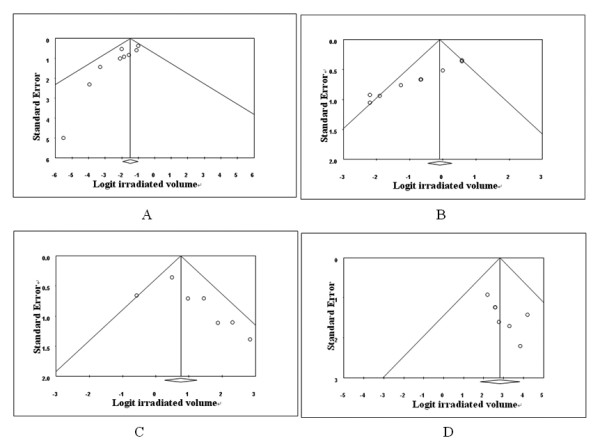
Results: In total, 13 articles comprised of 222 IMRT-treated and 233 3D-CRT-treated patients were included. For rectum receiving doses ≥30 Gy, the IMRT pooled average irradiated volumes were less than those from 3D-CRT by 26.40% (30 Gy, p = 0.004), 27.00% (35 Gy, p = 0.040), 37.30% (40 Gy, p = 0.006), and 39.50% (45 Gy, p = 0.002). Reduction in irradiated small bowel was also observed for IMRT-delivered 40 Gy and 45 Gy (by 17.80% (p = 0.043) and 17.30% (p = 0.012), respectively), as compared with 3D-CRT. However, there were no significant differences in the IMRT and 3D-CRT pooled average percent volumes of irradiated small bowel or rectum from lower doses, or in the bladder or bone marrow from any of the doses. IMRT-treated patients did not experience more severe acute or chronic toxicities than 3D-CRT-treated patients.
Conclusions: IMRT-delivered high radiation dose produced significantly less average percent volumes of irradiated rectum and small bowel than 3D-CRT, but did not differentially affect the average percent volumes in the bladder and bone marrow.
Figures

References
-
- Creutzberg CL, van Putten WL, Koper PC, Lybeert ML, Jobsen JJ, Warlam-Rodenhuis CC, De Winter KA, Lutgens LC, van den Bergh AC, van de Steen-Banasik E, Beerman H, van Lent M. Surgery and postoperative radiotherapy versus surgery alone for patients with stage-1 endometrial carcinoma: multicentre randomised trial. PORTEC Study Group. Post Operative Radiation Therapy in Endometrial Carcinoma. Lancet. 2000;355:1404–1411. doi: 10.1016/S0140-6736(00)02139-5. - DOI - PubMed
-
- Papp Z, Csapo Z, Mayer A, Hupuczi P. [Wertheim-operation: 5-year survival of 501 consecutive patients with cervical cancer] Orv Hetil. 2006;147:537–545. - PubMed
-
- Vargas C, Martinez A, Kestin LL, Yan D, Grills I, Brabbins DS, Lockman DM, Liang J, Gustafson GS, Chen PY, Vicini FA, Wong JW. Dose-volume analysis of predictors for chronic rectal toxicity after treatment of prostate cancer with adaptive image-guided radiotherapy. Int J Radiat Oncol Biol Phys. 2005;62:1297–1308. doi: 10.1016/j.ijrobp.2004.12.052. - DOI - PubMed
Publication types
MeSH terms
LinkOut - more resources
Full Text Sources
Medical
Research Materials
