


Inflammatory markers in blood and exhaled air after short-term exposure to cooking fumes
- PMID: 23179989
- PMCID: PMC3567812
- DOI: 10.1093/annhyg/mes069
Inflammatory markers in blood and exhaled air after short-term exposure to cooking fumes
Abstract
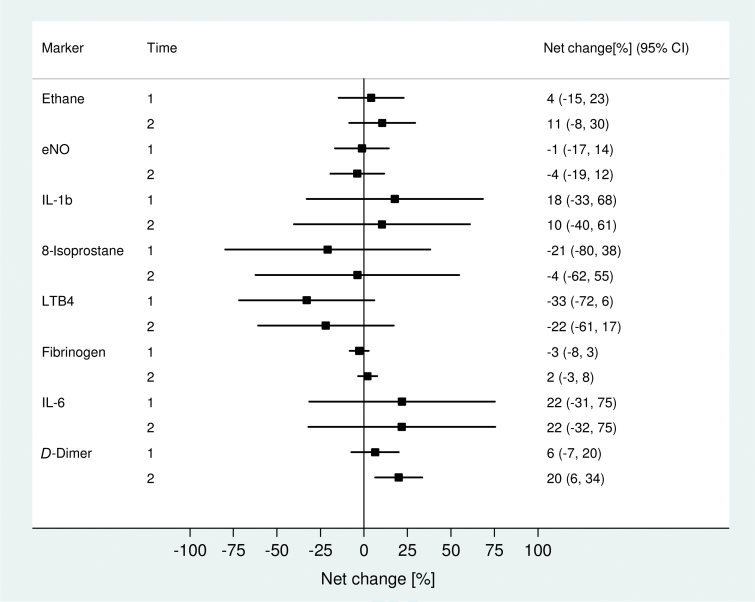
Objectives: Cooking fumes contain aldehydes, alkanoic acids, polycyclic aromatic hydrocarbons, and heterocyclic compounds. The inhalation of cooking fumes entails a risk of deleterious health effects. The aim of this study was to see if the inhalation of cooking fumes alters the expression of inflammatory reactions in the bronchial mucosa and its subsequent systemic inflammatory response in blood biomarkers.
Methods: Twenty-four healthy volunteers stayed in a model kitchen on two different occasions for 2 or 4 h. On the first occasion, there was only exposure to normal air, and on the second, there was exposure to controlled levels of cooking fumes. On each occasion, samples of blood, exhaled air, and exhaled breath condensate (EBC) were taken three times in 24 h and inflammatory markers were measured from all samples.
Results: There was an increase in the concentration of the d-dimer in blood from 0.27 to 0.28 mg ml(-1) on the morning after exposure to cooking fumes compared with the levels the morning before (P-value = 0.004). There was also a trend of an increase in interleukin (IL)-6 in blood, ethane in exhaled air, and IL-1β in EBC after exposure to cooking fumes. In a sub-analysis of 12 subjects, there was also an increase in the levels of ethane--from 2.83 parts per billion (ppb) on the morning before exposure to cooking fumes to 3.53 ppb on the morning after exposure (P = 0.013)--and IL-1β--from 1.04 on the morning before exposure to cooking fumes to 1.39 pg ml(-1) immediately after (P = 0.024).
Conclusion: In our experimental setting, we were able to unveil only small changes in the levels of inflammatory markers in exhaled air and in blood after short-term exposure to moderate concentrations of cooking fumes.
Figures
References
-
- Afshari A, Matson U, Ekberg LE. (2005). Characterization of indoor sources of fine and ultrafine particles: a study conducted in a full-scale chamber. Indoor Air; 15: 141–50 - PubMed
-
- Aliberti G, Pulignano I, Schiappoli A, et al. (2005). Fibrinogen metabolism in the lungs. Metab Clin Exp; 54: 271–4 - PubMed
-
- American Thoracic Society/European Respiratory Society (2005). ATS/ERS recommendations for standardized procedures for the online and offline measurement of exhaled lower respiratory nitric oxide and nasal nitric oxide, 2005. . Am J Respir Crit Care Med; 171:: 912–30 - PubMed
-
- Barregard L, Sällsten G, Andersson L, et al. (2008). Experimental exposure to wood smoke: effects on airway inflammation and oxidative stress. Occup Environ Med; 65: 319–24 - PubMed
Publication types
MeSH terms
Substances
LinkOut - more resources
Full Text Sources
Medical
Molecular Biology Databases
