. 2013 Mar;229(4):535-45.
doi: 10.1002/path.4145.

High-throughput RNA sequencing of a formalin-fixed, paraffin-embedded autopsy lung tissue sample from the 1918 influenza pandemic

Affiliations

High-throughput RNA sequencing of a formalin-fixed, paraffin-embedded autopsy lung tissue sample from the 1918 influenza pandemic

Yong-Li Xiao et al. J Pathol. 2013 Mar.

Abstract

Most biopsy and autopsy tissues are formalin-fixed and paraffin-embedded (FFPE), but this process leads to RNA degradation that limits gene expression analysis. The RNA genome of the 1918 pandemic influenza virus was previously determined in a 9-year effort by overlapping RT-PCR from post-mortem samples. Here, the full genome of the 1918 virus at 3000× coverage was determined in one high-throughput sequencing run of a library derived from total RNA of a 1918 FFPE sample after duplex-specific nuclease treatments. Bacterial sequences associated with secondary bacterial pneumonias were also detected. Host transcripts were well represented in the library. Compared to a 2009 pandemic influenza virus FFPE post-mortem library, the 1918 sample showed significant enrichment for host defence and cell death response genes, concordant with prior animal studies. This methodological approach should assist in the analysis of FFPE tissue samples isolated over the past century from a variety of diseases.


Conflict of interest statement

No conflicts of interest were declared.

Figures
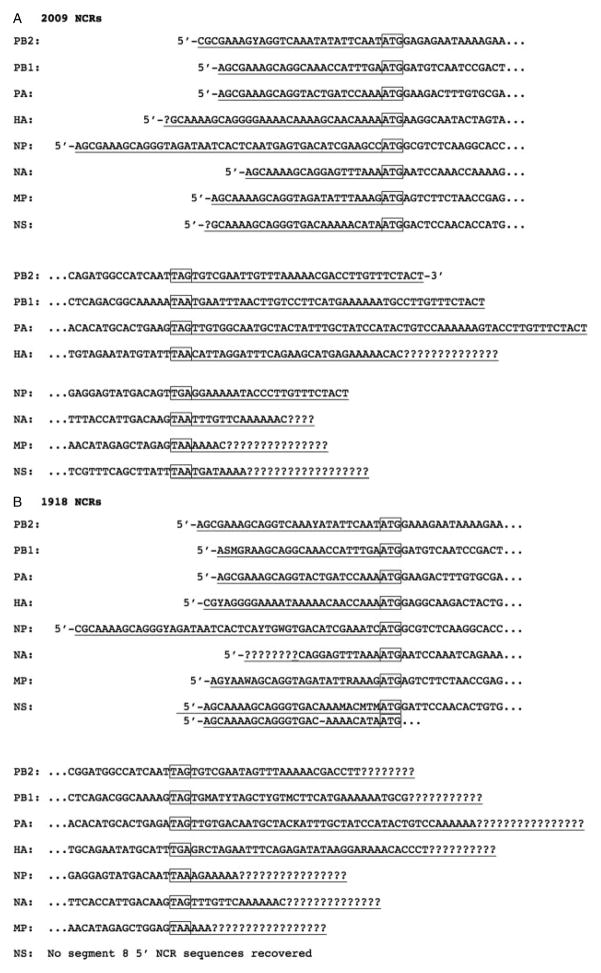
Figure 1
Figure 1
Influenza viral genome segment terminal non-coding regions (NCR) identified in the libraries. (A) NCR sequences from the 2009 influenza pandemic sample. (B) NCR sequences from the 1918 influenza pandemic autopsy sample. Sequences are presented in sense (mRNA) orientation. Start and stop codons are boxed. NCR sequences are underlined and ‘?’ represents undetermined NCR sequences. Variant sequences are identified by their degenerate nucleotide codes: MA/C; R =A/G; W =A/T; S =C/G; Y =C/T; and K =G/T.
Figure 2
Figure 2
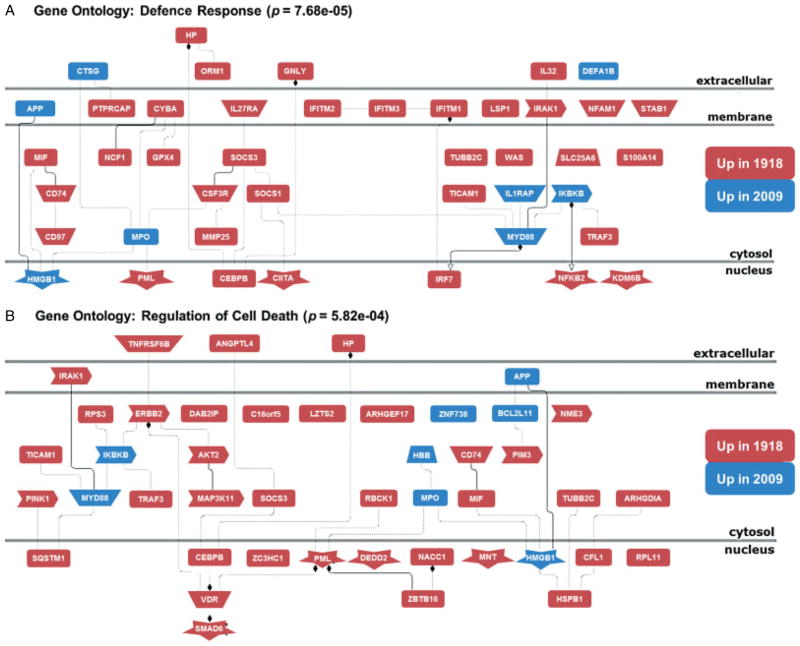
Host response in the 1918 autopsy sample is associated with increased defence and cell death responses. Network diagrams are shown that were derived from functional Gene Ontology analysis of genes with statistically significant differential expression patterns in the 1918 and 2009 samples as identified using Cufflink. Functional analysis was performed using the Genomatix Genome Analyzer (as described in the Supplementary materials and methods). Genes shown in red indicate transcripts with more than four-fold increased relative expression in the 1918 autopsy sample, and genes shown in blue indicate transcripts with more than four-fold increased relative expression in the 2009 autopsy sample.
Figure 3
Figure 3
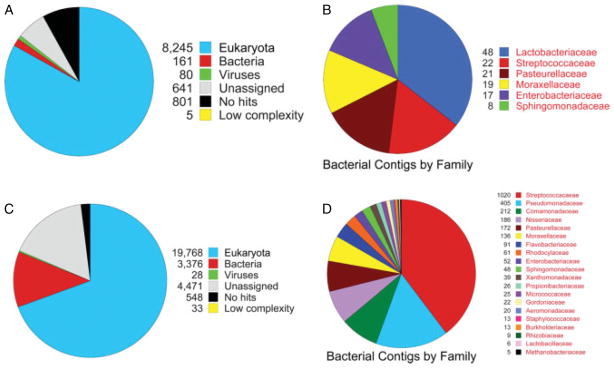
Taxonomic analysis of the 2009 and 1918 influenza pandemic samples. (A) From the 2009 influenza pandemic sample, a pie chart was generated by MEGAN based on blastn output of the NCBI nt database from contigs of at least 76 bp. (B) From the 2009 influenza pandemic sample, a pie chart was generated by MEGAN based on blastn output of the NCBI bacterial genome database from contigs of at least 76 bp. (C) From the 1918 influenza pandemic sample, a pie chart was generated by MEGAN based on blastn output of the NCBI nt database from contigs of at least 48 bp. (D) From the 1918 influenza pandemic sample, a pie chart was generated by MEGAN based on blastn output of the NCBI bacterial genome database from contigs of at least 48 bp.

References

    1. Taubenberger JK, Morens DM. Pandemic influenza – including a risk assessment of H5N1. Rev Sci Tech. 2009;28:187–202. - PMC - PubMed
    1. Morens DM, Taubenberger JK. Pandemic influenza: certain uncertainties. Rev Med Virol. 2011;21:262–284. - PMC - PubMed
    1. Johnson NP, Mueller J. Updating the accounts: global mortality of the 1918–1920 “Spanish” influenza pandemic. Bull Hist Med. 2002;76:105–115. - PubMed
    1. Fraser C, Donnelly CA, Cauchemez S, et al. Pandemic potential of a strain of influenza A (H1N1): early findings. Science. 2009;324:1557–1561. - PMC - PubMed
    1. Garten RJ, Davis CT, Russell CA, et al. Antigenic and genetic characteristics of swine-origin 2009 A(H1N1) influenza viruses circulating in humans. Science. 2009;325:197–201. - PMC - PubMed

Publication types

MeSH terms