


Economic analysis of Heart and Stroke Foundation of Ontario's Hypertension Management Initiative
- PMID: 23180969
- PMCID: PMC3501398
- DOI: 10.2147/CEOR.S33390
Economic analysis of Heart and Stroke Foundation of Ontario's Hypertension Management Initiative
Abstract
Objectives: Hypertension is suboptimally treated in primary care settings. We evaluated the cost-effectiveness of the Heart and Stroke Foundation of Ontario's Hypertension Management Initiative (HMI), an interdisciplinary, evidence-informed chronic disease management model for primary care that focuses on improving blood pressure management and control by primary care providers and patients according to clinical best practice guidelines.
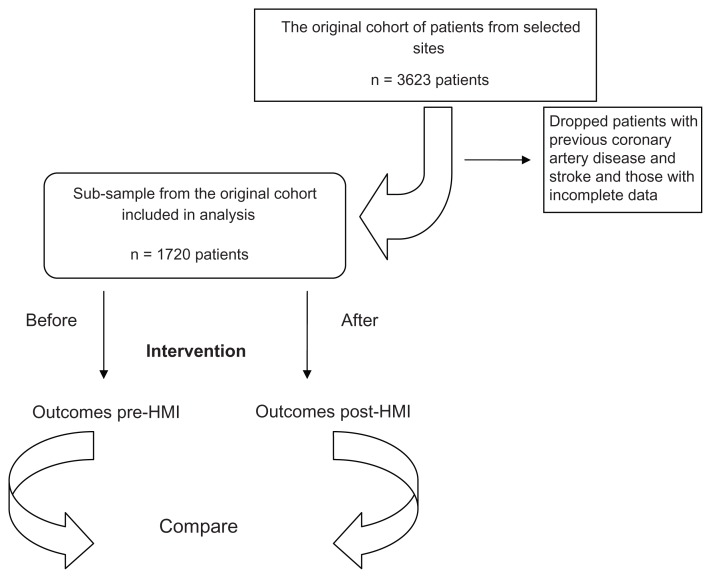
Methods: The perspective of our analysis was that of the Ontario Ministry of Health and Long-Term Care with a lifetime horizon and 5% annual discount rate. Using data from a prospective cohort study from the HMI, we created two matched groups: pre-HMI (standard care), and post-HMI (n = 1720). For each patient, we estimated the 10-year risk of cardiovascular disease (CVD) using the Framingham risk equation and life expectancy from life tables. Long-term health care costs incurred with physician visits, acute and chronic care hospitalizations, emergency department visits, same-day surgeries, and medication use were determined through linkage to administrative databases, using a bottom-up approach.
Results: The HMI intervention was associated with significant reductions in systolic blood pressure (126 mmHg vs 134 mmHg with standard care; P-value < 0.001). These improvements were associated with a reduction in the 10-year risk of CVD (9.5% risk vs 10.7% in standard care; P-value < 0.001) and a statistically significant improvement in discounted life expectancy (9.536 years vs 9.516 in standard care; P-value < 0.001). The HMI cohort had a discounted mean lifetime cost of $22,884 CAD vs $22,786 CAD for standard care, with an incremental cost-effectiveness ratio of $4939 CAD per life-year gained.
Conclusion: We found that the HMI is a cost-effective means of providing evidence-informed, chronic disease management in primary care to patients with hypertension.
Keywords: cardiovascular disease; economic evaluation; hypertension.
Figures
References
-
- D’Agostino RB, Sr, Vasan RS, Pencina MJ, et al. General cardiovascular risk profile for use in primary care: the Framingham Heart Study. Circulation. 2008;117(6):743–753. - PubMed
-
- Peeters A, Mamun AA, Willekens F, Bonneux L. A cardiovascular life history. A life course analysis of the original Framingham Heart Study cohort. Eur Heart J. 2002;23(6):458–66. - PubMed
-
- Health Canada. Economic Burden of Illness in Canada, 1998. Ottawa: Health Canada; 2002. Ref Type: Report.
-
- Neal B, MacMahon S, Chapman N Blood Pressure Lowering Treatment Trialists’ Collaboration. Effects of ACE inhibitors, calcium antagonists, and other blood-pressure-lowering drugs: results of prospectively designed overviews of randomised trials. Blood Pressure Lowering Treatment Trialists’ Collaboration. Lancet. 2000;356:1955–1964. - PubMed
LinkOut - more resources
Full Text Sources
Miscellaneous
