Adherence to clinical practice guidelines for adjuvant chemotherapy for colorectal cancer in a Canadian province: a population-based analysis
- PMID: 23180992
- PMCID: PMC3396825
- DOI: 10.1200/JOP.2012.000578
Adherence to clinical practice guidelines for adjuvant chemotherapy for colorectal cancer in a Canadian province: a population-based analysis
Abstract
Purpose: Clinical practice guidelines (CPGs) recommend adjuvant chemotherapy after curative-intent surgery for colorectal cancer (CRC). Studies have shown variable rates of adherence to adjuvant therapy CPGs. This study sought to determine the proportion of patients in Nova Scotia receiving CPG-concordant adjuvant chemotherapy within 12 weeks of surgery for CRC in 2001 to 2005, and to identify factors associated with chemotherapy receipt beyond 12 weeks from surgery or chemotherapy nonreceipt.
Methods: Patients with stages IIB or III colon or stages II or III rectal cancer who underwent curative-intent surgery in Nova Scotia were identified through the provincial cancer registry and anonymously linked to 14 administrative health databases. Chart review was conducted to obtain chemotherapy data and reasons for chemotherapy nonreceipt. Logistic regression was used to identify factors independently associated with receipt of chemotherapy and meeting the 12-week benchmark (P < .05).
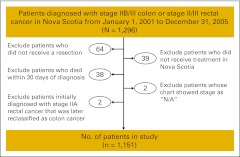
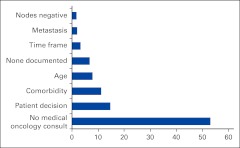
Results: A total of 1,151 patients were identified, of whom 59% received chemotherapy. Factors predicting chemotherapy receipt were male sex, age < 75 years, no hospital readmission within 30 days of surgery, stage III disease, no prior cancer diagnosis, and rectal cancer. Of the 679 patients who received chemotherapy, 479 (72%) met the 12-week benchmark, with male sex, urban residence, less social deprivation, colon cancer and increased length of hospital stay as significant factors. Of the 472 patients who did not receive chemotherapy, the most common reason for nonreceipt was no consultation with a medical oncologist (53%).
Conclusion: A number of factors influence adherence to adjuvant chemotherapy CPGs for CRC and should be incorporated in future work as novel regimens enter clinical practice.
Figures
References
-
- Siegel R, Ward E, Brawley O, et al. Cancer statistics, 2011: The impact of eliminating socioeconomic and racial disparities on premature cancer deaths. CA Cancer J Clin. 2011;61:212–236. - PubMed
-
- Canadian Cancer Society. Toronto, Canada: Canadian Cancer Society; 2010. Canadian Cancer Statistics 2010.
-
- Cunningham D, Atkin W, Lenz HJ, et al. Colorectal cancer. Lancet. 2010;375:1030–1047. - PubMed
-
- Saltz LB, Minsky B. Adjuvant therapy of cancers of the colon and rectum. Surg Clin North Am. 2002;82:1035–1058. - PubMed
-
- Jonker DJ, Spithoff K, Maroun J. Gastrointestinal Cancer Disease Site Group of Cancer Care Ontario's Program in Evidence-based Care. Adjuvant systemic chemotherapy for stage II and III colon cancer after complete resection: An updated practice guideline. Clin Oncol (R Coll Radiol) 2011;23:314–322. - PubMed
Publication types
MeSH terms
Grants and funding
LinkOut - more resources
Full Text Sources
Medical
Miscellaneous