. 2012 Nov 19:6:167.
doi: 10.3389/fnins.2012.00167. eCollection 2012.

Molecular Mechanisms in Amyotrophic Lateral Sclerosis: The Role of Angiogenin, a Secreted RNase

Affiliations

Molecular Mechanisms in Amyotrophic Lateral Sclerosis: The Role of Angiogenin, a Secreted RNase

Isabela M Aparicio-Erriu et al. Front Neurosci. .

Abstract

Amyotrophic lateral sclerosis is a fatal neurodegenerative disease caused by the loss of motoneurons. The precise molecular and cellular basis for neuronal death is not yet well established, but the contemporary view is that it is a culmination of multiple aberrant biological processes. Among the proposed mechanisms of motoneuron degeneration, alterations in the homeostasis of RNA binding proteins (RBP) and the consequent changes in RNA metabolism have received attention recently. The ribonuclease, angiogenin was one of the first RBPs associated with familial and sporadic ALS. It is enriched in motoneurons under physiological conditions, and is required for motoneuron survival under stress conditions. Furthermore, delivery of angiogenin protects cultured motoneurons against stress-induced injury, and significantly increases the survival of motoneurons in SOD(G93A) mice. In this overview on the role of angiogenin in RNA metabolism and in the control of motoneuron survival, we discuss potential pathogenic mechanisms of angiogenin dysfunction relevant to ALS and other neurodegenerative disorders. We also discuss recent evidence demonstrating that angiogenin secreted from stressed motoneurons may alter RNA metabolism in astrocytes.

Keywords: RNA binding proteins; RNA metabolism; amyotrophic lateral sclerosis; angiogenin; stress signals.


Figures
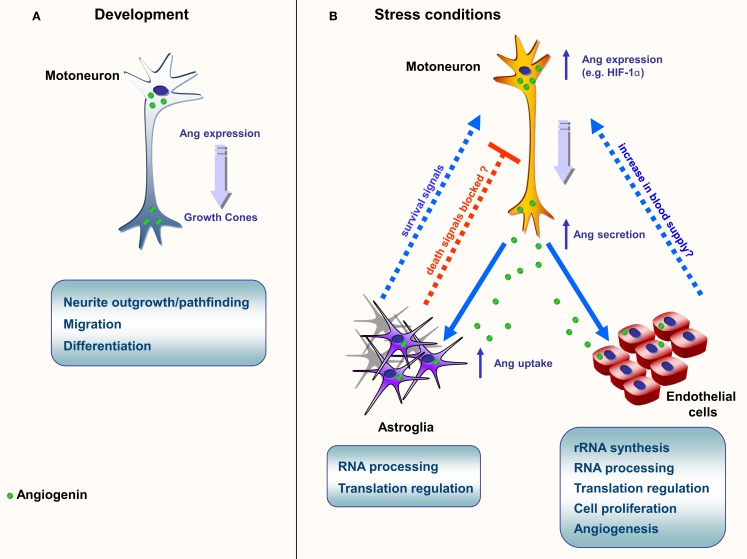
Figure 1
Figure 1
Schematic representation of the main known functions of angiogenin. (A) Neurite growth and pathfinding. Angiogenin is found in high levels during embryogenesis, both on the brain and spinal cord; (B) Neuroprotection in ALS models. In situations of stress, such as starvation and hypoxia, angiogenin expression is up-regulated in motoneurons. Angiogenin is secreted and endocytosed by surrounding astroglia and close endothelial cells. In astroglia, angiogenin processes RNA, possibly altering the protein translation profile. A similar phenomenon is proposed to happen in endothelial cells, culminating in the production of survival signals (astroglia) and angiogenesis (endothelial cells), possibly resulting in increase of blood flow in affected areas.
Figure 2
Figure 2
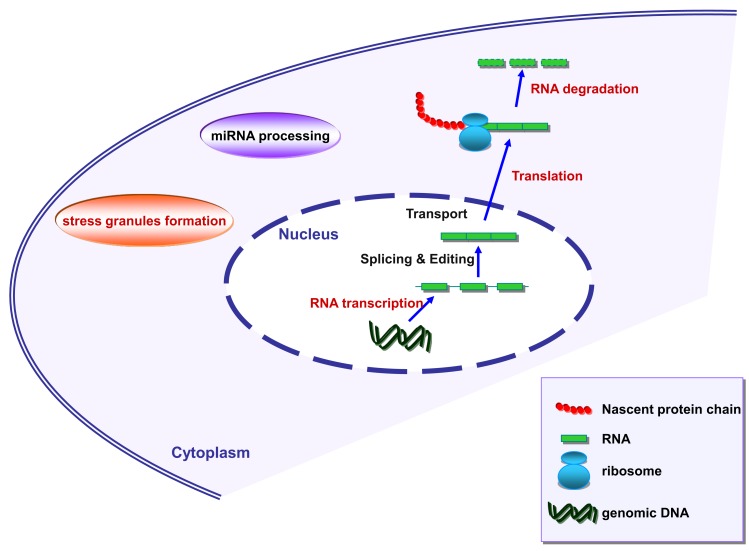
Schematic representation of RNA metabolism in mammalian cells. Marked in red are the processes where angiogenin has been shown to be involved.

References

    1. Adams S. A., Subramanian V. (1999). The angiogenins: an emerging family of ribonuclease related proteins with diverse cellular functions. Angiogenesis 3, 189–19910.1023/A:1009015512200 - DOI - PubMed
    1. Appel S. H., Zhao W., Beers D. R., Henkel J. S. (2011). The microglial-motoneuron dialogue in ALS. Acta Myol. 30, 4–8 - PMC - PubMed
    1. Bicknell R., Vallee B. L. (1988). Angiogenin activates endothelial cell phospholipase C. Proc. Natl. Acad. Sci. U.S.A. 85, 5961–596510.1073/pnas.85.16.5961 - DOI - PMC - PubMed
    1. Bosco D. A., Lemay N., Ko H. K., Zhou H., Burke C., Kwiatkowski T. J., et al. (2010). Mutant FUS proteins that cause amyotrophic lateral sclerosis incorporate into stress granules. Hum. Mol. Genet. 19, 4160–417510.1093/hmg/ddq335 - DOI - PMC - PubMed
    1. Colombrita C., Zennaro E., Fallini C., Weber M., Sommacal A., Buratti E., et al. (2009). J. Neurochem. 111, 1051–106110.1111/j.1471-4159.2009.06383.x - DOI - PubMed