


Age- and gender-related prevalence of multimorbidity in primary care: the Swiss FIRE project
- PMID: 23181753
- PMCID: PMC3557138
- DOI: 10.1186/1471-2296-13-113
Age- and gender-related prevalence of multimorbidity in primary care: the Swiss FIRE project
Abstract
Background: General practitioners often care for patients with several concurrent chronic medical conditions (multimorbidity). Recent data suggest that multimorbidity might be observed more often than isolated diseases in primary care. We explored the age- and gender-related prevalence of multimorbidity and compared these estimates to the prevalence estimates of other common specific diseases found in Swiss primary care.
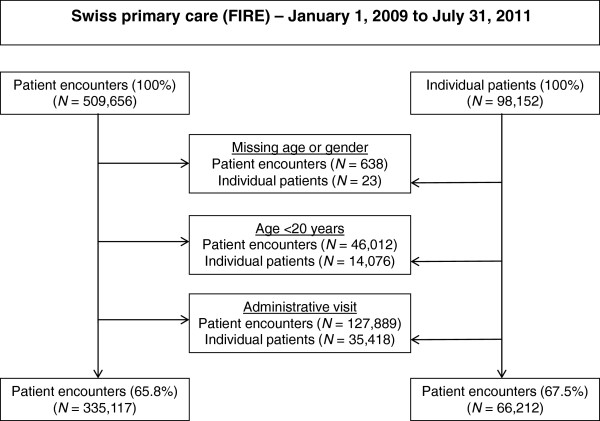
Methods: We analyzed data from the Swiss FIRE (Family Medicine ICPC Research using Electronic Medical Record) project database, representing a total of 509,656 primary care encounters in 98,152 adult patients between January 1, 2009 and July 31, 2011. For each encounter, medical problems were encoded using the second version of the International Classification of primary Care (ICPC-2). We defined chronic health conditions using 147 pre-specified ICPC-2 codes and defined multimorbidity as 1) two or more chronic health conditions from different ICPC-2 rubrics, 2) two or more chronic health conditions from different ICPC-2 chapters, and 3) two or more medical specialties involved in patient care. We compared the prevalence estimates of multimorbidity defined by the three methodologies with the prevalence estimates of common diseases encountered in primary care.
Results: Overall, the prevalence estimates of multimorbidity were similar for the three different definitions (15% [95%CI 11-18%], 13% [95%CI 10-16%], and 14% [95%CI 11-17%], respectively), and were higher than the prevalence estimates of any specific chronic health condition (hypertension, uncomplicated 9% [95%CI 7-11%], back syndrome with and without radiating pain 6% [95%CI 5-7%], non-insulin dependent diabetes mellitus 3% [95%CI 3-4%]), and degenerative joint disease 3% [95%CI 2%-4%]). The prevalence estimates of multimorbidity rose more than 20-fold with age, from 2% (95%CI 1-2%) in those aged 20-29 years, to 38% (95%CI 31-44%) in those aged 80 or more years. The prevalence estimates of multimorbidity were similar for men and women (15% vs. 14%, p=0.288).
Conclusions: In primary care, prevalence estimates of multimorbidity are higher than those of isolated diseases. Among the elderly, more than one out of three patients suffer from multimorbidity. Management of multimorbidity is a principal concern in this vulnerable patient population.
Figures

References
-
- Perrin EC, Newacheck P, Pless IB, Drotar D, Gortmaker SL, Leventhal J, Perrin JM, Stein RE, Walker DK, Weitzman M. Issues involved in the definition and classification of chronic health conditions. Pediatrics. 1993;91(4):787–793. - PubMed
-
- Wu SY. Green A: Projection of chronic illness prevalence and costs inflation. Santa Monica: RAND Health; 2000.
Publication types
MeSH terms
LinkOut - more resources
Full Text Sources
Medical
