


Review
doi: 10.1016/j.ccc.2012.10.007.
Preventing delirium in the intensive care unit
Affiliations
- PMID: 23182527
- PMCID: PMC3508697
- DOI: 10.1016/j.ccc.2012.10.007
Item in Clipboard
Review
Preventing delirium in the intensive care unit
Crit Care Clin.
2013 Jan.
Abstract
Delirium in the intensive care unit (ICU) is exceedingly common, and risk factors for delirium among the critically ill are nearly ubiquitous. Addressing modifiable risk factors including sedation management, deliriogenic medications, immobility, and sleep disruption can help to prevent and reduce the duration of this deadly syndrome. The ABCDE approach to critical care is a bundled approach that clinicians can implement for many patients treated in their ICUs to prevent the adverse outcomes associated with delirium and critical illness.
Copyright © 2013 Elsevier Inc. All rights reserved.
Conflict of interest statement
The authors have no financial conflicts to disclose.
Figures
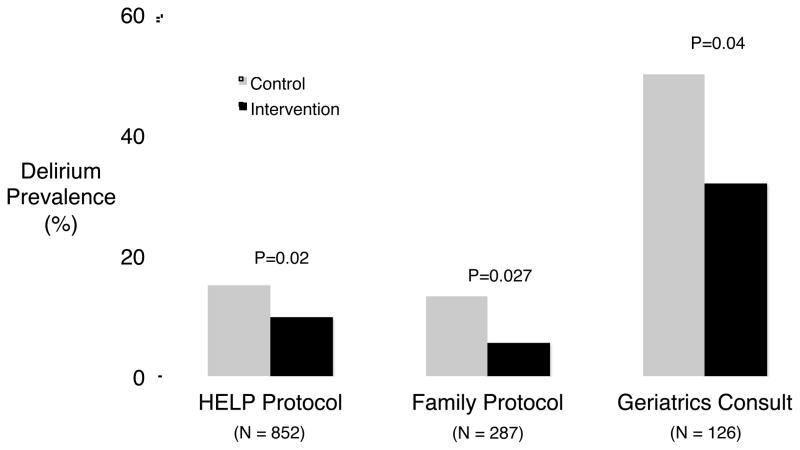
Prevalence of delirium in non-pharmacologic delirium prevention trials. Inouye and colleagues studied the Hospital Elder Life Program (HELP) protocol in hospitalized elderly and found a reduction in delirium prevalence from 15% among patients in the usual care group to 9.9% among patients in the intervention group. A similar protocol, studied by Martinez and colleagues, utilized family members to deliver the non-pharmacologic interventions to acutely ill elderly patients and found a reduction in delirium prevalence from 13.3% in the usual care group to 5.6% in the intervention group. Finally, Marcantonio and colleagues found that a geriatrics consultation in patients undergoing surgical fixation of hip fractures reduced delirium from 50% in patients not receiving a consultation to 32% in patients who received a consultation.
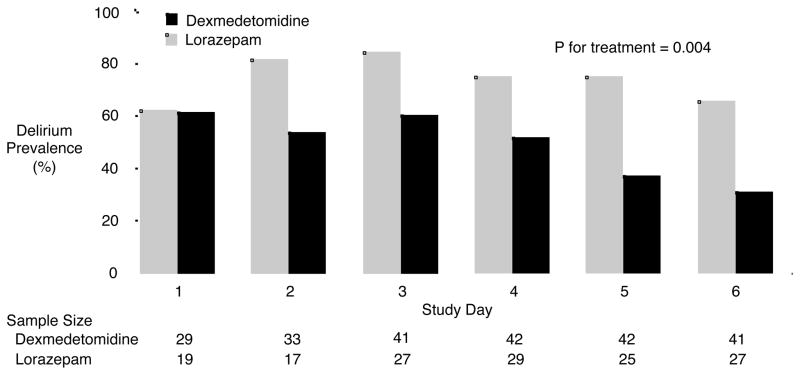
In the MENDS trial dexmedetomidine significantly reduced the prevalence of delirium over time. The sample size changes with study day as patients were extubated, died, discharged from the ICU or did not have delirium assessed. Reproduced with permission from Pandharipande et al., Critical Care 2010; 14: R38.
References
-
- American Psychiatric A. Diagnostic and statistical manual of mental disorders. 4. Washington, DC: American Psychiatric Association; 2000. text revision.
-
- Ely EW, Inouye SK, Bernard GR, et al. Delirium in mechanically ventilated patients: validity and reliability of the confusion assessment method for the intensive care unit (CAM-ICU) JAMA. 2001 Dec 5;286(21):2703–2710. - PubMed
-
- Dubois MJ, Bergeron N, Dumont M, Dial S, Skrobik Y. Delirium in an intensive care unit: a study of risk factors. Intensive Care Med. 2001;27(8):1297–1304. - PubMed
-
- Bergeron N, Dubois MJ, Dumont M, Dial S, Skrobik Y. Intensive Care Delirium Screening Checklist: evaluation of a new screening tool. Intensive Care Med. 2001 May;27(5):859–864. - PubMed
-
- Girard TD, Kress JP, Fuchs BD, et al. Efficacy and safety of a paired sedation and ventilator weaning protocol for mechanically ventilated patients in intensive care (Awakening and Breathing Controlled trial): a randomised controlled trial. Lancet. 2008;371(9607):126–134. - PubMed
Publication types
MeSH terms
Substances
Grants and funding
LinkOut - more resources
Full Text Sources
Other Literature Sources
Medical
