Reading increases ocular illuminance during light treatment
- PMID: 23183735
- PMCID: PMC5600184
- DOI: 10.1515/ijamh.2012.049
Reading increases ocular illuminance during light treatment
Abstract
Background: Bright-light treatment is a safe and effective treatment for the management of winter seasonal affective disorder (SAD). In a recent study, we found that the relative duration of reading was positively associated with likelihood of remission after six weeks of light treatment.
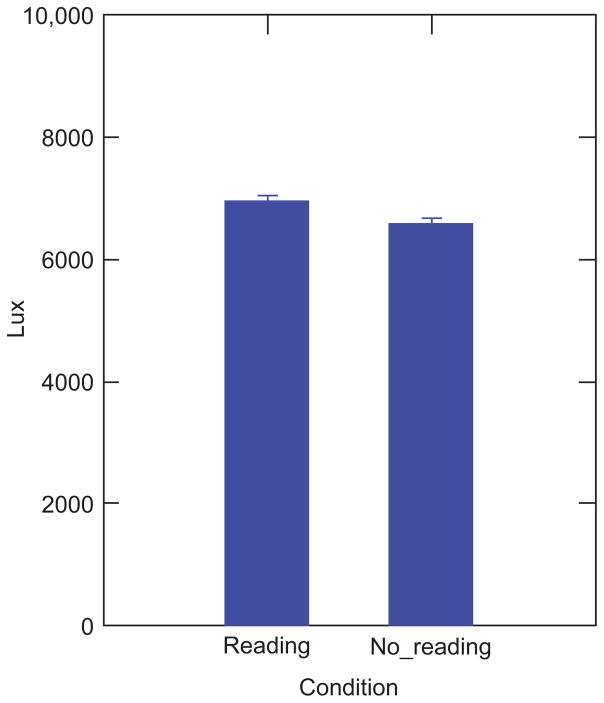
Methods: Two technicians measured the illuminance of a light box with a light meter directed towards the center of reading material that was placed on a table in front of the light box. The measurement was also performed after reading material was removed. The two measurements were performed in a randomized order. Friedman analysis of variance with Wilcoxon post-hoc tests were used to compare illuminance with vs. without reading.
Results: The presence of the reading material increased illuminance by 470.93 lux (95% CI 300.10-641.75), p<0.0001.
Limitations: This is a technical report done under conditions intended to mimic those of typical ambulatory light treatment as much as possible.
Conclusions: As reading materials reflect light from the light box, reading during light therapy increases ocular illuminance. If confirmed by future studies using continuous recordings in randomized design, instructing SAD patients to read during light therapy may contribute to a more complete response to light treatment. The downside of specific relevance for students, is that reading, in particular, with bright light in the late evening/early night may induce or worsen circadian phase delay, adversely affecting health and functioning.
Figures
References
-
- Rosenthal NE, Sack DA, Gillin JC, Lewy AJ, Goodwin FK, et al. Seasonal affective disorder: a description of the syndrome and preliminary findings with light therapy. Arch Gen Psychiatry. 1984;41:72–80. - PubMed
-
- Wehr TA, Duncan WC, Jr, Sher L, Aeschbach D, Schwartz PJ, et al. A circadian signal of change of season in patients with seasonal affective disorder. Arch Gen Psychiatry. 2001;58:1108–14. - PubMed
-
- Lavoie MP, Lam RW, Bouchard G, Sasseville A, Charron MC, et al. Evidence of a biological effect of light therapy on the retina of patients with seasonal affective disorder. Biol Psychiatry. 2009;66:253–8. - PubMed
-
- Eastman CI, Young MA, Fogg LF, Liu L, Meaden PM. Bright light treatment of winter depression. Arch Gen Psychiatry. 1998;55:883–9. - PubMed
-
- Flory R, Ametepe J, Bowers B. A randomized, placebo-controlled trial of bright light and high density negative air ions for treatment of seasonal affective disorder. Psychiatry Res. 2010;177:101–8. - PubMed
Publication types
MeSH terms
Grants and funding
LinkOut - more resources
Full Text Sources
Medical
Research Materials