


Evolutionary mode routinely varies among morphological traits within fossil species lineages
- PMID: 23184976
- PMCID: PMC3528549
- DOI: 10.1073/pnas.1209901109
Evolutionary mode routinely varies among morphological traits within fossil species lineages
Abstract
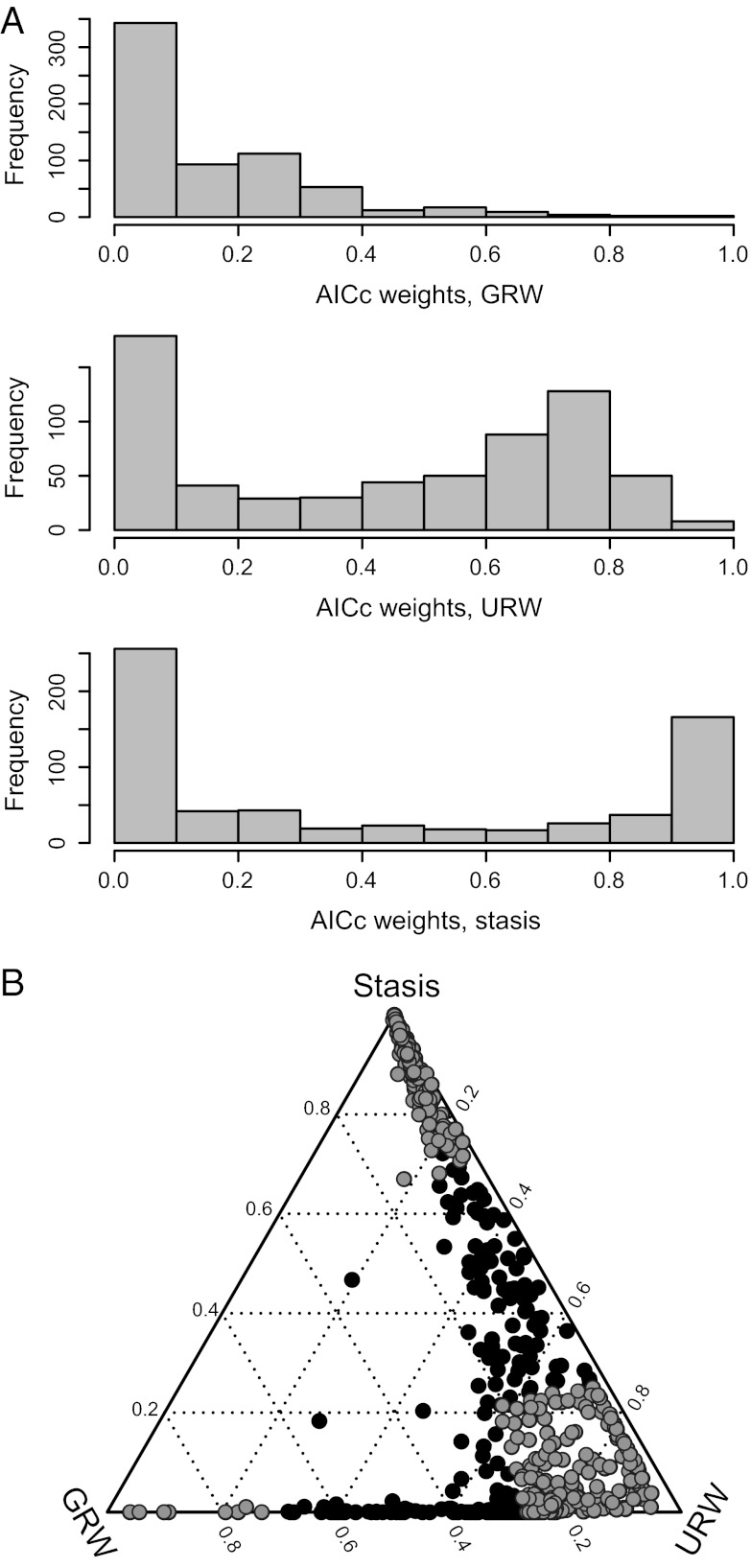
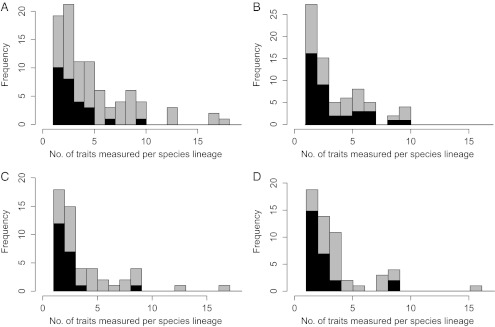
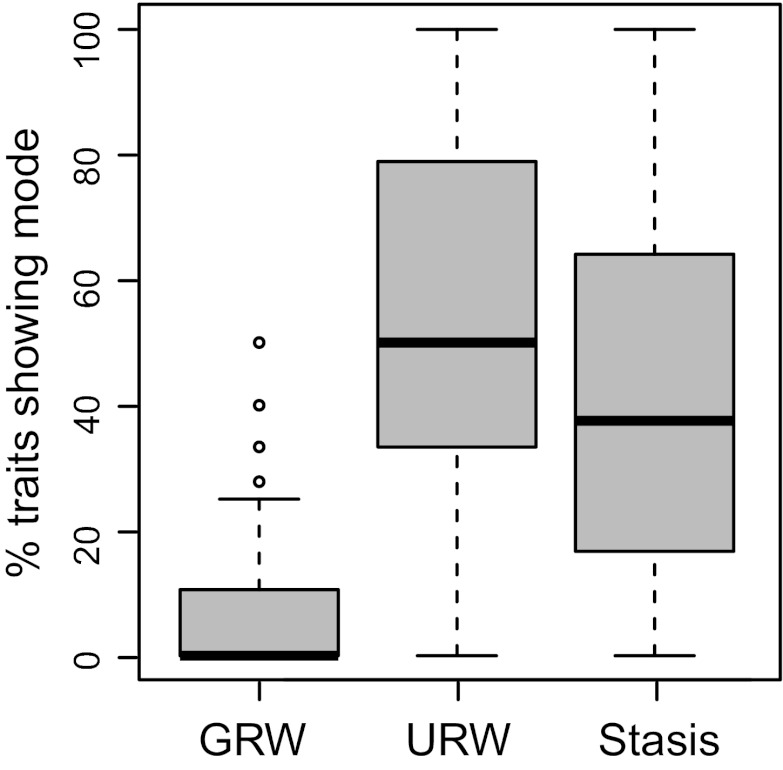
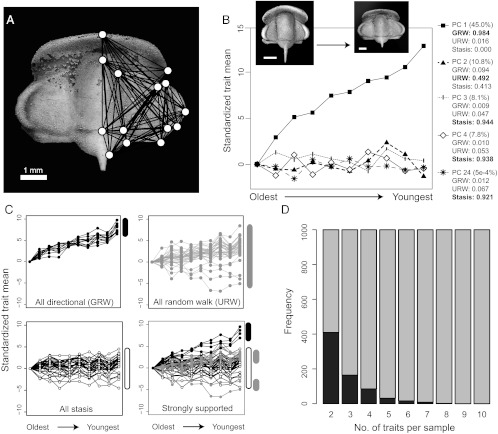
Recent studies have revitalized interest in methods for detecting evolutionary modes in both fossil sequences and phylogenies. Most of these studies examine single size or shape traits, often implicitly assuming that single phenotypic traits are adequate representations of species-level change. We test the validity of this assumption by tallying the frequency with which traits vary in evolutionary mode within fossil species lineages. After fitting models of directional change, unbiased random walk, and stasis to a dataset of 635 traits across 153 species lineages, we find that within the majority of lineages, evolutionary mode varies across traits and the likelihood of conflicting within-lineage patterns increases with the number of traits analyzed. In addition, single traits may show variation in evolutionary mode even in situations where the overall morphological evolution of the lineage is dominated by one type of mode. These quantified, stratigraphically based findings validate the idea that morphological patterns of mosaic evolution are pervasive across groups of organisms throughout Earth's history.
Conflict of interest statement
The authors declare no conflict of interest.
Figures
References
-
- Hansen TF, Houle D. Evolvability, stabilizing selection, and the problem of stasis. In: Pigliucci M, Preston K, editors. Phenotypic Integration: Studying the Ecology and Evolution of Complex Phenotypes. Oxford, UK: Oxford Univ Press; 2004. pp. 130–150.
-
- Estes S, Arnold SJ. Resolving the paradox of stasis: Models with stabilizing selection explain evolutionary divergence on all timescales. Am Nat. 2007;169(2):227–244. - PubMed
-
- Eldredge N, et al. The dynamics of evolutionary stasis. Paleobiology. 2005;31:133–145.
-
- Parsons PA. Environments and evolution: Interactions between stress, resource inadequacy and energetic efficiency. Biol Rev Camb Philos Soc. 2005;80(4):589–610. - PubMed
-
- Sheldon PR. Plus ça change—A model for stasis and evolution in different environments. Palaeogeogr Palaeoclimatol Palaeoecol. 1996;127:209–227.
Publication types
MeSH terms
LinkOut - more resources
Full Text Sources
