. 2012;10(11):e1001424.
doi: 10.1371/journal.pbio.1001424. Epub 2012 Nov 20.

The evolution of mutualism in gut microbiota via host epithelial selection

Affiliations

The evolution of mutualism in gut microbiota via host epithelial selection

Jonas Schluter et al. PLoS Biol. 2012.

Abstract

The human gut harbours a large and genetically diverse population of symbiotic microbes that both feed and protect the host. Evolutionary theory, however, predicts that such genetic diversity can destabilise mutualistic partnerships. How then can the mutualism of the human microbiota be explained? Here we develop an individual-based model of host-associated microbial communities. We first demonstrate the fundamental problem faced by a host: The presence of a genetically diverse microbiota leads to the dominance of the fastest growing microbes instead of the microbes that are most beneficial to the host. We next investigate the potential for host secretions to influence the microbiota. This reveals that the epithelium-microbiota interface acts as a selectivity amplifier: Modest amounts of moderately selective epithelial secretions cause a complete shift in the strains growing at the epithelial surface. This occurs because of the physical structure of the epithelium-microbiota interface: Epithelial secretions have effects that permeate upwards through the whole microbial community, while lumen compounds preferentially affect cells that are soon to slough off. Finally, our model predicts that while antimicrobial secretion can promote host epithelial selection, epithelial nutrient secretion will often be key to host selection. Our findings are consistent with a growing number of empirical papers that indicate an influence of host factors upon microbiota, including growth-promoting glycoconjugates. We argue that host selection is likely to be a key mechanism in the stabilisation of the mutualism between a host and its microbiota.


Conflict of interest statement

The authors have declared that no competing interests exist.

Figures
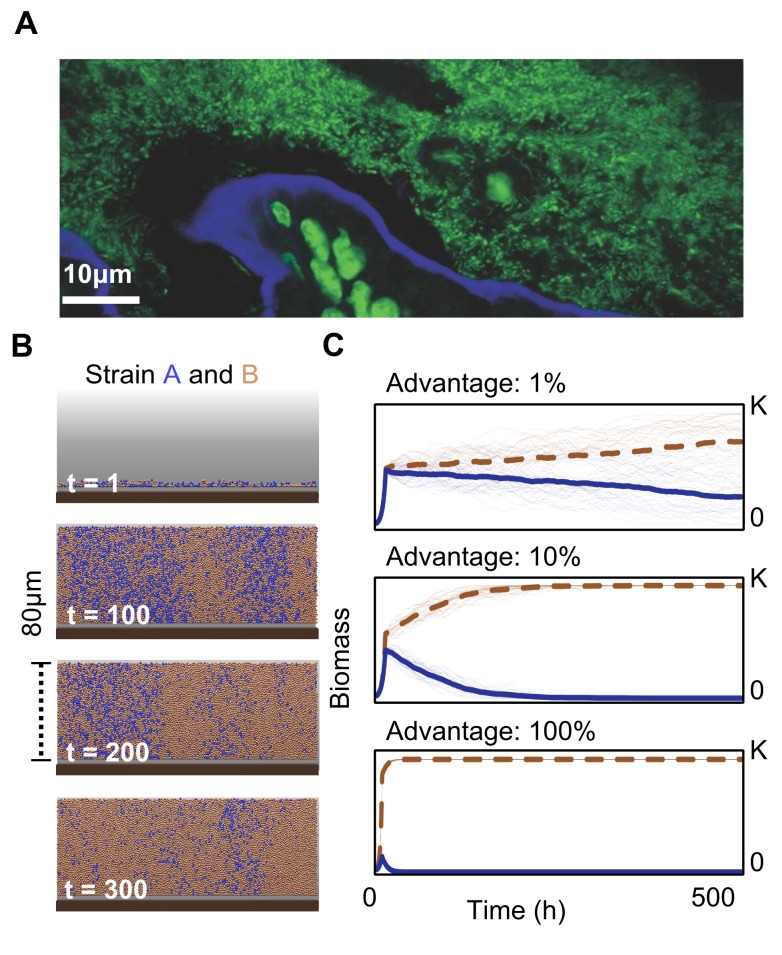
Figure 1
Figure 1. Microscopic image and simulations of microbial growth near a host epithelium.
(A) Confocal fluorescence image of bacteria growing in the lumen on top of host epithelial cells. Sample taken from the cecum of a laboratory mouse, where there has been no intentional manipulation of the animal's microbiotia. Epithelial and bacterial cells in green (DNA stained with Sytox green), and the epithelial border brush in blue (actin stained with Alexa-647-phalloidin) from . (B) Simulation of bacterial growth on host epithelium; brown bacterial cells (strain B) have a 1% growth rate advantage over blue bacterial cells (strain A). Even with a modest growth rate advantage, strain B succeeds as strain A is slowly washed out. (C) Thirty independent simulations of bacterial competition. Development of biomass of strain B (brown dashed) and A (blue) with growth rate advantages for strain B of 1%, 10%, and 100% and environmental capacity K. The thick lines are mean values.
Figure 2
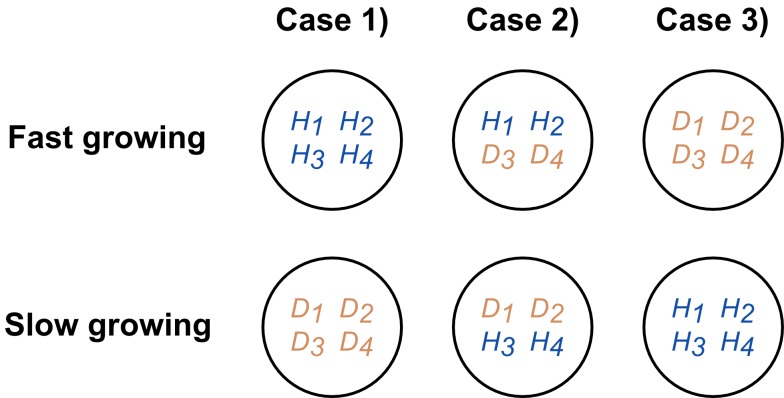
Figure 2. Cartoon to illustrate the potential problem faced by a host.
Three scenarios are shown for four helpful strains (H) and four detrimental strains (D) that occupy four different niches, 1 to 4. Two extreme cases exist: beneficial strains grow faster in all niches (case 1) or all detrimental stains grow faster in all niches (case 3). In the first case, no partner choice is required, as natural selection favours the beneficial strain throughout all niches. However, any deviation (case 2 or 3) from this means that the host will experience a sub-optimal microbiota.
Figure 3
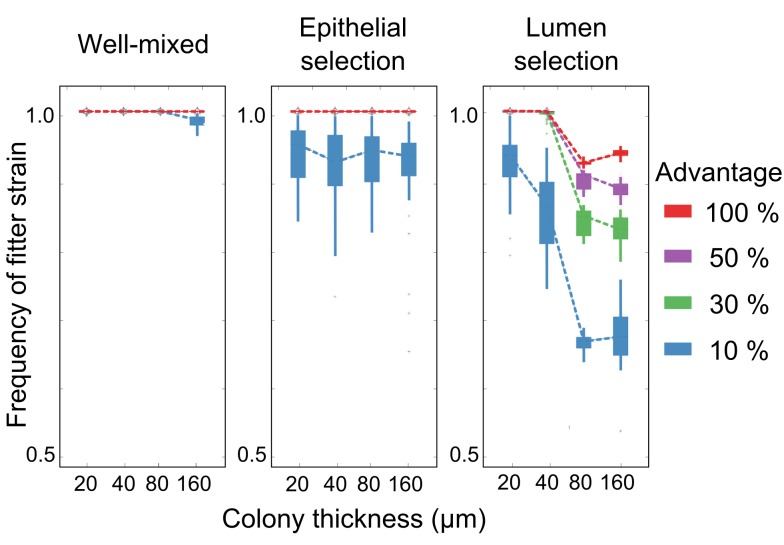
Figure 3. Epithelial nutrients have more effect on a bacterial community than lumen nutrients.
Box plots show the final frequency of a faster growing strain after 12 d as a function of microbial community thickness, where the growth rate advantages of the fitter strain range from 10% to 100%. Well-mixed: No gradients of nutrients exist (Figure 1B,C). Epithelial selection: Nutrients exclusively diffuse into the colony from the host epithelium. Lumen selection: Nutrients exclusively diffuse into the colony from the lumen. Dashed lines connect mean values of 30 independent simulations. The total nutrient influx into the system from the host or the lumen is kept identical. Results agree with a steady-state solution of a simplified ODE model (Figure S2).
Figure 4
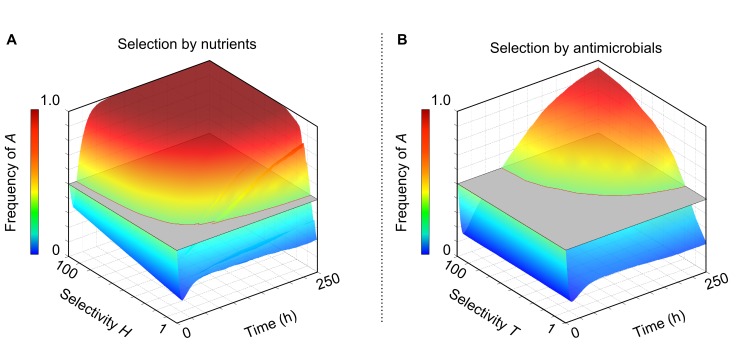
Figure 4. Selectivity amplification by the host epithelium.
Weak epithelial selection dominates strong lumen selection. Strain B has a 100% growth rate advantage on nutrients from the lumen, and lumen nutrients are five times the concentration as epithelial nutrients. Grey planes mark the starting frequency of the two strains (0.5). (A) Host nutrients provide growth rate advantages to strain A ranging from 1% to 100%. (B) The host secretes antimicrobials that preferentially kill strain B; susceptibility advantages for strain A range from 1% to 100%. Host-secreted nutrients are also provided that neutral. In (A) and (B) strain A outcompetes strain B for all but the smallest selective advantages.
Figure 5
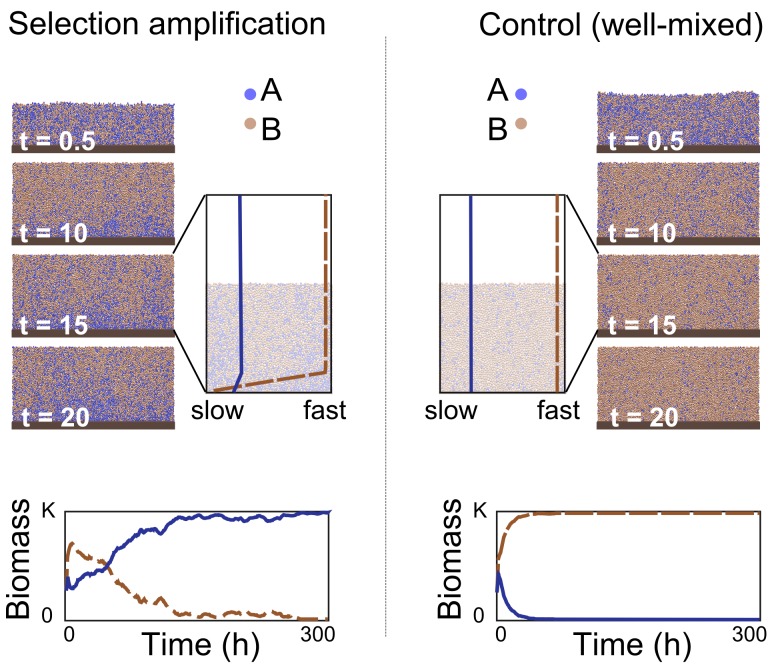
Figure 5. The host need only influence a thin layer of a microbial community to exert control.
Selection amplification: To illustrate, we apply constant distributions to all solutes in the simulation (no gradient for lumen nutrients, steep gradient for host secretions) to create a thin layer in which the strain A (blue) outgrows strain B (brown). The snapshots show the progression of a representative simulation with the expanded snapshot showing the growth rates of the two strains throughout the community. Strain A only grows better very close to the surface of the epithelium. Well-mixed: Control simulation with identical total amounts of solutes but without spatial differences in solute concentrations and growth rates of the two strains. In such an environment, strain A is out-competed by strain B; environmental capacity K.

References

    1. Sanon A, Andrianjaka ZN, Prin Y, Bally R, Thioulouse J, et al. (2009) Rhizosphere microbiota interfers with plant-plant interactions. Plant Soil 321: 259–278.
    1. Callaway RM, Thelen GC, Rodriguez A, Holben WE (2004) Soil biota and exotic plant invasion. Nature 427: 731–733. - PubMed
    1. Ruby EG, McFall-Ngai MJ (1999) Oxygen-utilizing reactions and symbiotic colonization of the squid light organ by Vibrio fischeri . Trends Microbiol 7: 414–420. - PubMed
    1. Visick KL, McFall-Ngai MJ (2000) An exclusive contract: specificity in the Vibrio fischeri-Euprymna scolopes partnership. J Bacteriol 182: 1779. - PMC - PubMed
    1. Graf J (1998) Host-derived amino acids support the proliferation of symbiotic bacteria. Proc Natl Acad Sci U S A 95: 1818–1822. - PMC - PubMed

Publication types