


After the PBDE phase-out: a broad suite of flame retardants in repeat house dust samples from California
- PMID: 23185960
- PMCID: PMC3525011
- DOI: 10.1021/es303879n
After the PBDE phase-out: a broad suite of flame retardants in repeat house dust samples from California
Abstract
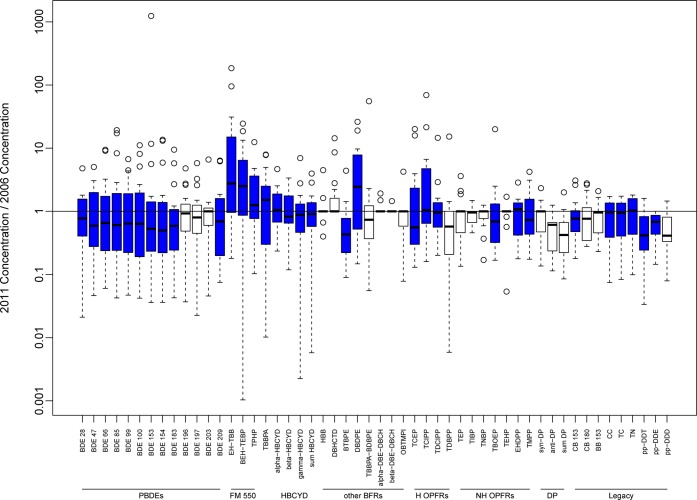
Higher house dust levels of PBDE flame retardants (FRs) have been reported in California than other parts of the world, due to the state's furniture flammability standard. However, changing levels of these and other FRs have not been evaluated following the 2004 U.S. phase-out of PentaBDE and OctaBDE. We analyzed dust collected in 16 California homes in 2006 and again in 2011 for 62 FRs and organohalogens, which represents the broadest investigation of FRs in homes. Fifty-five compounds were detected in at least one sample; 41 in at least 50% of samples. Concentrations of chlorinated OPFRs, including two (TCEP and TDCIPP) listed as carcinogens under California's Proposition 65, were found up to 0.01% in dust, higher than previously reported in the U.S. In 75% of the homes, we detected TDBPP, or brominated "Tris," which was banned in children's sleepwear because of carcinogenicity. To our knowledge, this is the first report on TDBPP in house dust. Concentrations of Firemaster 550 components (EH-TBB, BEH-TEBP, and TPHP) were higher in 2011 than 2006, consistent with its use as a PentaBDE replacement. Results highlight the evolving nature of FR exposures and suggest that manufacturers continue to use hazardous chemicals and replace chemicals of concern with chemicals with uncharacterized toxicity.
Figures
References
-
- Zota A. R.; Rudel R. A.; Morello-Frosch R. A.; Brody J. G. Elevated house dust and serum concentrations of PBDEs in California: Unintended consequences of furniture flammability standards?. Environ. Sci. Technol. 2008, 42(21), 8158–8164. - PubMed
-
- Quiros-Alcala L.; Bradman A.; Nishioka M.; Harnly M. E.; Hubbard A.; McKone T. E.; Eskenazi B. Concentrations and loadings of polybrominated diphenyl ethers in dust from low-income households in California. Environ Int 2011, 37(3), 592–6. - PubMed
-
- Whitehead T.; Metayer C.; Buffler P.; Rappaport S. M. Estimating exposures to indoor contaminants using residential dust. J. Exposure Sci. Environ. Epidemiol. 2011, 21(6), 549–64. - PubMed
Publication types
MeSH terms
Substances
Grants and funding
LinkOut - more resources
Full Text Sources
