Review
. 2012 Dec;15(12):1613-20.
doi: 10.1038/nn.3262. Epub 2012 Nov 27.

Neurogenesis and generalization: a new approach to stratify and treat anxiety disorders

Affiliations
Review

Neurogenesis and generalization: a new approach to stratify and treat anxiety disorders

Mazen A Kheirbek et al. Nat Neurosci. 2012 Dec.

Abstract

Although an influence of adult neurogenesis in mediating some of the effects of antidepressants has received considerable attention in recent years, much less is known about how alterations in this form of plasticity may contribute to psychiatric disorders such as anxiety and depression. One way to begin to address this question is to link the functions of adult-born hippocampal neurons with specific endophenotypes of these disorders. Recent studies have implicated adult-born hippocampal neurons in pattern separation, a process by which similar experiences or events are transformed into discrete, non-overlapping representations. Here we propose that impaired pattern separation underlies the overgeneralization often seen in anxiety disorders, specifically post-traumatic stress disorder and panic disorder, and therefore represents an endophenotype for these disorders. The development of new, pro-neurogenic compounds may therefore have therapeutic potential for patients who display pattern separation deficits.


Figures
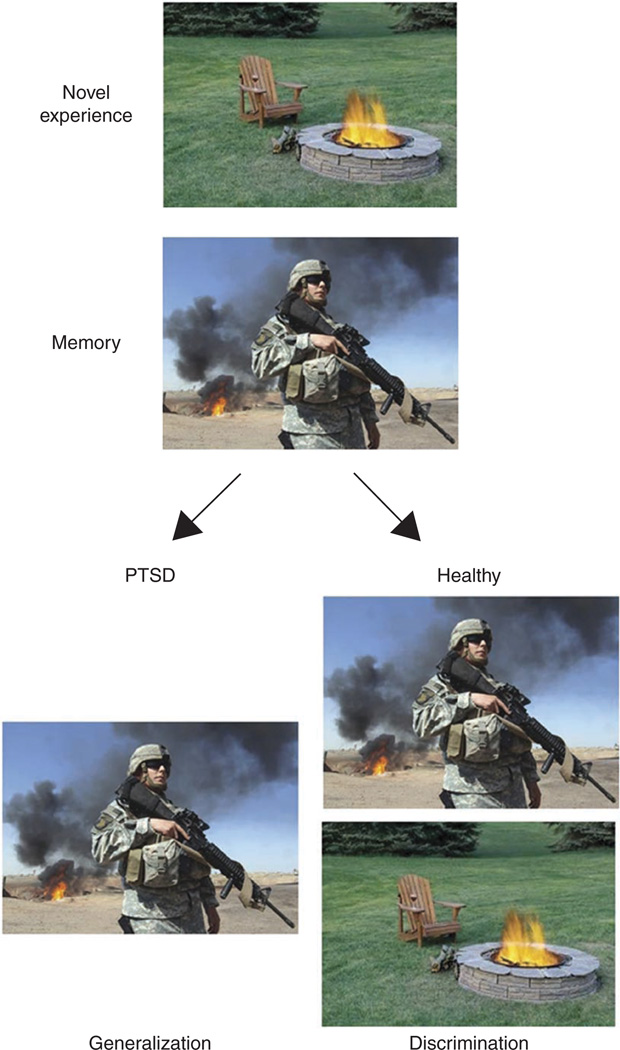
Figure 1
Figure 1
Excessive generalization in PTSD. Pattern separation serves to disambiguate a new experience from stored memories. When a novel experience (campfire) contains some shared features with a previously stored experience (war zone), it evokes retrieval of that memory. Upon experiencing a situation that shares features of a traumatic event, a healthy individual is able to discriminate the novel experience from the fearful one and successfully encode this experience as novel and safe. Alternatively, in an individual suffering from PTSD, excessive generalization manifests as a failure to discriminate the novel, safe experience from the previously stored emotional memory, leading to excessive arousal and fear responses.
Figure 2
Figure 2
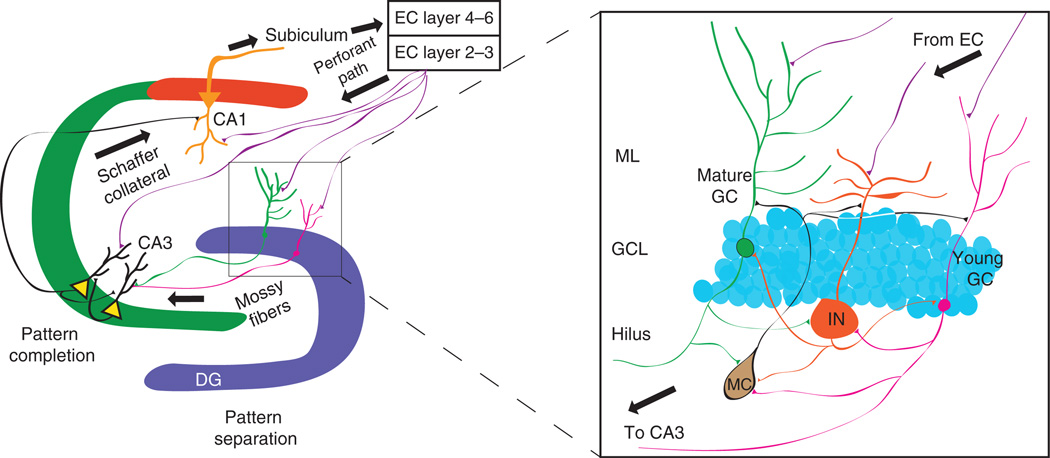
Local circuit properties of the dentate gyrus that facilitate pattern separation. Perforant path inputs from the entorhinal cortex carrying processed sensory information innervate granule cells of the dentate gyrus and pyramidal cells of both CA3 and CA1. In the dentate gyrus, sparseness is achieved by inhibitory interneurons that constrain granule cell firing through feedforward and feedback inhibition. The sparse cohort of granule cells that fire in a specific context can drive CA3 with high fidelity, owing to the robust mossy fiber synapses on CA3 pyramidal neurons. In this way, sparse coding and the mossy fiber–CA3 synapse can facilitate pattern separation. Activation of CA3 can instruct the generation of autoassociative networks in CA3 to facilitate future pattern completion for retrieval of stored representations. DG, dentate gyrus; EC, entorhinal cortex; GC, granule cell; IN, inhibitory interneuron; MC, mossy cell; ML, molecular layer.
Figure 3
Figure 3
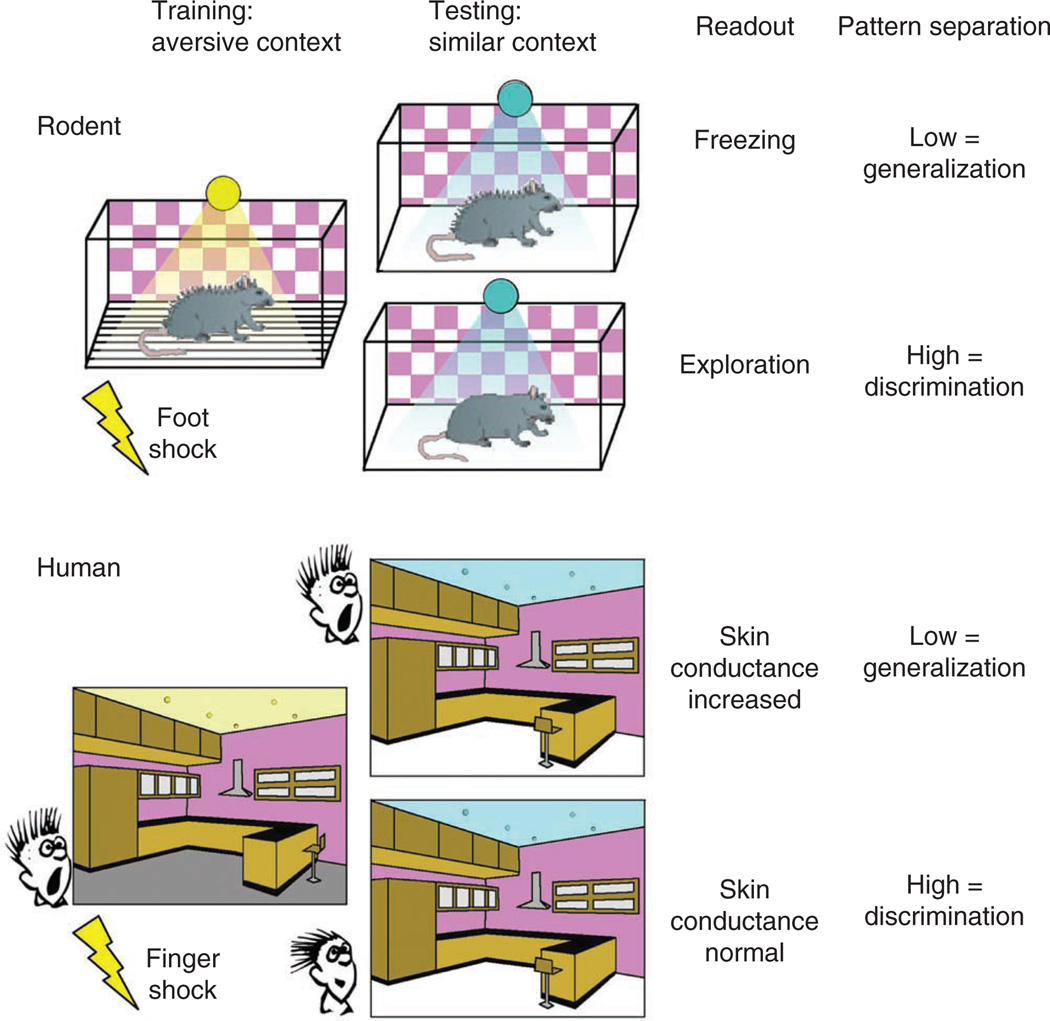
Testing pattern separation with contextual fear discrimination in rodents and humans. Top: in the contextual fear discrimination task, rodents are trained to associate a neutral context with an aversive foot shock. Placing animals in a similar context that shares some, but not all, of the contextual cues present in the training context tests the ability to discriminate. Freezing in this similar context indicates a generalization of the new context to the training context, whereas exploration indicates discrimination and recognition that the context is novel. Bottom: testing pattern separation in humans using a virtual reality fear discrimination task. Humans freely navigate through a virtual reality environment while receiving unsignaled finger shocks. Upon exposure to a similar environment, measures of increased arousal indicate a generalization of the new context to the training context, whereas low arousal indicates discrimination of the two contexts.
Figure 4
Figure 4
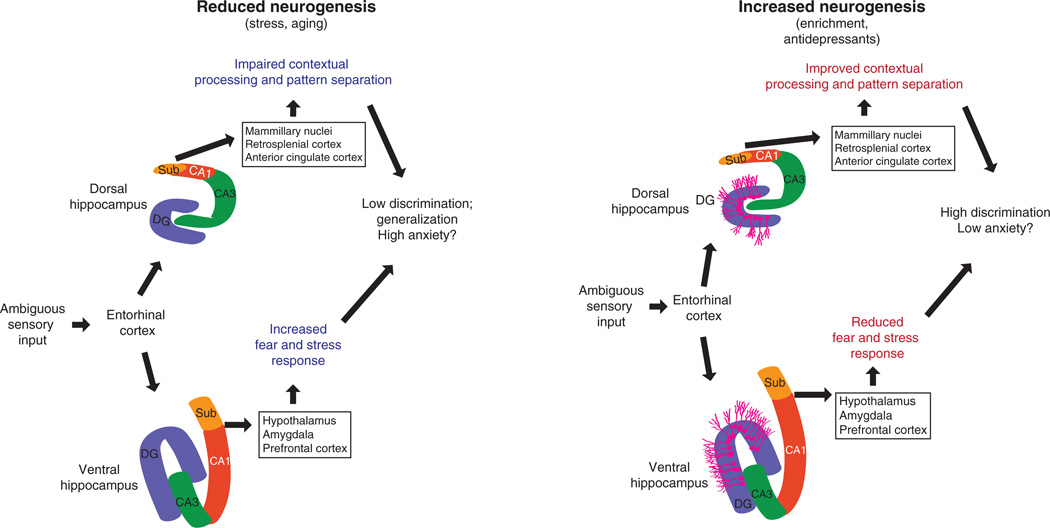
Modulation of pattern separation by adult neurogenesis and its impact on mood. Novel sensory representations can be disambiguated from stored representations through pattern separation on inputs from entorhinal cortex. Under stressful conditions, neurogenesis is low, leading to low discrimination and to generalization of contexts with substantial emotional valence. This may lead to increased anxiety owing to impaired contextual processing through modulation of exploration through dorsal outputs and increased stress responses by influencing outputs from the ventral pole. In conditions with high neurogenesis, such as enrichment or antidepressant treatment, enhanced pattern separation leads to high discrimination and greater ability to disambiguate similar contexts with differing emotional valence. This may influence output of the dorsal hippocampus to increase exploration and contextual encoding, and the ventral hippocampus to modulate stress responses. DG, dentate gyrus; Sub, subiculum.
Figure 5
Figure 5
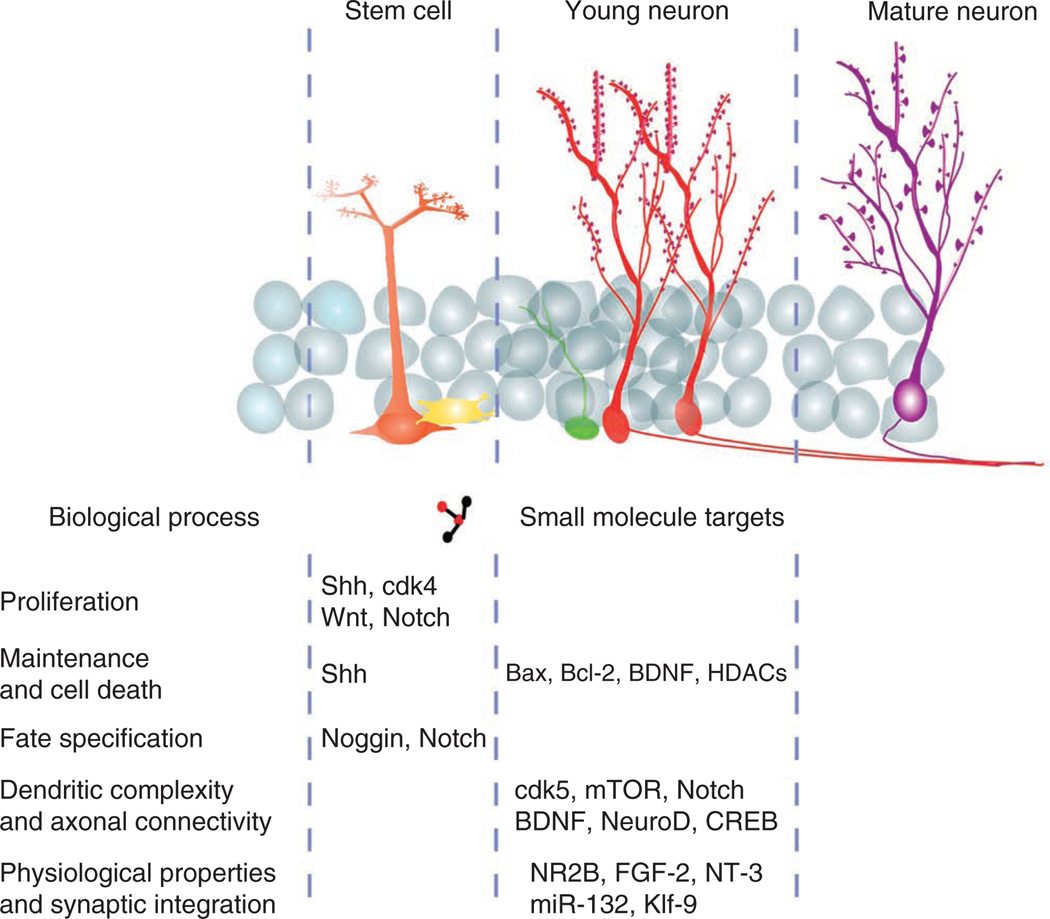
Targets for stimulating neurogenesis to enhance pattern separation and restrain overgeneralization. The mechanisms that regulate the proliferation, integration and maturation of adult born granule cells provide targets to generate new therapies aimed at increasing neurogenesis to reduce overgeneralization in anxiety disorders. Targets aimed at increasing proliferation (Sonic hedgehog (Shh), cyclin-dependent kinase 4 (cdk4), Wnt, Notch) or those that increase the survival of young neurons (Bax, brain-derived neurotrophic factor (BDNF), histone deacetylases (HDACs)) can provide an increased available pool of young neurons. Expanding the pool of young neurons has recently been shown to increase pattern separation in rodent models. Alternatively, targeting the distinct physiological properties or the structural properties of young neurons will provide further insight into the specific function of young neurons in pattern separation, and in turn in anxiety disorders such as PTSD, and may provide more specific targets for the treatment of overgeneralization in anxiety disorders.

References

    1. Kessler RC, et al. Lifetime prevalence age-of-onset distributions of DSM-IV disorders in the National Comorbidity Survey Replication. Arch.Gen. Psychiatry. 2005;62:593–602. - PubMed
    1. DuPont RL, et al. Economic costs of anxiety disorders. Anxiety. 1996;2:167–172. - PubMed
    1. Kessler RC, Sonnega A, Bromet E, Hughes M, Nelson CB. Posttraumatic stress disorder in the National Comorbidity Survey. Arch. Gen. Psychiatry. 1995;52:1048–1060. - PubMed
    1. Milad MR, Quirk GJ. Fear extinction as a model for translational neuroscience: ten years of progress. Annu. Rev. Psychol. 2012;63:129–151. - PMC - PubMed
    1. Jovanovic T, Ressler KJ. How the neurocircuitry genetics of fear inhibition may inform our understanding of PTSD. Am. J. Psychiatry. 2010;167:648–662. - PMC - PubMed

Publication types