


An empiric risk scoring tool for identifying high-risk heterosexual HIV-1-serodiscordant couples for targeted HIV-1 prevention
- PMID: 23187945
- PMCID: PMC3620695
- DOI: 10.1097/QAI.0b013e31827e622d
An empiric risk scoring tool for identifying high-risk heterosexual HIV-1-serodiscordant couples for targeted HIV-1 prevention
Abstract
Background and objectives: Heterosexual HIV-1-serodiscordant couples are increasingly recognized as an important source of new HIV-1 infections in sub-Saharan Africa. A simple risk assessment tool could be useful for identifying couples at highest risk for HIV-1 transmission.
Methods: Using data from 3 prospective studies of HIV-1-serodiscordant couples from 7 African countries and standard methods for development of clinical prediction rules, the authors derived and validated a risk scoring tool developed from multivariate modeling and composed of key predictors for HIV-1 risk that could be measured in standard research and clinical settings.
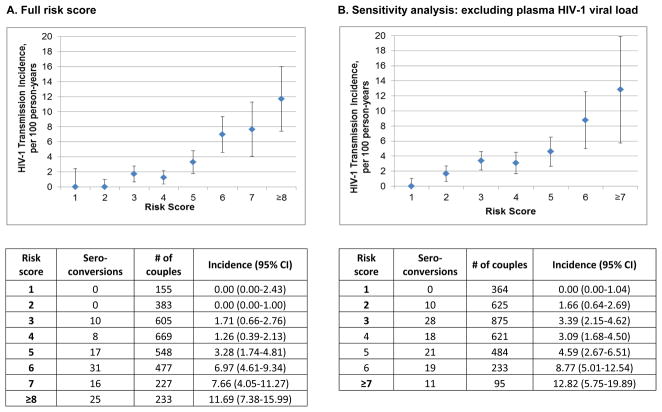
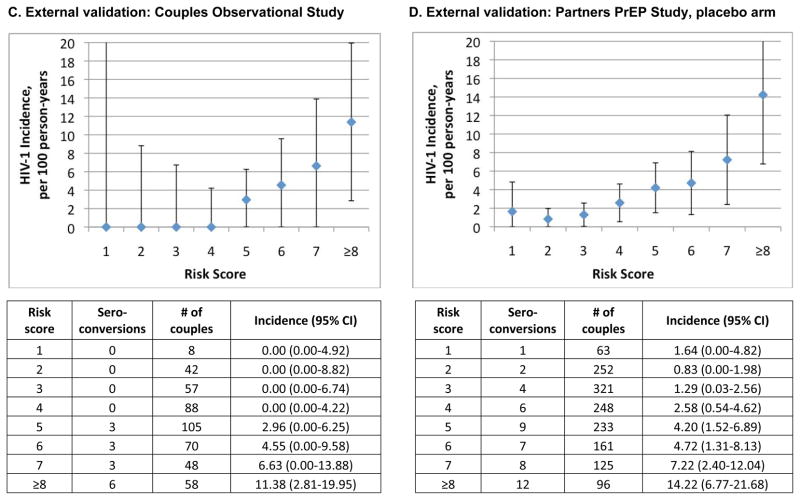
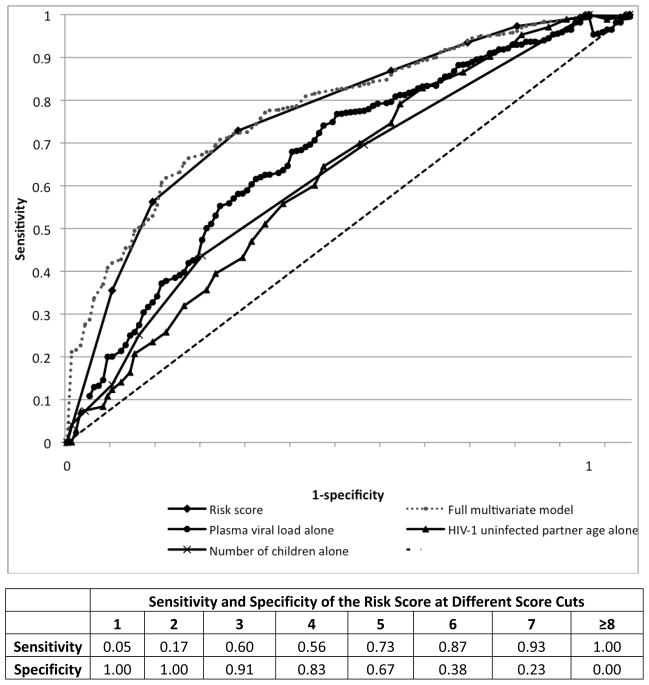
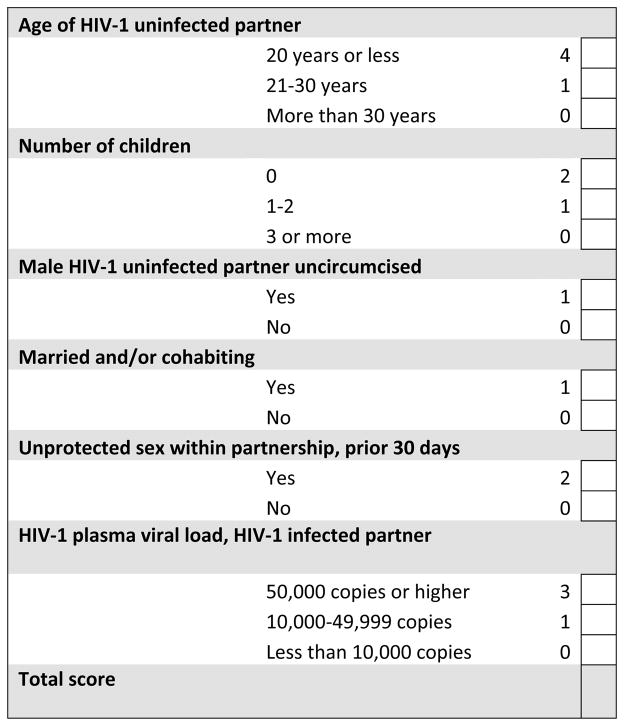
Results: The final risk score included age of the HIV-1-uninfected partner, married and/or cohabiting partnership, number of children, unprotected sex, uncircumcised male HIV-1-uninfected partner, and plasma HIV-1 RNA in the HIV-1-infected partner. The maximum risk score was 12, scores ≥5 were associated with an annual HIV-1 incidence of >3%, and couples with a score ≥6 accounted for only 28% of the population but 67% of HIV-1 transmissions. The area under the curve for predictive ability of the score was 0.74 (95% confidence interval: 0.70 to 0.78). Internal and external validation showed similar predictive ability of the risk score, even when plasma viral load was excluded from the risk score.
Conclusions: A discrete combination of clinical and behavioral characteristics defines highest risk HIV-1-serodiscordant couples. Discriminating highest risk couples for HIV-1 prevention programs and clinical trials using a validated risk score could improve research efficiency and maximize the impact of prevention strategies for reducing HIV-1 transmission.
Conflict of interest statement
Figures
References
-
- UNAIDS. AIDS epidemic update. 3 Vol. 304. Joint United Nations Programme on HIV/AIDS (UNAIDS) and World Health Organization; 2009.
-
- Dunkle KL, Stephenson R, Karita E, et al. New heterosexually transmitted HIV infections in married or cohabiting couples in urban Zambia and Rwanda: an analysis of survey and clinical data. Lancet. 2008;371(9631):2183–2191. - PubMed
-
- Liechty CA. The Evolving Role of HIV Counseling and Testing in Resource-limited Settings: HIV Prevention and Linkage to Expanding HIV Care Access. Curr Infect Dis Rep. 2005;7(2):154–158. - PubMed
-
- Grabbe KL, Bunnell R. Reframing HIV prevention in sub-Saharan Africa using couple-centered approaches. JAMA. 2010;304(3):346–347. - PubMed
Publication types
MeSH terms
Grants and funding
LinkOut - more resources
Full Text Sources
Other Literature Sources
Medical
