


Comment
doi: 10.1038/emboj.2012.320.
Epub 2012 Nov 27.
Double SET point: G9a makes its mark in adipogenesis
Affiliations
- PMID: 23188078
- PMCID: PMC3545305
- DOI: 10.1038/emboj.2012.320
Item in Clipboard
Comment
Double SET point: G9a makes its mark in adipogenesis
EMBO J.
.
Abstract
EMBO J (2013) 32 1, 45–59 doi:; DOI: 10.1038/emboj.2012.306; published online November 23 2012
Sequence-specific DNA-binding transcription factors (TFs) bind throughout the genome to orchestrate the process of adipocyte differentiation in an exquisitely timed and precise manner. TF binding recruits histone-modifying enzymes, resulting in dynamic epigenomic modifications that correlate with extensive gene expression changes. In this issue of The EMBO Journal, Wang et al (2012) demonstrate a critical role for the SET-containing histone methyltransferase G9a in generating repressive chromatin marks that are lost in the process of adipogenesis.
Conflict of interest statement
The authors declare that they have no conflict of interest.
Figures
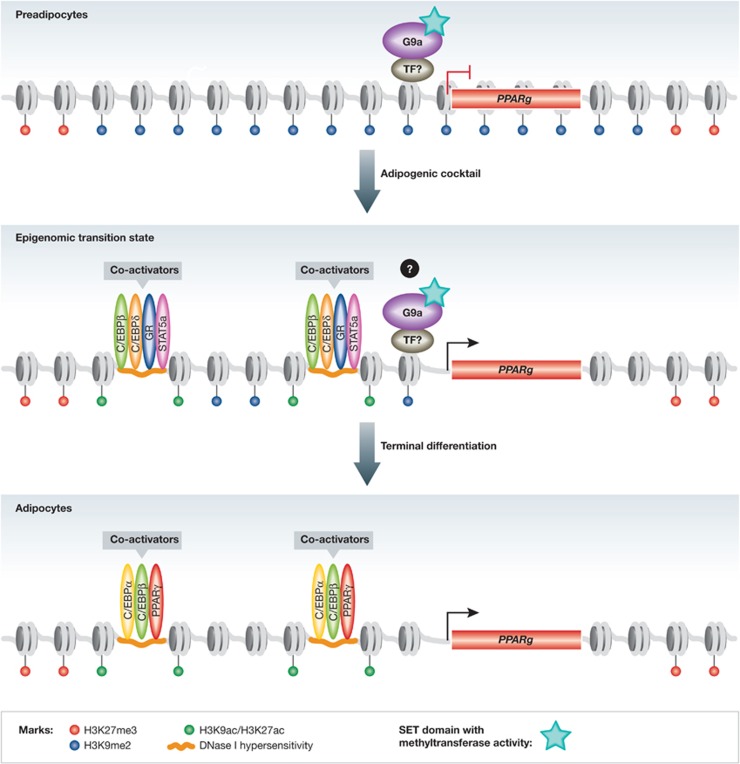
G9a represses PPARγ levels in preadipocytes. In preadipocytes, the repressive H3K27me3 mark surrounds the PPARg locus, but Wang et al have shown that H3K9me2 is a repressive mark found throughout this region. G9a, an SET domain containing histone methyltransferase, is required for the deposition of H3K9me2 at this locus. However, the sequence-specific TF(s) that localize it to the genome are unknown. During early differentiation, as G9a levels begin to decrease and H3K9me2 levels also diminish at the PPARg locus, transcriptional activators of adipogenesis (C/EBPβ, C/EBPδ, GR and STAT5a) are recruited to enhancers at hotspots of open chromatin and epigenomic change, driving the increase in PPARγ levels. The exact temporal relation of changes in H3K9me2 levels to the epigenomic transition state remains to be determined. In mature adipocytes, the major sequence-specific positive regulators of adipogenesis (PPARγ, C/EBPα and C/EBPβ) bind enhancers characterized as regions with DNAse I hypersensitivity and histone modifications of active transcription, like H3K9ac and H3K27ac, H3K9me2 is no longer present and robust PPARγ expression is sustained.
Comment on
-
Histone H3K9 methyltransferase G9a represses PPARγ expression and adipogenesis.EMBO J. 2013 Jan 9;32(1):45-59. doi: 10.1038/emboj.2012.306. Epub 2012 Nov 23. EMBO J. 2013. PMID: 23178591 Free PMC article.
References
Publication types
MeSH terms
Substances
LinkOut - more resources
Full Text Sources
Miscellaneous
