


Can resource costs of polyploidy provide an advantage to sex?
- PMID: 23188174
- PMCID: PMC3554456
- DOI: 10.1038/hdy.2012.78
Can resource costs of polyploidy provide an advantage to sex?
Abstract
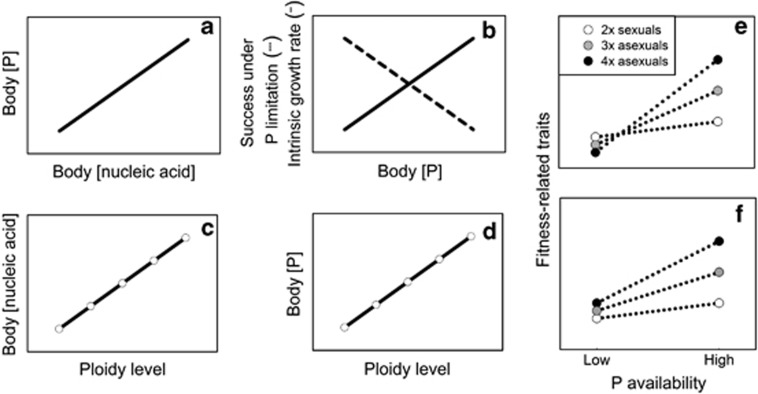
The predominance of sexual reproduction despite its costs indicates that sex provides substantial benefits, which are usually thought to derive from the direct genetic consequences of recombination and syngamy. While genetic benefits of sex are certainly important, sexual and asexual individuals, lineages, or populations may also differ in physiological and life history traits that could influence outcomes of competition between sexuals and asexuals across environmental gradients. Here, we address possible phenotypic costs of a very common correlate of asexuality, polyploidy. We suggest that polyploidy could confer resource costs related to the dietary phosphorus demands of nucleic acid production; such costs could facilitate the persistence of sex in situations where asexual taxa are of higher ploidy level and phosphorus availability limits important traits like growth and reproduction. We outline predictions regarding the distribution of diploid sexual and polyploid asexual taxa across biogeochemical gradients and provide suggestions for study systems and empirical approaches for testing elements of our hypothesis.
Figures
References
-
- Adams KL. Evolution of duplicate gene expression in polyploid and hybrid plants. J Hered. 2007;98:136–141. - PubMed
-
- Adams KL, Wendel JF. Novel patterns of gene expression in polyploid plants. Trends Genet. 2005;21:539–543. - PubMed
-
- Adolfsson S, Michalakis Y, Paczesniak D, Bode SNS, Butlin RK, Lamatsch DK, et al. Evaluation of elevated ploidy and asexual reproduction as alternative explanations for geographic parthenogenesis in Eucypris virens ostracods. Evolution. 2010;64:986–997. - PubMed
Publication types
MeSH terms
Substances
LinkOut - more resources
Full Text Sources
