. 2012 Dec;29(12):1381-91.
doi: 10.1007/s10815-012-9893-9. Epub 2012 Nov 28.

Follicular fluid hormonal profile and cumulus cell gene expression in controlled ovarian hyperstimulation with recombinant FSH: effects of recombinant LH administration

Affiliations

Follicular fluid hormonal profile and cumulus cell gene expression in controlled ovarian hyperstimulation with recombinant FSH: effects of recombinant LH administration

Marzia Barberi et al. J Assist Reprod Genet. 2012 Dec.

Abstract

Purpose: Down-regulation with gonadodropin-releasing agonist (GnRH-a) protocol during IVF stimulation leads to a severe endogenous LH suppression, which may affect the follicular development. The aim of the study was to evaluate the effects of recombinant LH (r-LH) administration, during late follicular development stages, in recombinant FSH (r-FSH) stimulated cycles on follicular fluid (FF) parameters and on cumulus cell quality.

Methods: Twenty patients undergoing IVF were stimulated in a long GnRH agonist protocol with r-FSH alone or with r-LH supplementation when the leading follicle reached diameter of 14 mm. FF was collected at the time of oocyte retrieval from 32 follicles ≥ 18 mm. Serum FSH, LH, estradiol (E(2)), and progesterone (P(4)) were evaluated on the day of hCG administration. Intra-follicular E(2), P(4), AMH and TGF-β were assayed. Total RNA from 18 individual cumuli was isolated for gene expression analyses.

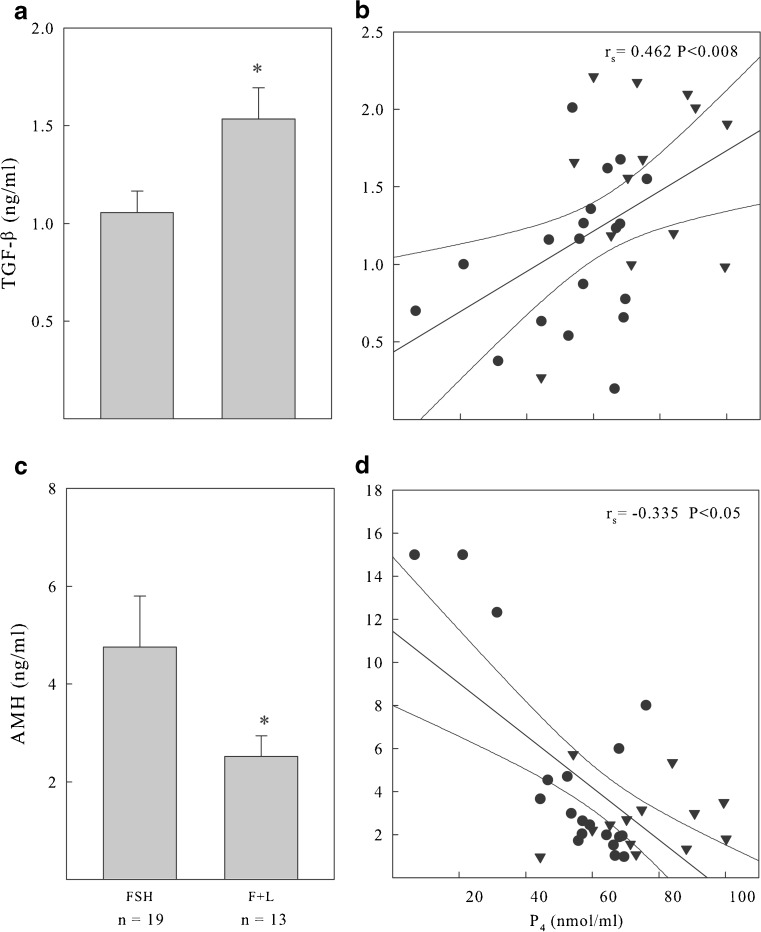
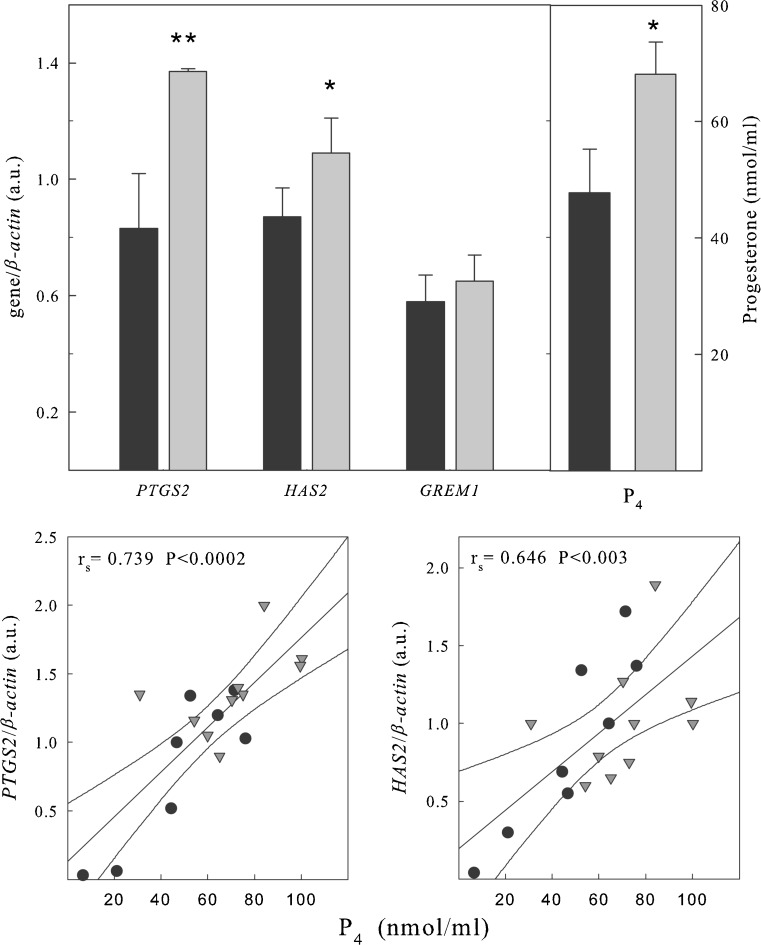
Results: R-LH increased FF P(4) levels. FF TGF-β levels and PTGS2 and HAS2 expression in cumulus cells (CCs) positively correlated with increased P(4) levels observed in FFs, while a negative correlation was found between P(4) and AMH levels.

Conclusions: FF positive correlation between P(4) and TGF-β levels and CC expression of PTGS2 and HAS2 suggest an association with a better follicle quality. In addition, our data suggest that late follicular phase r-LH supplementation leads to a more advanced stage of follicular maturation.


Figures
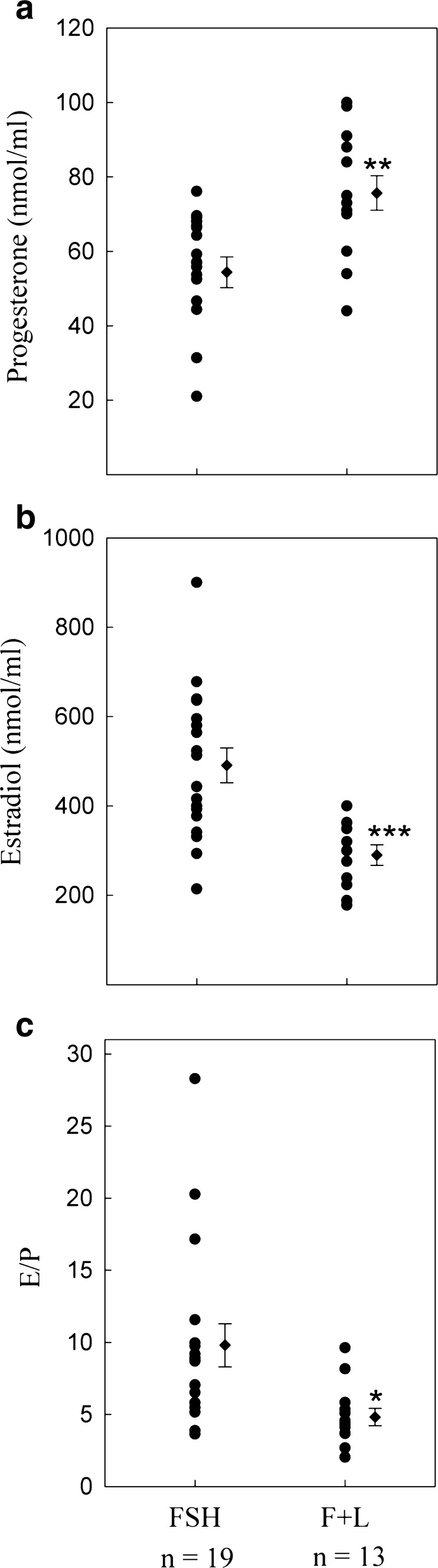
Fig. 1
Fig. 1
a Progesterone and b Estradiol levels in FFs obtained from single follicles at oocyte retrieval after stimulation with r-FSH (FSH), or r-FSH plus r-LH administered in the late follicular phase (F+L). c ratio of estradiol/progesterone (E/P). Each point represents the value obtained from a single FF. Dots on the rigth represent the mean ± S.E.M. *P < 0.05; **P < 0.01; ***P < 0.001. n = follicle numbers
Fig. 2
Fig. 2
a TGF-β and c AMH levels in FFs. FFs were collected from single follicles at oocyte retrieval after stimulation with r-FSH (FSH; n = 19), or r-FSH plus r-LH administered in the late follicular phase (F+L; n = 13). Relationships between TGF-β (b), AMH (d) and Progesterone (P4) levels in FFs. There is a positive and statistically significant relationship between TGF-β and follicular P4 levels while there is a negative and statistically significant relationship between AMH and P4. ● r-FSH ▼ r-FSH + r-LH; *P < 0.05
Fig. 3
Fig. 3
Upper panel: relative expression of PTGS2, HAS2 and GREM1 obtained by multiplex-PCR. Total RNA was extracted from CCs obtained from single follicles and subjected to multiplex RT-PCR using primers for PTGS2, HAS2 and GREM1, as well as for β-actin used as internal control. An aliquot of each PCR product was electrophoresed onto 2 % agarose gel and stained with ethidium bromide. Expression levels were quantified by densitometric evaluation of the bands with a chemiluminescence detection system (raytest) and values were normalised by their respective β-actin values and represent the mean ± S.E.M. In the right panel is represented the mean ± S.E.M. of the levels of P4 in the FFs corresponding to the CCs examined. *P < 0.05; **P < 0.01 vs. respective FSH. Lower panels: relationship between PTGS2 and HAS2 expression in CCs and the progesterone (P4) levels in the corresponding FFs. There is a positive and statistically significant relationship between PTGS2 and HAS2 and follicular P4 levels ● r-FSH (n = 8)▼ r-FSH+r-LH (n = 10)
Fig. 4
Fig. 4
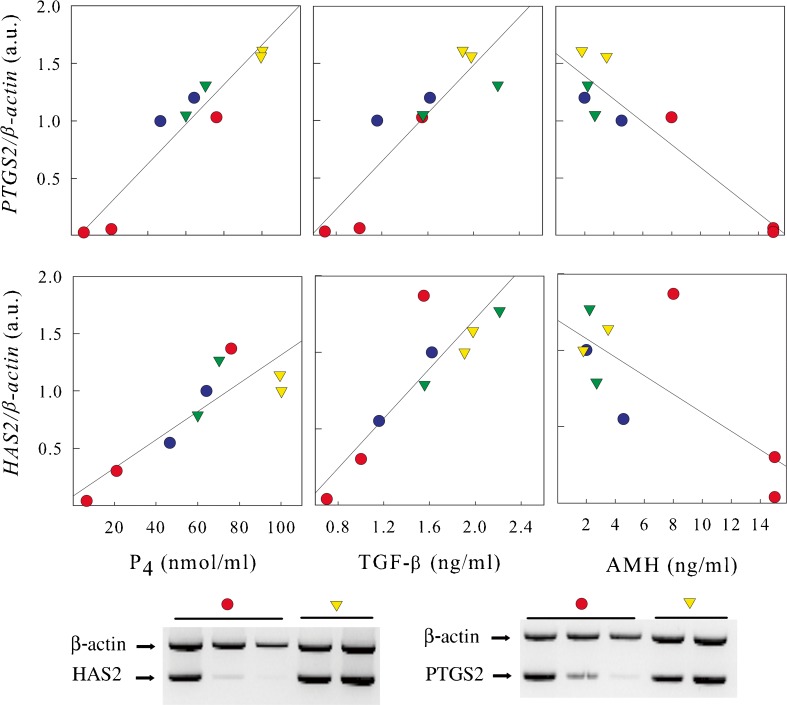
Patients with more then 1 follicle retrieved. (Upper panel) Relationship between PTGS2 and HAS2 expression in CCs and the levels of progesterone (P4), TGF-β and AMH in the corresponding FFs. Two patients (5 follicles) treated with r-FSH (●), and two patients (4 follicles) treated with r-FSH+r-LH (▼). Symbols with the same colour belong to the same patient. The same positive or negative correlation observed for the entire group was observed in CCs coming from single patients. (Lower panel) Representative images of multiplex RT-PCR from one patient of the r-FSH group (● red) and one patient of the r-FSH+r-LH group (▼ yellow)

References

    1. Abe M, Harpel JG, Metz CN, Nunes I, Loskutoff DJ, Rifkin DB. An assay for transforming growth factor-beta using cells transfected with a plasminogen activator inhibitor-1 promoter-luciferase construct. Anal Biochem. 1994;216:276–284. doi: 10.1006/abio.1994.1042. - DOI - PubMed
    1. Assou S, Haouzi D, Mahmoud K, Aouacheria A, Guillemin Y, Pantesco V, et al. A non-invasive test for assessing embryo potential by gene expression profiles of human cumulus cells: a proof of concept study. Mol Hum Reprod. 2008;14:711–719. doi: 10.1093/molehr/gan067. - DOI - PubMed
    1. Baarends WM, Uilenbroek JT, Kramer P, Hoogerbrugge JW, Leeuwen EC, Themmen AP, et al. Anti-mullerian hormone and anti-mullerian hormone type II receptor messenger ribonucleic acid expression in rat ovaries during postnatal development, the estrous cycle, and gonadotropin-induced follicle growth. Endocrinology. 1995;136:4951–4962. doi: 10.1210/en.136.11.4951. - DOI - PubMed
    1. Balasch J, Miro F, Burzaco I, Casamitjana R, Civico S, Ballesca JL, et al. The role of luteinizing hormone in human follicle development and oocyte fertility: evidence from in-vitro fertilization in a woman with long-standing hypogonadotrophic hypogonadism and using recombinant human follicle stimulating hormone. Hum Reprod. 1995;10:1678–1683. - PubMed
    1. Barrenetxea G, Agirregoikoa JA, Jimenez MR, Larruzea AL, Ganzabal T, Carbonero K. Ovarian response and pregnancy outcome in poor-responder women: a randomized controlled trial on the effect of luteinizing hormone supplementation on in vitro fertilization cycles. Fertil Steril. 2008;89:546–553. doi: 10.1016/j.fertnstert.2007.03.088. - DOI - PubMed

Publication types

MeSH terms