Motilin: towards a new understanding of the gastrointestinal neuropharmacology and therapeutic use of motilin receptor agonists
- PMID: 23189978
- PMCID: PMC3838679
- DOI: 10.1111/bph.12075
Motilin: towards a new understanding of the gastrointestinal neuropharmacology and therapeutic use of motilin receptor agonists
Abstract
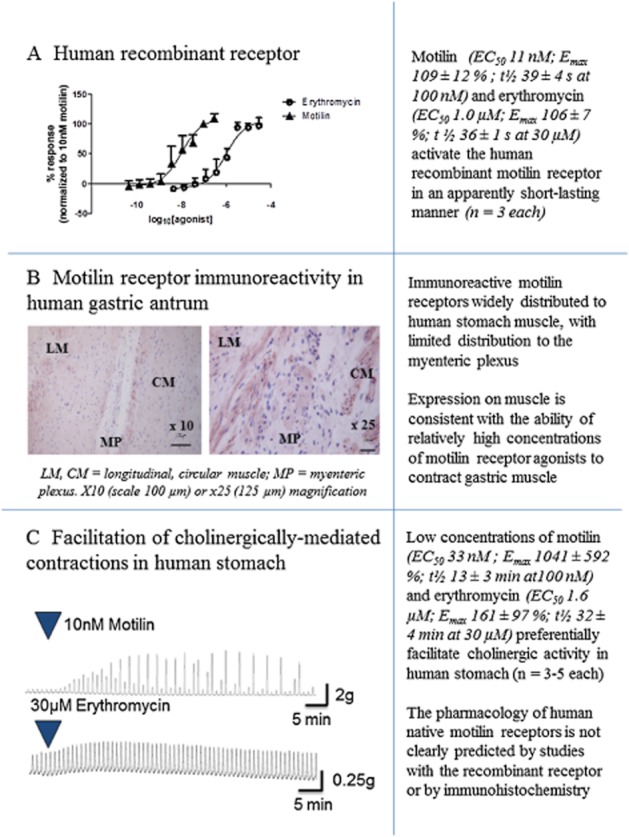
The gastrointestinal hormone motilin has been known about for >40 years, but after identification of its receptor and subsequent development of new tools and methods, a reappraisal of its actions is required. Firstly, it is important to note that motilin and ghrelin receptors are members of the same family (similar genomic organization, gastrointestinal distribution and abilities to stimulate gastrointestinal motility), yet each fails to recognize the ligand of the other; and whereas ghrelin and ghrelin receptors are widespread outside the gastrointestinal tract, motilin and its receptors are largely restricted to the gastrointestinal tract. Secondly, although some studies suggest motilin has activity in rodents, most do not, and receptor pseudogenes exist in rodents. Thirdly, motilin preferentially operates by facilitating enteric cholinergic activity rather than directly contracting the muscle, despite the relatively high expression of receptor immunoreactivity in muscle. This activity is ligand-dependent, with short-lasting actions of motilin contrasting with longer-lasting actions of the non-selective and selective motilin receptor agonists erythromycin and GSK962040. Finally, the use of erythromycin (also an antibiotic drug) to treat patients requiring acceleration of gastric emptying has led to concerns over safety and potential exacerbation of antibiotic resistance. Replacement motilin receptor agonists derived from erythromycin (motilides) have been unsuccessful. New, non-motilide, small molecule receptor agonists, designed to minimize self-desensitization, are now entering clinical trials for treating patients undergoing enteral feeding or with diabetic gastroparesis. Thus, for the translational pharmacologist, the study of motilin illustrates the need to avoid overreliance on artificial systems, on structural information and on animal studies.
Linked articles: This article is part of a themed section on Neuropeptides. To view the other articles in this section visit http://dx.doi.org/10.1111/bph.2013.170.issue-7.
Keywords: gastrointestinal; ghrelin; motilin; neuropharmacology; translational sciences.
© 2012 The Authors. British Journal of Pharmacology © 2012 The British Pharmacological Society.
Figures
References
-
- Abu-Gharbieh E, Vasina V, Poluzzi E, De Ponti F. Antibacterial macrolides: a drug class with a complex pharmacological profile. Pharmacol Res. 2004;50:211–222. - PubMed
-
- Ang DC, Nicolai H, Vos R, Berghe PV, Sifrim D, Depoortere I, et al. Gastric phase 3 is a hunger signal in the interdigestive state in man. Gastroenterology. 2008;134(4 Suppl. 1):A-314. (abstract)
-
- Ashitani J, Matsumoto N, Nakazato M. Ghrelin and its therapeutic potential for cachectic patients. Peptides. 2009;30:1951–1956. - PubMed
-
- Bailey CP, Smith FL, Kelly E, Dewey WL, Henderson G. How important is protein kinase C in mu-opioid receptor desensitization and morphine tolerance? Trends Pharmacol Sci. 2006;27:558–565. - PubMed
-
- Bassil A, Murray C, Dass NM, Muir A, Sanger GJ. Prokineticin-2, motilin, ghrelin and metoclopramide: prokinetic utility in mouse stomach and colon. Eur J Pharmacol. 2005;524:138–144. - PubMed
Publication types
MeSH terms
Substances
Grants and funding
LinkOut - more resources
Full Text Sources
Other Literature Sources
Molecular Biology Databases