


Systemic immune suppression predicts diminished Merkel cell carcinoma-specific survival independent of stage
- PMID: 23190897
- PMCID: PMC3570636
- DOI: 10.1038/jid.2012.388
Systemic immune suppression predicts diminished Merkel cell carcinoma-specific survival independent of stage
Abstract
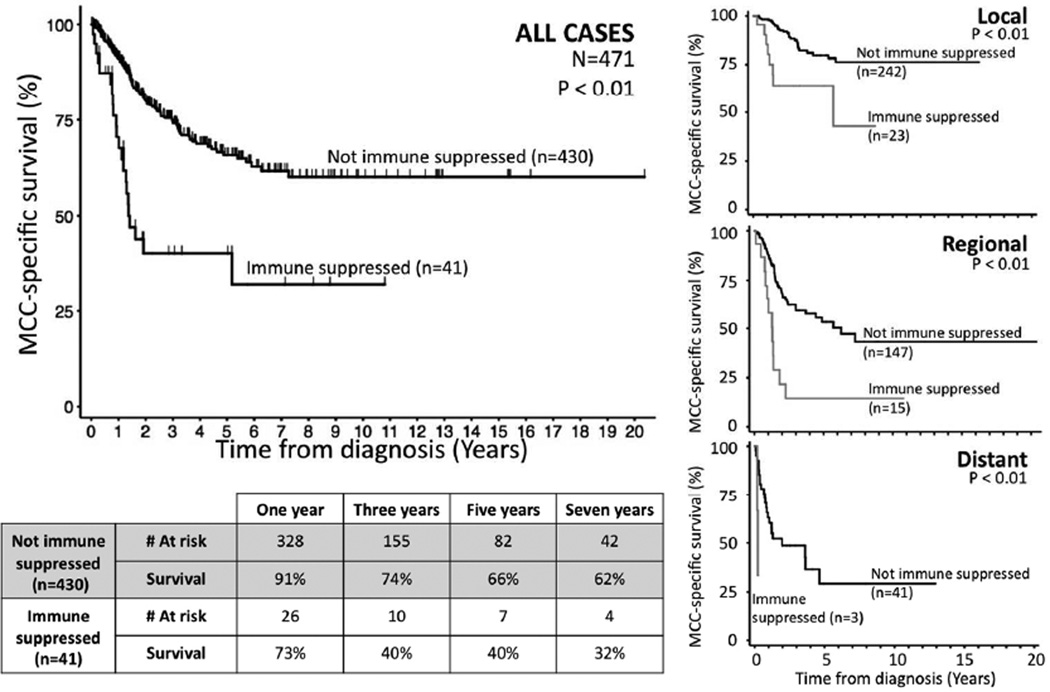
Merkel cell carcinoma (MCC) is an aggressive cutaneous malignancy linked to a contributory virus (Merkel cell polyomavirus). Multiple epidemiologic studies have established an increased incidence of MCC among persons with systemic immune suppression. Several forms of immune suppression are associated with increased MCC incidence, including hematologic malignancies, HIV/AIDS, and immunosuppressive medications for autoimmune disease or transplant. Indeed, immune-suppressed individuals represent ∼10% of MCC patients, a significant overrepresentation relative to the general population. We hypothesized that immune-suppressed patients may have a poorer MCC-specific prognosis and examined a cohort of 471 patients with a combined follow-up of 1,427 years (median 2.1 years). Immune-suppressed patients (n=41) demonstrated reduced MCC-specific survival (40% at 3 years) compared with patients with no known systemic immune suppression (n=430; 74% MCC-specific survival at 3 years). By competing risk regression analysis, immune suppression was a stage-independent predictor of worsened MCC-specific survival (hazard ratio 3.8, P<0.01). Thus, immune-suppressed individuals have both an increased chance of developing MCC and poorer MCC-specific survival. It may be appropriate to follow these higher-risk individuals more closely, and, when clinically feasible, there may be a benefit of diminishing iatrogenic systemic immune suppression.
Conflict of interest statement
Figures
References
-
- Alam M, Brown RN, Silber DH, Mullen GM, Feldman DS, Oren RM, et al. Increased incidence and mortality associated with skin cancers after cardiac transplant. Am J Transplant. 11:1488–1497. - PubMed
-
- Becker JC, Houben R, Ugurel S, Trefzer U, Pfohler C, Schrama D. MC polyomavirus is frequently present in Merkel cell carcinoma of European patients. J Invest Dermatol. 2009;129:248–250. - PubMed
-
- Brewer JD, Shanafelt TD, Otley CC, Roenigk RK, Cerhan JR, Kay NE, et al. Chronic lymphocytic leukemia is associated with decreased survival of patients with malignant melanoma and Merkel cell carcinoma in a SEER population-based study. J Clin Oncol. 2012;30:843–849. - PubMed
-
- Engels EA, Frisch M, Goedert JJ, Biggar RJ, Miller RW. Merkel cell carcinoma and HIV infection. Lancet. 2002;359:497–498. - PubMed
Publication types
MeSH terms
Grants and funding
LinkOut - more resources
Full Text Sources
Other Literature Sources
Medical
