


Custom-designed nanomaterial libraries for testing metal oxide toxicity
- PMID: 23194152
- PMCID: PMC4140534
- DOI: 10.1021/ar300032q
Custom-designed nanomaterial libraries for testing metal oxide toxicity
Abstract
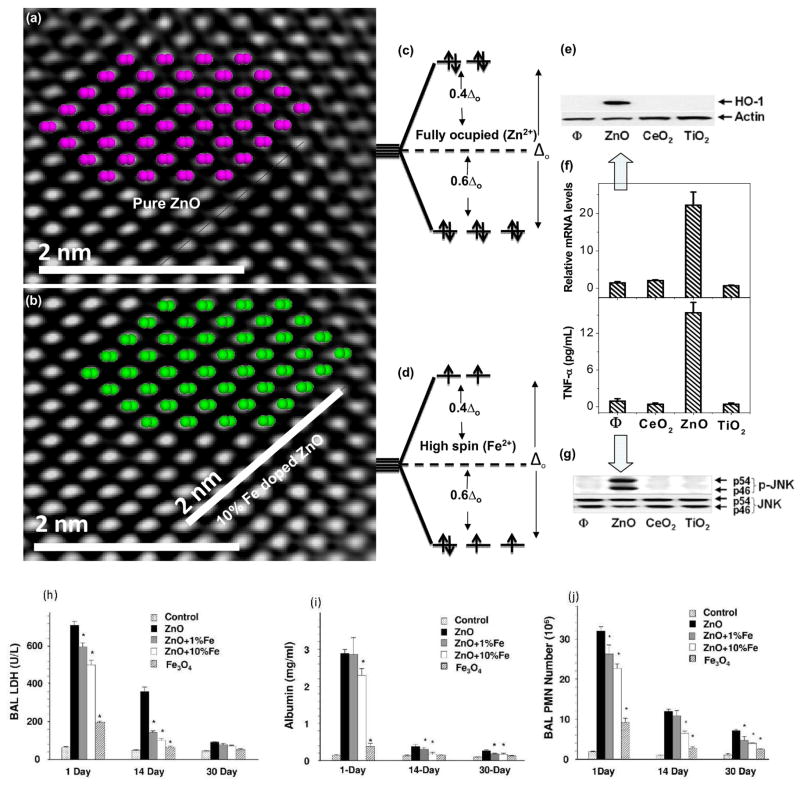
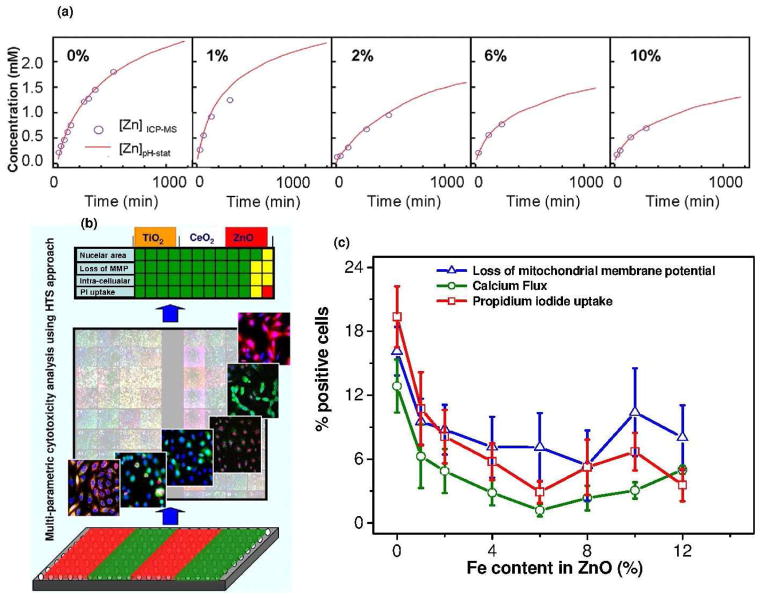
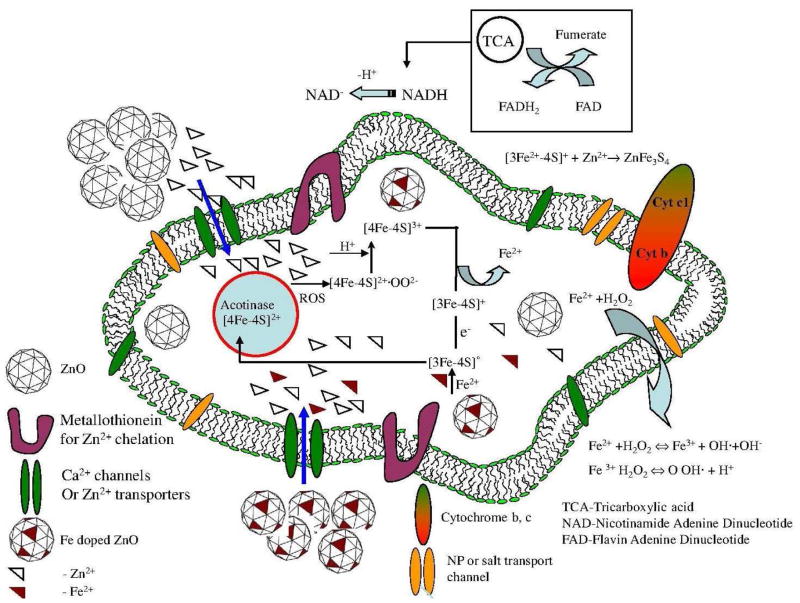
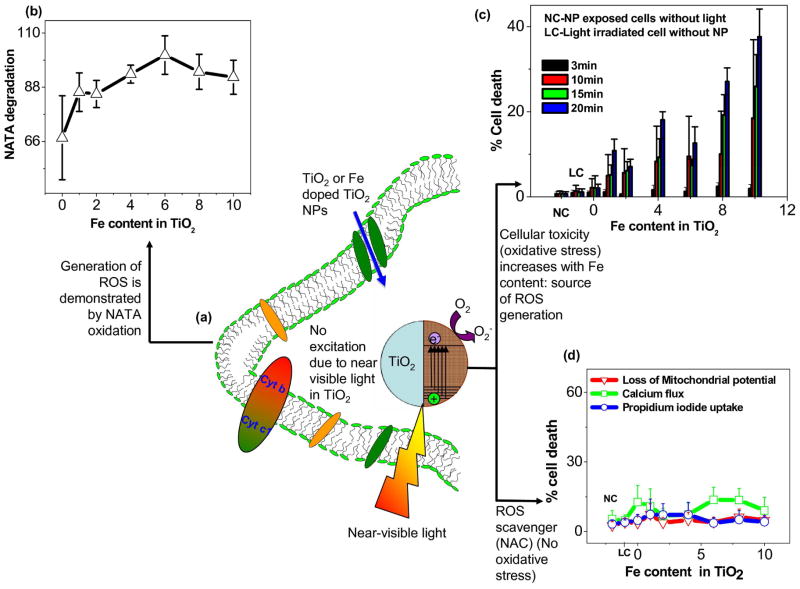
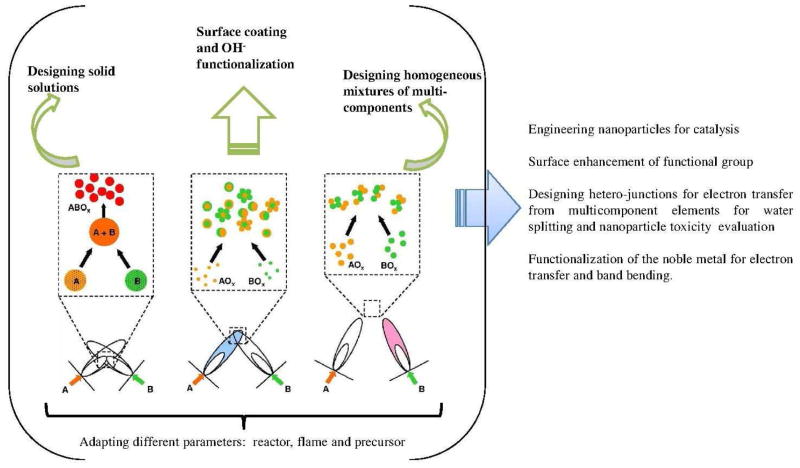
Advances in aerosol technology over the past 10 years have enabled the generation and design of ultrafine nanoscale materials for many applications. A key new method is flame spray pyrolysis (FSP), which produces particles by pyrolyzing a precursor solution in the gas phase. FSP is a highly versatile technique for fast, single-step, scalable synthesis of nanoscale materials. New innovations in particle synthesis using FSP technology, including variations in precursor chemistry, have enabled flexible, dry synthesis of loosely agglomerated, highly crystalline ultrafine powders (porosity ≥ 90%) of binary, ternary, and mixed-binary-and-ternary oxides. FSP can fulfill much of the increasing demand, especially in biological applications, for particles with specific material composition, high purity, and high crystallinity. In this Account, we describe a strategy for creating nanoparticle libraries (pure or Fedoped ZnO or TiO₂) utilizing FSP and using these libraries to test hypotheses related to the particles' toxicity. Our innovation lies in the overall integration of the knowledge we have developed in the last 5 years in (1) synthesizing nanomaterials to address specific hypotheses, (2) demonstrating the electronic properties that cause the material toxicity, (3) understanding the reaction mechanisms causing the toxicity, and (4) extracting from in vitro testing and in vivo testing in terrestrial and marine organisms the essential properties of safe nanomaterials. On the basis of this acquired knowledge, we further describe how the dissolved metal ion from these materials (Zn²⁺ in this Account) can effectively bind with different cell constituents, causing toxicity. We use Fe-S protein clusters as an example of the complex chemical reactions taking place after free metal ions migrate into the cells. As a second example, TiO₂ is an active material in the UV range that exhibits photocatalytic behavior. The induction of electron-hole (e⁻/h⁺) pairs followed by free radical production is a key mechanism for biological injury. We show that decreasing the bandgap energy increases the phototoxicity in the presence of near-visible light. We present in detail the mechanism of electron transfer in biotic and abiotic systems during light exposure. Through this example we show that FSP is a versatile technique for efficiently designing a homologous library, meaning a library based on a parent oxide doped with different amounts of dopant, and investigating the properties of the resulting compounds. Finally, we describe the future outlook and state-of-the-art of an innovative two-flame system. A double-flame reactor enables independent control over each flame, the nozzle distances and the flame angles for efficient mixing of the particle streams. In addition, it allows for different flame compositions, flame sizes, and multicomponent mixing (a grain-grain heterojunction) during the reaction process.
Figures
References
-
- Joner EJ, Hartnik T, Amundsen CE. Nanoparticles and the environment (TA-2304/2007) Bioforsk, Ås; 2007. pp. 1–64.
-
- Xia Y. Nanomaterials at work in biomedical research. Nat Mater. 2008;7(10):758–760. - PubMed
-
- Buzea C, Pacheco II, Robbie K. Nanomaterials and nanoparticles: Sources and toxicity. Biointerphases. 2007;2(4):MR17–MR71. - PubMed
-
- Niederberger M. Nonaqueous Sol-gel routes to metal oxide nanoparticles. Acc Chem Res. 2007;40(9):793–800. - PubMed
-
- Pokhrel S, Simion CE, Teodorescu VS, Barsan N, Weimar U. Synthesis, mechanism, and gas-sensing application of surfactant tailored tungsten oxide nanostructures. Adv Funct Mater. 2009;19(11):1767–1774.
Publication types
MeSH terms
Substances
Grants and funding
LinkOut - more resources
Full Text Sources
Medical
Research Materials
Miscellaneous
