. 2012 Dec 18;109(51):20975-9.
doi: 10.1073/pnas.1207715109. Epub 2012 Nov 29.

Conserved regulatory architecture underlies parallel genetic changes and convergent phenotypic evolution

Affiliations

Conserved regulatory architecture underlies parallel genetic changes and convergent phenotypic evolution

Nicolás Frankel et al. Proc Natl Acad Sci U S A. .

Abstract

Similar morphological, physiological, and behavioral features have evolved independently in different species, a pattern known as convergence. It is known that morphological convergence can occur through changes in orthologous genes. In some cases of convergence, cis-regulatory changes generate parallel modifications in the expression patterns of orthologous genes. Our understanding of how changes in cis-regulatory regions contribute to convergence is hampered, usually, by a limited understanding of the global cis-regulatory structure of the evolving genes. Here we examine the genetic causes of a case of precise phenotypic convergence between Drosophila sechellia and Drosophila ezoana, species that diverged ~40 Mya. Previous studies revealed that changes in multiple transcriptional enhancers of shavenbaby (svb, a transcript of the ovo locus) caused phenotypic evolution in the D. sechellia lineage. It has also been shown that the convergent phenotype of D. ezoana was likely caused by cis-regulatory evolution of svb. Here we show that the large-scale cis-regulatory architecture of svb is conserved between these Drosophila species. Furthermore, we show that the D. ezoana orthologs of the evolved D. sechellia enhancers have also evolved expression patterns that correlate precisely with the changes in the phenotype. Our results suggest that phenotypic convergence resulted from multiple noncoding changes that occurred in parallel in the D. sechellia and D. ezoana lineages.


Conflict of interest statement

The authors declare no conflict of interest.

Figures
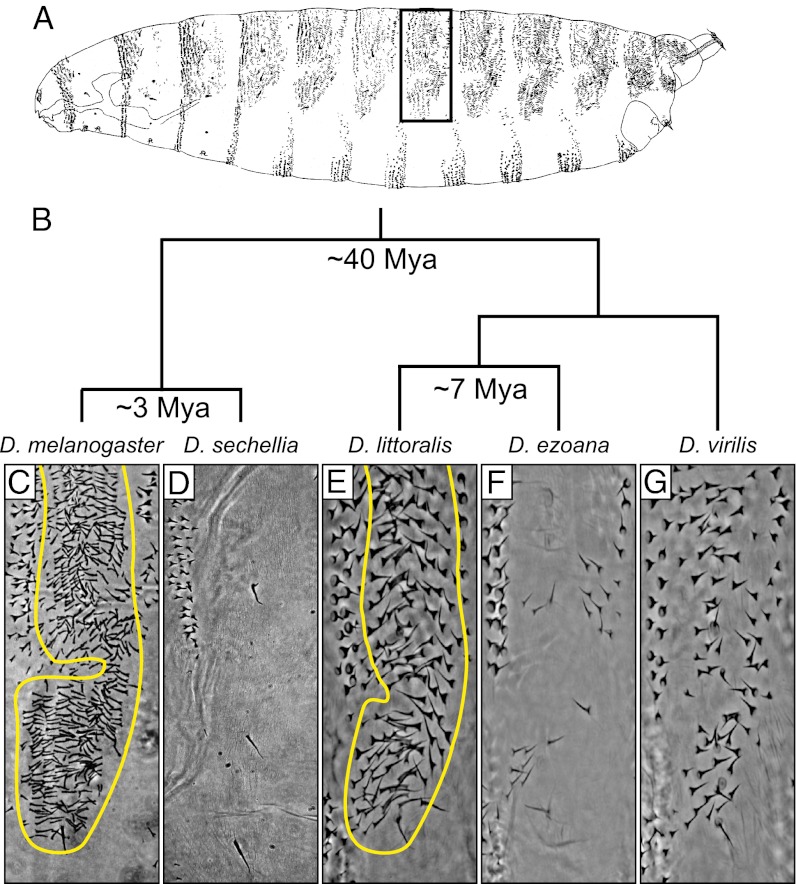
Fig. 1.
Fig. 1.
Convergent evolution of a naked dorso-lateral cuticle phenotype in first-instar larvae of D. sechellia and D. ezoana. (A) Drawing from the lateral perspective of a D. melanogaster first-instar larva. The dark rectangle indicates the cuticle region shown in C–G. (B) Phylogenetic relationships and estimated divergence dates between species discussed in this article. Dorso-lateral cuticle of the fourth abdominal segment for five Drosophila species. The “hairy” phenotype present in D. melanogaster (C), D. littoralis (E), and D. virilis (G) is the ancestral state in the genus Drosophila. Quaternary trichomes are outlined in D. melanogaster (C) and D. littoralis (E). Quaternary trichomes were lost independently in D. sechellia (D) and D. ezoana (F).
Fig. 2.
Fig. 2.
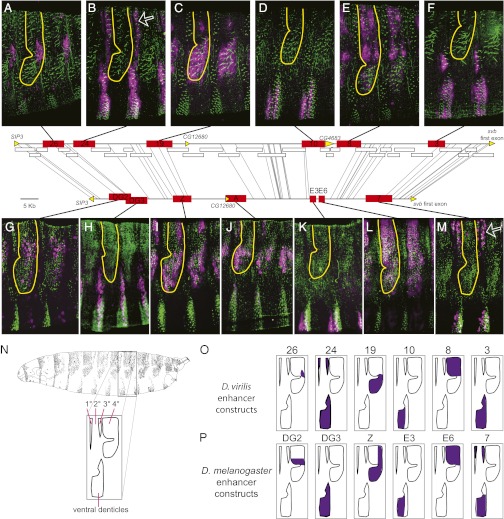
Positional and functional conservation between svb embryonic enhancers of D. melanogaster and D. virilis. Horizontal lines schematize the svb cis-regulatory region in D. virilis (Upper) and D. melanogaster (Lower). Thin lines connect identical 30 bp sequences (“anchors”) between the orthologous regions. The fact that none of these lines cross implies that the orthologous svb regions are largely collinear. White rectangles correspond to D. virilis DNA fragments tested for enhancer activity in transgenic D. virilis embryos that did not drive expression in embryonic epidermis. Yellow arrows specify coding regions. Red rectangles indicate the position of embryonic enhancers for the two species. Positional conservation is evident for six enhancer pairs. Expression patterns of D. virilis enhancers (A–F) and of D. melanogaster enhancers (G–M) are shown. Quaternary trichomes are outlined in all panels. Similar expression patterns are driven by the orthologous enhancers 26 (A) and DG2 (G), 24 (B) and DG3 (H), 19 (C) and Z (I), 10 (D) and E3 (K), 8 (E) and E6 (L), and 3 (F) and 7 (M). White arrows highlight the dorsal expression pattern encoded by different enhancers in the two species. Pictures were taken from stage 15–16 embryos. Trichomes are stained in green; lacZ reporter expression is purple. Different embryos display slightly different rotations along the dorso-ventral axis. (N) Drawing of a lateral view of the D. melanogaster first-instar larval cuticle and, below, a diagram of the major cuticular domains is shown. On the dorsal surface, the primary (1°), tertiary (3°), and quaternary (4°) cells differentiate trichomes, and the secondary (2°) cells differentiate naked cuticle (38). The ventral denticle belts are also labeled. (O) The epidermal domains in which the six D. virilis enhancers drive expression is illustrated with purple shading. (P) The epidermal domains in which the six D. melanogaster enhancers that appear to be orthologous to the six D. virilis enhancers, based on shared chromosomal synteny and sequence similarity are illustrated with purple shading. The expression patterns of the D. virilis enhancers are placed directly above the expression patterns of their putative orthologs in D. melanogaster.
Fig. 3.
Fig. 3.
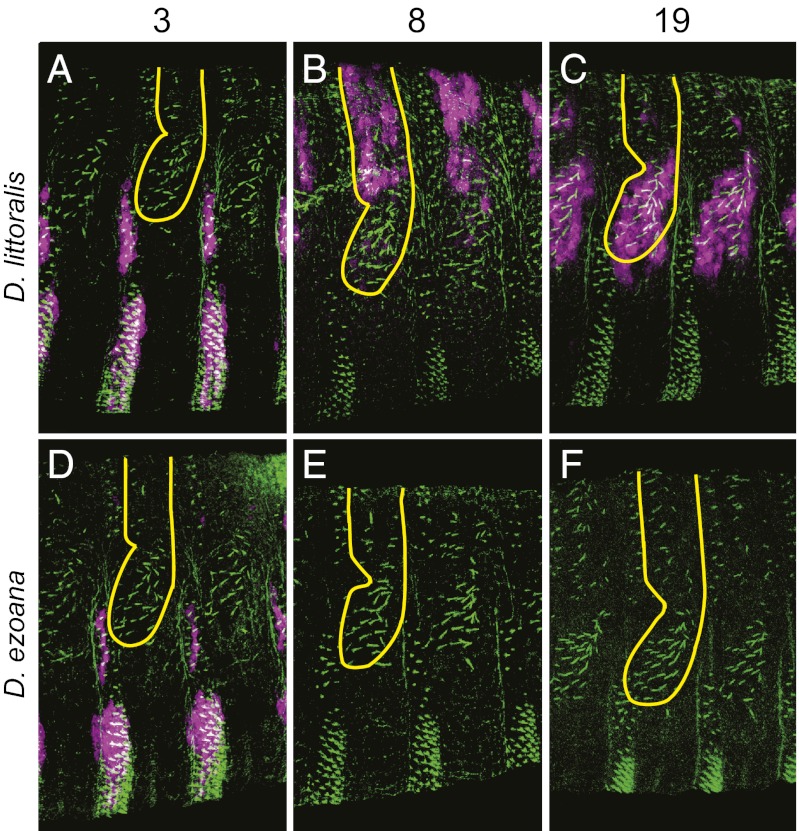
Cis-regulatory changes in evolutionarily conserved svb enhancers underlie the convergent loss of quaternary trichomes in D. ezoana. D. littoralis enhancers 3 (A), 8 (B), and 19 (C) drive expression patterns that cannot be distinguished from those produced by the D. virilis orthologous enhancers (Fig. 2). (D) The expression pattern of the D. ezoana enhancer 3 also is conserved. In contrast, D. ezoana enhancers 8 (E) and 19 (F) do not produce detectable expression. This explains, at least in part, the absence of quaternary trichomes in D. ezoana. In D. sechellia, the parallel inactivation of E6 and Z (the orthologs of D. virilis 8 and 19) likely caused the convergent loss of quaternary trichomes. The activity of all D. ezoana and D. littoralis constructs were tested in transgenic D. virilis embryos. Differences in the activity of these enhancers therefore represent differences in the enhancer sequences from each species. Colors and symbols as in Fig. 2.

References

    1. Wood TE, Burke JM, Rieseberg LH. Parallel genotypic adaptation: When evolution repeats itself. Genetica. 2005;123(1-2):157–170. - PMC - PubMed
    1. Wlasiuk G, Khan S, Switzer WM, Nachman MW. A history of recurrent positive selection at the toll-like receptor 5 in primates. Mol Biol Evol. 2009;26(4):937–949. - PMC - PubMed
    1. Streisfeld MA, Rausher MD. Genetic changes contributing to the parallel evolution of red floral pigmentation among Ipomoea species. New Phytol. 2009;183(3):751–763. - PubMed
    1. Chan YF, et al. Adaptive evolution of pelvic reduction in sticklebacks by recurrent deletion of a Pitx1 enhancer. Science. 2010;327(5963):302–305. - PMC - PubMed
    1. Shapiro MD, Bell MA, Kingsley DM. Parallel genetic origins of pelvic reduction in vertebrates. Proc Natl Acad Sci USA. 2006;103(37):13753–13758. - PMC - PubMed

Publication types

LinkOut - more resources