


Effectiveness of using group visit model to support diabetes patient self-management in rural communities of Shanghai: a randomized controlled trial
- PMID: 23198694
- PMCID: PMC3533983
- DOI: 10.1186/1471-2458-12-1043
Effectiveness of using group visit model to support diabetes patient self-management in rural communities of Shanghai: a randomized controlled trial
Abstract
Background: Diabetes has become a major public health problem in China. Support of patient self-management is a key component of effective diabetes care and improved patient outcomes. A series of peer-led community-based disease-specific self-management programs including diabetes have been widely disseminated in urban communities of Shanghai since 1999. However, the strategy of using trained lay leaders to support patient self-management faces challenges in rural communities in Shanghai. This study developed a Chinese diabetes group visit program as an alternative approach to support patient self-management and examined its effectiveness on self-management behaviors, self-efficacy and health status for patients with type 2 diabetes in rural communities of Shanghai.
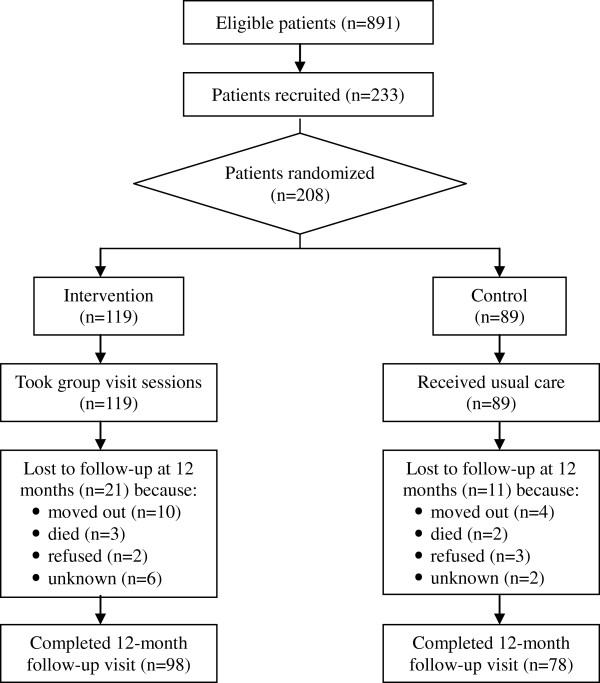
Methods: 208 patients with type 2 diabetes aged 35-80 years were randomly assigned to the intervention group (n=119) of 12 monthly group visit sessions or to a control group (n=89) of usual care. The trial was undertaken in two rural communities in Shanghai, China. Randomization and allocation to study group were carried out by using a random number table. Analysis of covariance was used to compare changes in the 17 self-management behavior, self-efficacy and health status related variables in two groups at 12 months' follow-up based on 176 patients (n=98; n=78).
Results: Compared with controls, the intervention patients, on average, increased their duration of aerobic exercise by more than 40 minutes per week (p=0.001); had significant increase of 0.71 in mean score on self-efficacy to manage diabetes (p=0.02); and had significant improvements in measures of illness intrusiveness and systolic blood pressure. The intervention patients attended an average of 10.1 of the 12 program sessions with 75.6% of them attended 10 and more sessions.
Conclusion: The Chinese diabetes group visit model is a feasible, acceptable and effective alternative for supporting diabetes patient self-management in Chinese rural communities. The model requires larger studies to determine its effect on blood glucose control and health care utilization.
Trial registration: ISRCTN87909028.
References
-
- Yang W, Lu J, Weng J, Jia W, Ji L, Xiao J, Shan Z, Liu J, Tian H, Ji Q, Zhu D, Ge J, Lin L, Chen L, Guo X, Zhao Z, Li Q, Zhou Z, Shan G, He J. for the China National Diabetes and Metabolic Disorders Study Group. Prevalence of diabetes among men and women in China. N Engl J Med. 2010;362:1090–1101. doi: 10.1056/NEJMoa0908292. - DOI - PubMed
-
- Coleman MT, Newton KS. Supporting self-management in patients with chronic illness. Am Fam Physician. 2005;72:1503–1510. - PubMed
-
- Norris SL, Nichols PJ, Caspersen CJ, Glasgow RE, Engelgau MM, Jack L, Snyder SR, Carande-Kulis VG, Isham G, Garfield S, Briss P, McCulloch D. Increasing diabetes self-management education in community settings. A systematic review. Am J Prev Med. 2002;22:39–66. doi: 10.1016/S0749-3797(02)00424-5. - DOI - PubMed
Publication types
MeSH terms
LinkOut - more resources
Full Text Sources
Medical
