. 2011 Mar;2(1):75-81.
doi: 10.1007/s13167-011-0074-1. Epub 2011 Apr 2.

Associations of impaired glucose metabolism and dyslipidemia with cardiovascular diseases: what have we learned from Japanese cohort studies for individualized prevention and treatment?

Affiliations

Associations of impaired glucose metabolism and dyslipidemia with cardiovascular diseases: what have we learned from Japanese cohort studies for individualized prevention and treatment?

Yoshihiro Kokubo. EPMA J. 2011 Mar.

Abstract

Metabolic disorder is a modifiable risk factor for cardiovascular diseases (CVD), and lifestyle modification is the key to improving metabolic disorder. Diabetes mellitus has been shown to be a risk factor for coronary heart disease (CHD) and ischemic stroke in both Western and Japanese populations. An association between impaired fasting glucose and pre-hypertension found in an urban Japanese population emphasized the combined risk of CVD. Mean total cholesterol levels in Japan have been increasing in the last three decades. The Japanese evidence for the positive association of total cholesterol with CHD is similar to that in the West. Higher low-density lipoprotein cholesterol (LDL-C) levels pose an increased risk of CHD and atherothrombotic infarction, whereas lower LDL-C levels may pose an increased risk of intracerebral hemorrhage in Japan. Overall, the studies reviewed here show that impaired glucose metabolism and dyslipidemia are emerging risk factors for CVD in the Japanese population.


Figures
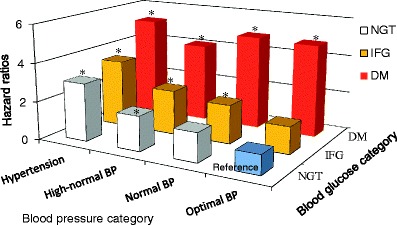
Fig. 1
Fig. 1
Multivariable-adjusted hazard ratios of cardiovascular diseases according to the combination of blood pressure and glucose categories. Multivariable-adjusted hazard ratios were adjusting for age, sex, body mass index, smoking, drinking, and hyperlipidemia. BP blood pressure; NGT normal glycemic tolerance; IFG impaired fasting glucose; DM diabetes mellitus; *: P < 0.05 (compared with the optimal blood pressure and normoglycemic group)

References

    1. Eckel RH, Grundy SM, Zimmet PZ. The metabolic syndrome. Lancet. 2005;365:1415–1428. doi: 10.1016/S0140-6736(05)66378-7. - DOI - PubMed
    1. Kokubo Y, Okamura T, Watanabe M, et al. The combined impact of blood pressure category and glucose abnormality on the incidence of cardiovascular diseases in a Japanese urban cohort: the Suita Study. Hypertens Res. 2010;33:1238–1243. doi: 10.1038/hr.2010.174. - DOI - PubMed
    1. Furukawa Y, Kokubo Y, Okamura T, et al. The relationship between waist circumference and the risk of stroke and myocardial infarction in a Japanese urban cohort: the Suita study. Stroke. 2010;41:550–553. doi: 10.1161/STROKEAHA.109.569145. - DOI - PubMed
    1. Doi Y, Ninomiya T, Hata J, et al. Proposed criteria for metabolic syndrome in Japanese based on prospective evidence: the Hisayama study. Stroke. 2009;40:1187–1194. doi: 10.1161/STROKEAHA.108.531319. - DOI - PubMed
    1. Executive Summary of the Third Report of the National Cholesterol Education Program (NCEP) Expert panel on detection, evaluation, and treatment of high blood cholesterol in adults (Adult Treatment Panel III) JAMA. 2001;285:2486–2497. doi: 10.1001/jama.285.19.2486. - DOI - PubMed

LinkOut - more resources
