


Review
doi: 10.1186/1479-7364-6-26.
The human crystallin gene families
Affiliations
- PMID: 23199295
- PMCID: PMC3554465
- DOI: 10.1186/1479-7364-6-26
Item in Clipboard
Review
The human crystallin gene families
Hum Genomics.
.
Abstract
Crystallins are the abundant, long-lived proteins of the eye lens. The major human crystallins belong to two different superfamilies: the small heat-shock proteins (α-crystallins) and the βγ-crystallins. During evolution, other proteins have sometimes been recruited as crystallins to modify the properties of the lens. In the developing human lens, the enzyme betaine-homocysteine methyltransferase serves such a role. Evolutionary modification has also resulted in loss of expression of some human crystallin genes or of specific splice forms. Crystallin organization is essential for lens transparency and mutations; even minor changes to surface residues can cause cataract and loss of vision.
Figures

Exon/intron structure of mammalian genes for α-, β- and γ-crystallins. Exons are shown as boxes with ORF in thicker boxes. CRYB genes coding for β-crystallins vary in 5′-exon structure. The exons encoding the four structural motifs of the β-crystallin and γ-crystallin proteins are indicated by 1, 2, 3, and 4. Some mammals have an alternatively spliced exon in the first intron of CRYAA, but in humans this is a pseudoexon.

Phylogenetic tree of the human sHSP gene family. Sequences were extracted from the UCSC web browser. Translated ORFs were aligned and neighbor-joining trees were constructed using MEGA4 [15].
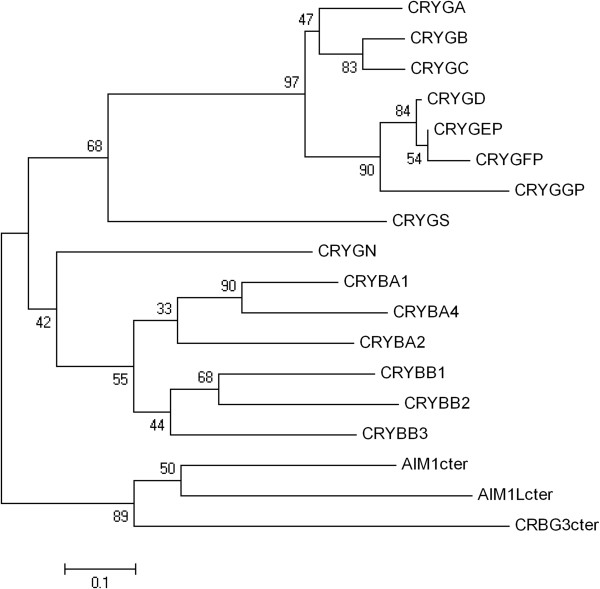
Phylogenetic tree of the humanβγ-crystallin gene superfamily. Sequences were extracted from the UCSC web browser. Translated ORFs were aligned and neighbor-joining trees were constructed as in Figure 2. AIM1, AIML, and CRYBG3 contain internal repeats corresponding to three β-crystallin-like genes in addition to regions not related to crystallin genes. For simplicity, the third, most highly conserved crystallin repeat from each gene was used for this alignment (designated AIM1cter, etc.).

Clustering of crystallin genes. Gaps, indicated by approximate sizes, contain non-crystallin genes. Gene orientations are indicated with arrows (dotted for pseudogenes).
References
-
- Wistow G, Slingsby C. Structure and evolution of crystallins. The Encyclopedia of the Eye. 2010;2:229–238.
-
- Harding JJ, Crabbe MJC. The lens: development, proteins, metabolism and cataract. Eye. 1984;1B:207–492.
Publication types
MeSH terms
Substances
LinkOut - more resources
Full Text Sources
Research Materials
