


Individual patient data meta-analysis shows no association between the SNP rs1800469 in TGFB and late radiotherapy toxicity
- PMID: 23199655
- PMCID: PMC3593101
- DOI: 10.1016/j.radonc.2012.10.017
Individual patient data meta-analysis shows no association between the SNP rs1800469 in TGFB and late radiotherapy toxicity
Abstract
Background and purpose: Reported associations between risk of radiation-induced normal tissue injury and single nucleotide polymorphisms (SNPs) in TGFB1, encoding the pro-fibrotic cytokine transforming growth factor-beta 1 (TGF-β1), remain controversial. To overcome publication bias, the international Radiogenomics Consortium collected and analysed individual patient level data from both published and unpublished studies.
Materials and methods: TGFB1 SNP rs1800469 c.-1347T>C (previously known as C-509T) genotype, treatment-related data, and clinically-assessed fibrosis (measured at least 2years after therapy) were available in 2782 participants from 11 cohorts. All received adjuvant breast radiotherapy. Associations between late fibrosis or overall toxicity, reported by STAT (Standardised Total Average Toxicity) score, and rs1800469 genotype were assessed.
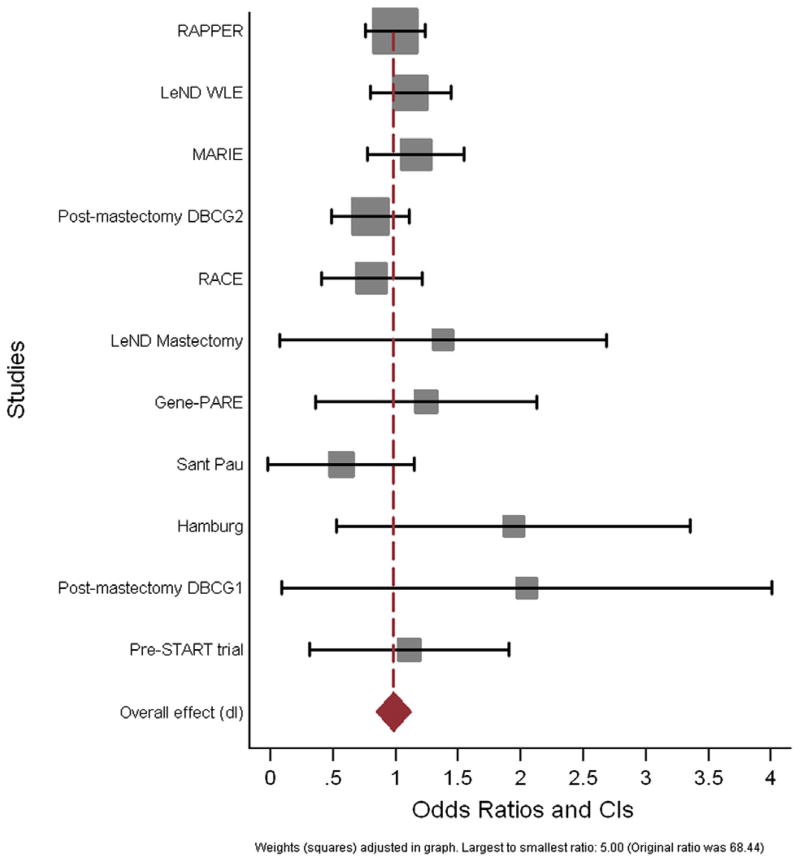
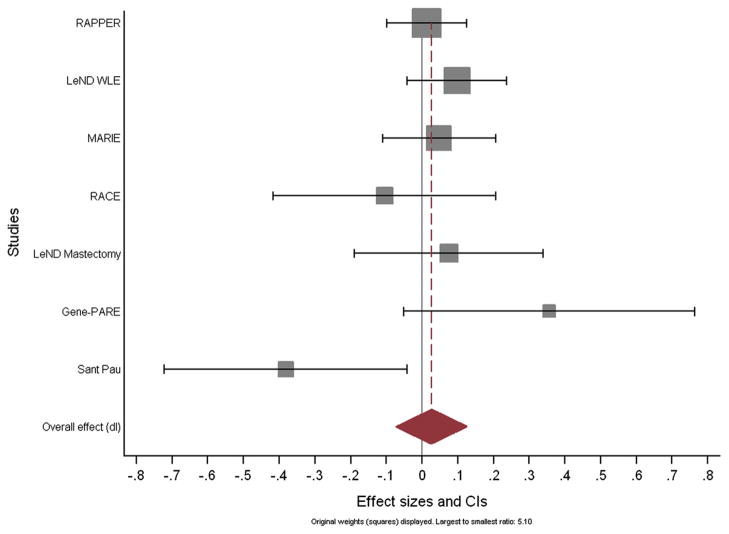
Results: No statistically significant associations between either fibrosis or overall toxicity and rs1800469 genotype were observed with univariate or multivariate regression analysis. The multivariate odds ratio (OR), obtained from meta-analysis, for an increase in late fibrosis grade with each additional rare allele of rs1800469 was 0.98 (95% Confidence Interval (CI) 0.85-1.11). This CI is sufficiently narrow to rule out any clinically relevant effect on toxicity risk in carriers vs. non-carriers with a high probability.
Conclusion: This meta-analysis has not confirmed previous reports of association between fibrosis or overall toxicity and rs1800469 genotype in breast cancer patients. It has demonstrated successful collaboration within the Radiogenomics Consortium.
Copyright © 2012 Elsevier Ireland Ltd. All rights reserved.
Conflict of interest statement
None declared.
Figures
References
-
- Alsner J, Andreassen CN, Overgaard J. Genetic markers for prediction of normal tissue toxicity after radiotherapy. Semin Radiat Oncol. 2008;18:126–35. - PubMed
-
- Andreassen CN. Searching for genetic determinants of normal tissue radiosensitivity – are we on the right track? Radiother Oncol. 2010;97:1–8. - PubMed
-
- Bentzen SM. Preventing or reducing late side effects of radiation therapy: radiobiology meets molecular pathology. Nat Rev Cancer. 2006;6:702–13. - PubMed
Publication types
MeSH terms
Substances
Grants and funding
LinkOut - more resources
Full Text Sources
Other Literature Sources
Medical
Miscellaneous
