. 2012 Nov 19;4(11):3209-26.
doi: 10.3390/v4113209.

Virus pathogen database and analysis resource (ViPR): a comprehensive bioinformatics database and analysis resource for the coronavirus research community

Affiliations

Virus pathogen database and analysis resource (ViPR): a comprehensive bioinformatics database and analysis resource for the coronavirus research community

Brett E Pickett et al. Viruses. .

Abstract

Several viruses within the Coronaviridae family have been categorized as either emerging or re-emerging human pathogens, with Severe Acute Respiratory Syndrome Coronavirus (SARS-CoV) being the most well known. The NIAID-sponsored Virus Pathogen Database and Analysis Resource (ViPR, www.viprbrc.org) supports bioinformatics workflows for a broad range of human virus pathogens and other related viruses, including the entire Coronaviridae family. ViPR provides access to sequence records, gene and protein annotations, immune epitopes, 3D structures, host factor data, and other data types through an intuitive web-based search interface. Records returned from these queries can then be subjected to web-based analyses including: multiple sequence alignment, phylogenetic inference, sequence variation determination, BLAST comparison, and metadata-driven comparative genomics statistical analysis. Additional tools exist to display multiple sequence alignments, view phylogenetic trees, visualize 3D protein structures, transfer existing reference genome annotations to new genomes, and store or share results from any search or analysis within personal private 'Workbench' spaces for future access. All of the data and integrated analysis and visualization tools in ViPR are made available without charge as a service to the Coronaviridae research community to facilitate the research and development of diagnostics, prophylactics, vaccines and therapeutics against these human pathogens.


Figures

Figure 1
Figure 1
Virus Pathogen Database and Analysis Resource (ViPR) Homepage. ViPR serves as a gateway to search for information compiled from multiple sources, perform bioinformatics analyses, visualize data, and save results within the Workbench feature for the 14 virus families supported in the system, including Coronaviridae.
Figure 2
Figure 2
Strain and Genome Information in ViPR. The relevant strain- and genome-level annotations for the SARS-CoV Tor2 strain are parsed from the corresponding GenBank file and organized into intuitive categories for display on the ViPR Strain Details page. (a) Strain-level information includes strain name, virus taxonomy and host, country, and date of specimen isolation. (b) Information at the genome level comprises publication information, GenBank accession number, sequence length, nucleotide sequence of the genome, number of annotated proteins, and molecule type. (c) Annotated gene symbols, protein product names, Entrez ID and locus name for each gene in the genome are similarly parsed from the GenBank record and displayed in a tabular format.
Figure 3
Figure 3
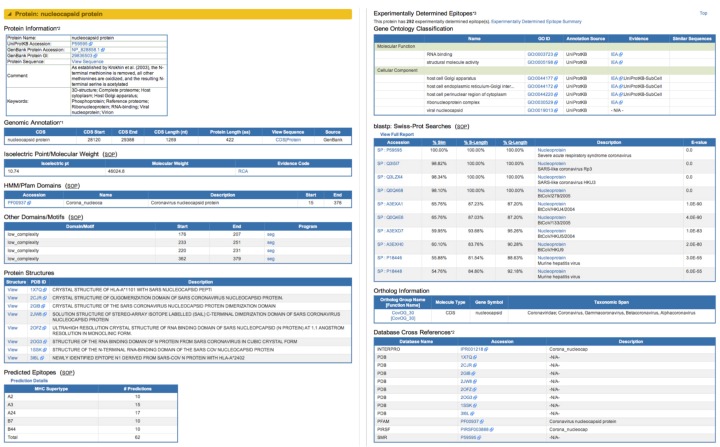
Gene and Protein Information in ViPR. The Gene/Protein Details page combines annotations at the gene and protein levels and presents them in a single comprehensive page in ViPR according to the source of the information. The information associated with the nucleocapsid protein from the SARS-CoV Tor2 strain is shown, including information such as UniProtKB and GenBank protein accession numbers, the corresponding protein sequence, genomic location, isoelectric point, molecular weight, Pfam (and other) domains, relevant 3D protein structures, predicted epitopes, experimentally-determined epitopes, Gene Ontology classification, results from BLASTp searches, and ortholog information, which are derived from UniProt, GenBank, InterProScan algorithm¬¬, PDB, NetCTL algorithm, Immune Epitope Database, Gene Ontology Consortium, BLAST, and the OrthoMCL algorithm, respectively.
Figure 4
Figure 4
Scientific Use Case Comparing Human and Civet SARS-CoV Isolates. The results that were obtained from the various analytical and visualization tools provided in ViPR and explored in the scientific use case are shown. (a) A portion of a multiple sequence alignment of strains isolated from 2003 through 2004, from either humans (white labels) or civets (gray labels), including a column found to significantly differ between the specified groups based on meta-CATS analysis. (b) A Maximum Likelihood phylogenetic tree color-coded by host of isolation. Horizontal branch lengths are proportional to distance (the proportion of nucleotide changes). The distance scale for the proportion of changes is provided at the bottom of the panel. Strains belonging to the “civet-predominate” (CP) or “human-predominate” (HP) clades are delineated with blue braces. (c) An abridged table of the meta-CATS output containing significant positions, raw chi-square values, C-values (roughly equivalent to p-values), chi-square degrees of freedom and residue diversity for a subset of significant positions identified across the genome. (d) A 3D homodimeric protein structure of the SARS-CoV Spike protein showing secondary structure in cartoon and positions 479 and 487 (highlighted in blue on one of the monomeric chains), which were identified as significantly differing between hosts at the nucleotide level by meta-CATS.

References

    1. CDC From the centers for disease control and prevention. Outbreak of west nile-like viral encephalitis--new york, 1999. MMWR Morb. Mortal. Wkly. Rep. 1999;48:845–849. - PubMed
    1. Trifonov V., Khiabanian H., Rabadan R. Geographic dependence, surveillance, and origins of the 2009 influenza a (h1n1) virus. N. Engl. J. Med. 2009;361:115–119. doi: 10.1056/NEJMp0904572. - DOI - PubMed
    1. Ha D.Q., Tien N.T., Huong V.T., Loan H.T., Thang C.M. Dengue epidemic in southern vietnam, 1998. Emerg. Infect. Dis. 2000;6:422–425. - PMC - PubMed
    1. CDC From the centers for disease control and prevention. Severe acute respiratory syndrome--taiwan, 2003. Jama. 2003;289:2930–2932. doi: 10.1001/jama.289.22.2930. - DOI - PubMed
    1. Skowronski D.M., Astell C., Brunham R.C., Low D.E., Petric M., Roper R.L., Talbot P.J., Tam T., Babiuk L. Severe acute respiratory syndrome (sars): A year in review. Ann. Rev. Med. 2005;56:357–381. doi: 10.1146/annurev.med.56.091103.134135. - DOI - PubMed