


Quantitative RT-PCR detection of hepatitis A virus, rotaviruses and enteroviruses in the Buffalo River and source water dams in the Eastern Cape Province of South Africa
- PMID: 23202829
- PMCID: PMC3524610
- DOI: 10.3390/ijerph9114017
Quantitative RT-PCR detection of hepatitis A virus, rotaviruses and enteroviruses in the Buffalo River and source water dams in the Eastern Cape Province of South Africa
Abstract
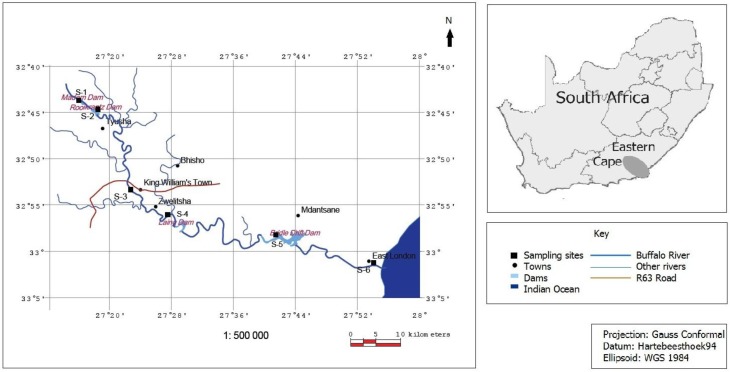
Human enteric viruses (HEntVs) are a major cause of water-related diseases. The prevalence of hepatitis A virus (HAV), rotaviruses (RoV) and enteroviruses (EnV) in Buffalo River waters was assessed quantitatively over a period of 12 months (August 2010 to July 2011). Seventy-two samples were collected from six sites, including three dams, and concentrated using the adsorption-elution method. Viral RNA was extracted using a commercial kit, and the viruses were quantified by real-time quantitative reverse transcriptase PCR (RT-qPCR). Two or more viruses were detected in 12.5% of the samples. HAV was detected in 43.1% of the samples and in significantly (p < 0.05) varying concentrations of 1.5 × 10(1)–1.9 × 10(5) genome copies/L compared to RoV and EnV, while RoVs were detected in 13.9% of samples, with concentrations ranging from 2.5 × 10(1)–2.1 × 10(3) genome copies/L, and EnV were detected in 9.7% of the samples, with concentrations ranging from 1.3 × 10(1)–8.6 × 10(1) genome copies/L. Only HAV was detected at all the sites, with the Bridle Drift Dam recording significantly higher (p < 0.05) concentrations. The presence of enteric viruses in Buffalo River may constitute public health risks and the incidence of HAV at all the sites could reflect both the epidemiological status of hepatitis A and HAV persistence in the water environments.
Figures


References
-
- World Health Organization (WHO) World Health Statistics 2009. WHO Press; Geneva, Switzerland: 2009. pp. 1–149.
-
- Gibson K.E., Schwab K.J. Detection of bacterial indicators and human and bovine enteric viruses in surface water and groundwater sources potentially impacted by animal and human wastes in Lower Yakima Valley, Washington. Appl. Environ. Microbiol. 2011;77:355–362. doi: 10.1128/AEM.01407-10. - DOI - PMC - PubMed
-
- World Health Organization (WHO) and UNICEF. Progress on Sanitation and Drinking-Water: 2010 Update. WHO Press; Geneva, Switzerland: 2010. pp. 1–60.
Publication types
MeSH terms
Substances
LinkOut - more resources
Full Text Sources
