


Radix Paeoniae Rubra and Radix Paeoniae Alba Attenuate CCl4-induced acute liver injury: an ultra-performance liquid chromatography-mass spectrometry (UPLC-MS) based metabolomic approach for the pharmacodynamic study of Traditional Chinese Medicines (TCMs)
- PMID: 23203085
- PMCID: PMC3509601
- DOI: 10.3390/ijms131114634
Radix Paeoniae Rubra and Radix Paeoniae Alba Attenuate CCl4-induced acute liver injury: an ultra-performance liquid chromatography-mass spectrometry (UPLC-MS) based metabolomic approach for the pharmacodynamic study of Traditional Chinese Medicines (TCMs)
Abstract
Metabolomics has been frequently used in pharmacodynamic studies, especially those on traditional Chinese medicine (TCM). Radix Paeoniae Alba and Radix Paeoniae Rubra are popularly used in TCM, and both have hepatoprotective effects. In this study, a CCl(4)-induced acute liver injury rat model was established and confirmed by the observed serum aminotransferase activities. The metabolomics approach was applied to study the influence of Radix Paeoniae Alba and Radix Paeoniae Rubra on the metabolic changes in rats with acute liver injury. The partial least-squares-discriminant analysis (PLS-DA) of rat serum and their ultra-performance liquid chromatography-mass spectrometry (UPLC-MS) fingerprints allowed discrimination of controlled, acute liver injury-model rats after administration of the two types of TCMs. The time-dependent PLS-DA plots showed that the changes in the metabolic patterns of the rats, which were administered with the TCMs, had stabilized within 2 h after they received the intraperitoneal CCl(4) injection. The results indicated the protective effect of TCMs against liver injury. Several potential biomarkers were detected and identified, which included creatine, deoxycholic acid, choline, 5-methylenetetrahydrofolate, folic acid, and glycocholic acid. The physiological significance of these metabolic changes was discussed.
Figures
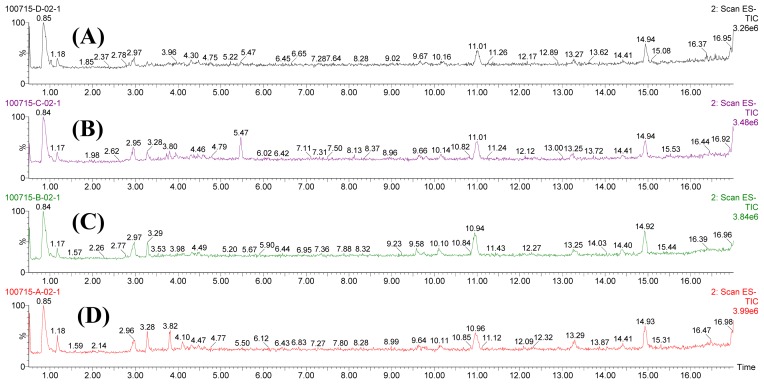
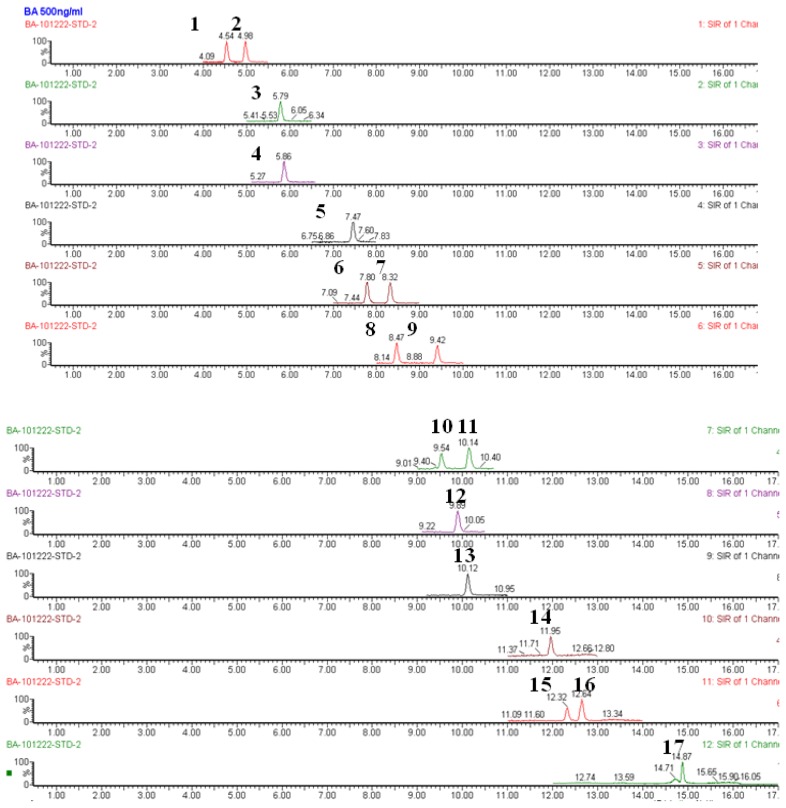
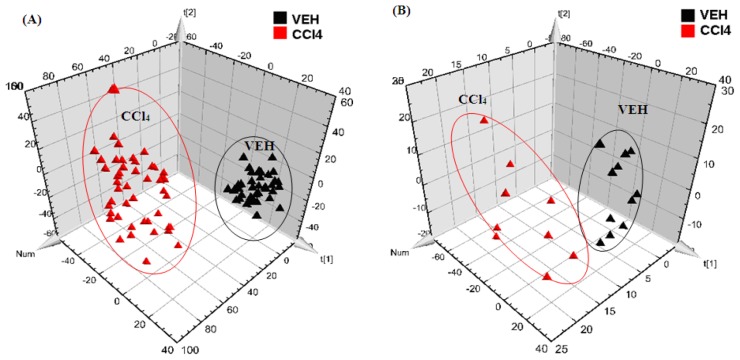
 CCl4 group).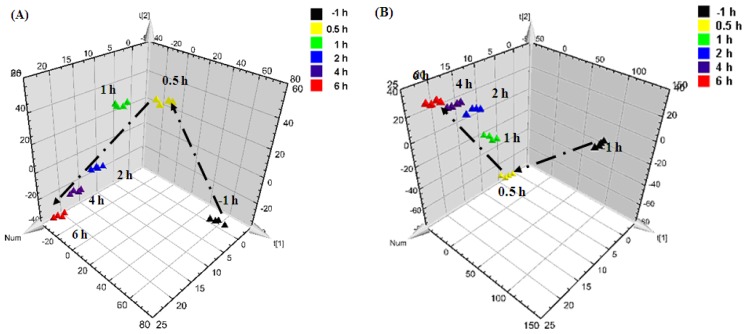
 0.5 h after injection,
 1 h after injection,
 2 h after injection,
 4 h after injection, and
6 h after injection).
4 h after injection, and
6 h after injection).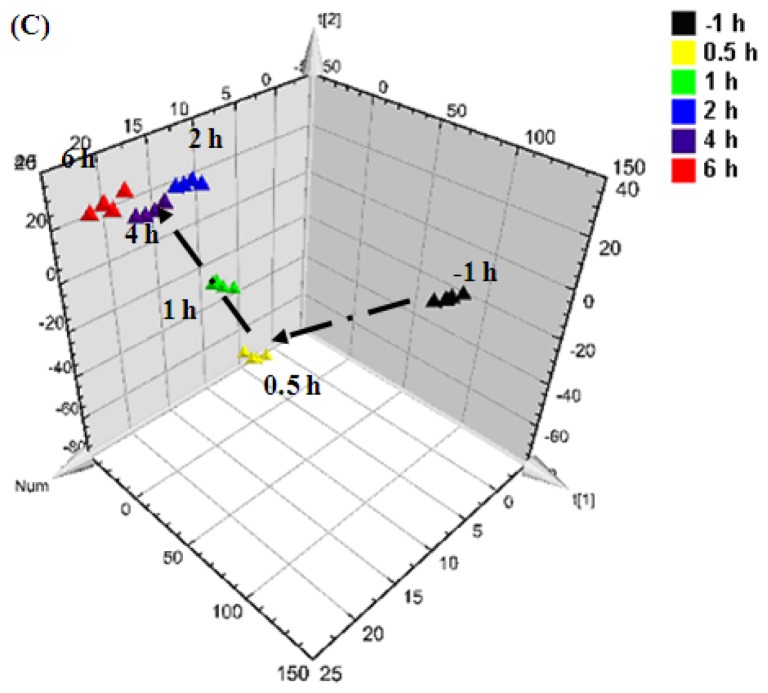 0.5 h after injection,
1 h after injection,
2 h after injection,
4 h after injection, and
6 h after injection).
0.5 h after injection,
1 h after injection,
2 h after injection,
4 h after injection, and
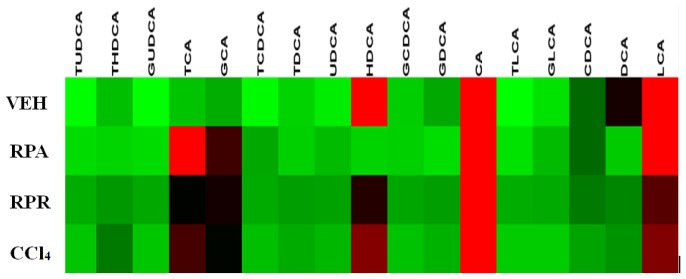
6 h after injection).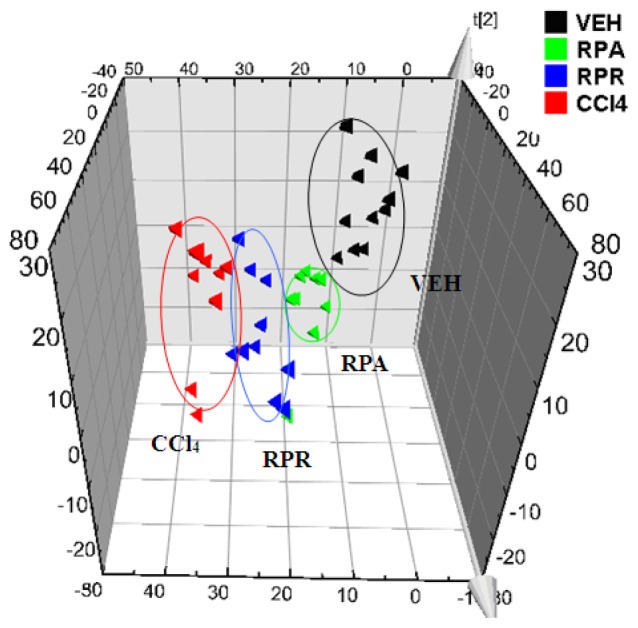 RPA group,
RPR group,
CCl4 group).
RPA group,
RPR group,
CCl4 group).References
-
- Feng C., Liu M., Shi X.W. Pharmacokinetic properties of paeoniflorin, albiflorin and oxypaeoniflorin after oral gavage of extracts of Radix Paeoniae Rubra and Radix Paeoniae Alba in rats. J. Ethnopharmacol. 2010;130:407–413. - PubMed
-
- Zhang A.H., Sun H., Wang Z.G. Metabolomics: Towards understanding traditional Chinese medicine. Planta Med. 2010;76:2026–2035. - PubMed
-
- Nicholson J.K., Wilson I.D. Understanding ‘global’ systems biology: Metabonomics and the continuum of metabolism. Nat. Rev. 2003;2:668–676. - PubMed
Publication types
MeSH terms
Substances
LinkOut - more resources
Full Text Sources
Other Literature Sources
Medical
Miscellaneous
