Early detection and management of pulmonary arterial hypertension
- PMID: 23204118
- PMCID: PMC9487225
- DOI: 10.1183/09059180.00005112
Early detection and management of pulmonary arterial hypertension
Abstract
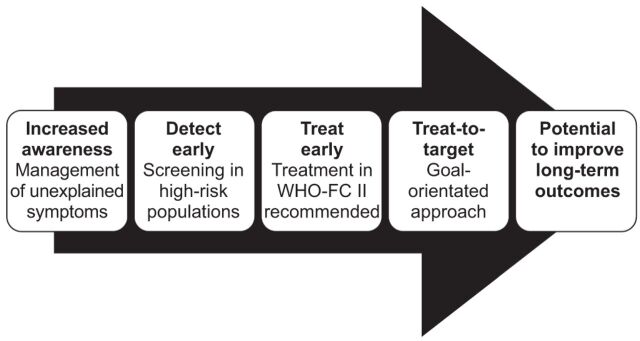
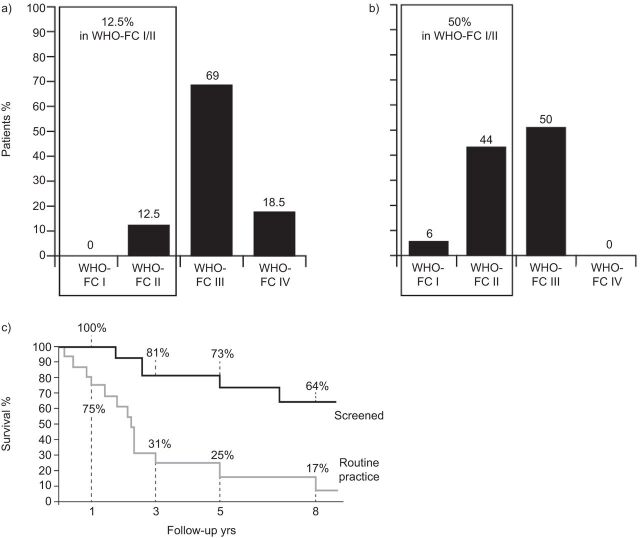
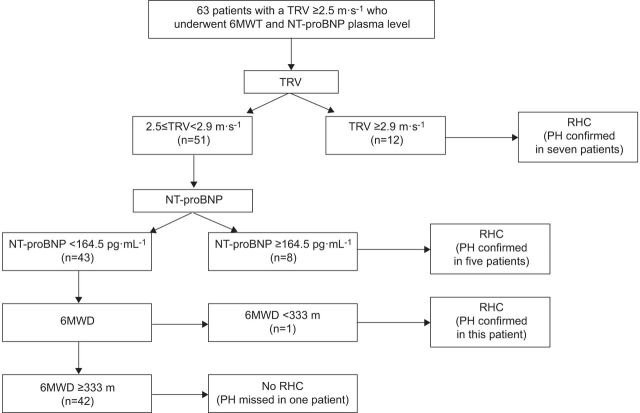
The long-term prognosis for patients with pulmonary arterial hypertension (PAH) remains poor, despite advances in treatment options that have been made in the past few decades. Recent evidence suggests that World Health Organization functional class I or II patients have significantly better long-term survival rates than patients in higher functional classes, thus providing a rationale for earlier diagnosis and treatment of PAH. However, early diagnosis is challenging and there is frequently a delay between symptom onset and diagnosis. Screening programmes play an important role in PAH detection and expert opinion favours echocardiographic screening of asymptomatic patients who may be predisposed to the development of PAH (i.e. those with systemic sclerosis or sickle cell disease), although current guidelines only recommend annual echocardiographic screening in symptomatic patients. This article reviews the currently available screening programmes, including their limitations, and describes alternative screening approaches that may identify more effectively those patients who require right heart catheterisation for a definitive PAH diagnosis.
Conflict of interest statement
M. Humbert has relationships with drug companies including Actelion, Aires, AstraZeneca, Bayer, Bristol-Myers Squibb, GSK, Merck, Novartis, Nycomed, Pfizer, Stallergènes, TEVA and United Therapeutics. In addition to being an investigator in trials involving these companies, relationships include consultancy service and membership of scientific advisory boards. J.G. Coghlan has received support for consultancy work, lectures, conference attendance, staff posts and research from Actelion, Pfizer, GSK, Lilly, Novartis and United Therapeutics. D. Khanna has received consulting fees from Actelion, Genentech, Gilead, Pfizer, Intermune and United Therapeutics. He serves on the speaker bureaus of Actelion and United Therapeutics. He has received funding for research from Actelion, Gilead, the Scleroderma Foundation and United Therapeutics.
Figures
References
-
- Humbert M, Sitbon O, Chaouat A, et al. . Survival in patients with idiopathic, familial, and anorexigen-associated pulmonary arterial hypertension in the modern management era. Circulation 2010; 122: 156–163. - PubMed
-
- Tyndall AJ, Bannert B, Vonk M, et al. . Causes and risk factors for death in systemic sclerosis: a study from the EULAR Scleroderma Trials and Research (EUSTAR) database. Ann Rheum Dis 2010; 69: 1809–1815. - PubMed
-
- Humbert M, Sitbon O, Yaïci A, et al. . Survival in incident and prevalent cohorts of patients with pulmonary arterial hypertension. Eur Respir J 2010; 36: 549–555. - PubMed
-
- Condliffe R, Kiely DG, Peacock AJ, et al. . Connective tissue disease-associated pulmonary arterial hypertension in the modern treatment era. Am J Respir Crit Care Med 2009; 179: 151–157. - PubMed
Publication types
MeSH terms
Substances
LinkOut - more resources
Full Text Sources
Other Literature Sources
Medical
Miscellaneous