. 2012;4(12):1331-8.
doi: 10.1093/gbe/evs111.

Birth-and-death of KLK3 and KLK2 in primates: evolution driven by reproductive biology

Birth-and-death of KLK3 and KLK2 in primates: evolution driven by reproductive biology

Patrícia Isabel Marques et al. Genome Biol Evol. 2012.

Abstract

The kallikrein (KLK) gene family comprises the largest uninterrupted locus of serine proteases in the human genome and represents a notable case for studying the evolutionary fate of duplicated genes. In primates, a recent duplication event gave rise to KLK2 and KLK3, both encoding essential proteins for the cascade of seminal plasma liquefaction. We reconstructed the evolutionary history of KLK2 and KLK3 by comparative analysis of the orthologous sequences from 22 primate species, calculated d(N)/d(S) ratios, and addressed the hypothesis of coevolution with their substrates, the semenogelins (SEMG1 and SEMG2). Our findings support the placement of the KLK2-KLK3 duplication in the Catarrhini ancestor and unveil the frequent loss of KLK2 throughout primate evolution by different genomic mechanisms, including unequal crossing-over, deletions, and pseudogenization. We provide evidences for an adaptive evolution of KLK3 toward an expanded enzymatic spectrum, with an effect on the hydrolysis of semen coagulum. Furthermore, we found associations between mating system, the number of SEMG repeat units, and the number of functional KLK2 and KLK3, suggesting complex evolutionary dynamics shaped by reproductive biology.


Figures

F<sc>ig</sc>. 1.—
Fig. 1.—
Phylogenetic analysis of KLK2 and KLK3 in primates. (A) Phylogenetic tree showing primate divergence times (Hedges et al. 2006) and functional status of KLK2 and KLK3. The criteria to define a nonfunctional KLK gene were the identification of at least one disrupting mutation. Gray square indicates a duplication event. The ancestral KLK3 branch is indicated (ancKLK3). (B) Alignment of exons IV–V for KLK2 and KLK3 in Catarrhini. The corresponding human genomic positions for these regions are represented at the top. Positions conserved with Gorilla gorilla (left panel) or Nomascus leucogenys (right panel) are in orange. Nonconserved positions are in blue. Sites conserved in all species were omitted.
F<sc>ig</sc>. 2.—
Fig. 2.—
Positive selected sites in biologically relevant regions. (A) Human KLK2 three-dimensional model showing amino acid replacements predicted to be under positive selection (Q109, H177, and G210). (B) Human KLK3 three-dimensional model showing D207S substitution predicted to be under positive selection in the ancestral branch. The catalytic triad is represented in light blue (H65, D120, and S213) and the binding sites in orange (S228, G230, and D207 in KLK2 or S207 in KLK3).
F<sc>ig</sc>. 3.—
Fig. 3.—
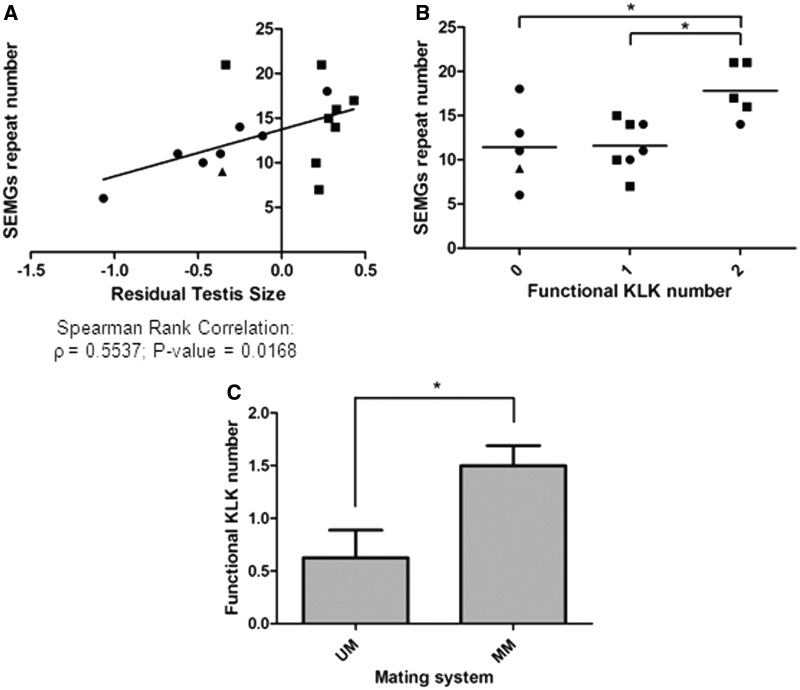
Evolution of primate KLK2 and KLK3 related to mating factors. (A) Correlation of residual testis size (Anderson et al. 2004; Dixson and Anderson 2004; Wlasiuk and Nachman 2010) with the combined SEMG repeat units (Jensen-Seaman and Li 2003; Hurle et al. 2007). (B) Correlation between the number of SEMG1 and SEMG2 repeat units (Jensen-Seaman and Li 2003; Hurle et al. 2007) and the presence of functional KLK2 and KLK3. *P < 0.05. (C) Correlation between the mating system (Wlasiuk and Nachman 2010) and the presence of functional KLK2 and KLK3. UM, unimale; MM, multimale. *P < 0.05. (•), monoandrous; (▪), polyandrous; and (▴), ambiguous.

References

    1. Adzhubei IA, et al. A method and server for predicting damaging missense mutations. Nat Methods. 2010;7:248–249. - PMC - PubMed
    1. Anderson MJ, Hessel JK, Dixson AF. Primate mating systems and the evolution of immune response. J Reprod Immunol. 2004;61:31–38. - PubMed
    1. Bielawski JP, Yang Z. Maximum likelihood methods for detecting adaptive evolution after gene duplication. J Struct Funct Genomics. 2003;3:201–212. - PubMed
    1. Blakesley RW, et al. An intermediate grade of finished genomic sequence suitable for comparative analyses. Genome Res. 2004;14:2235–2244. - PMC - PubMed
    1. Clark NL, Swanson WJ. Pervasive adaptive evolution in primate seminal proteins. PLoS Genet. 2005;1:e35. - PMC - PubMed

Publication types

Substances