


Patient-reported outcome 2 years after lung transplantation: does the underlying diagnosis matter?
- PMID: 23204877
- PMCID: PMC3508652
- DOI: 10.2147/PROM.S32399
Patient-reported outcome 2 years after lung transplantation: does the underlying diagnosis matter?
Abstract
Purpose: Transplantation has the potential to produce profound effects on survival and health-related quality of life (HRQL). The inclusion of the patient's perspective may play an important role in the assessment of the effectiveness of lung transplantation. Patient perspectives are assessed by patient-reported outcome measures, including HRQL measures. We describe how patients' HRQL among different diagnosis groups can be used by clinicians to monitor and evaluate the outcomes associated with transplantation.
Methods: Consecutive lung transplant recipients attending the lung transplant outpatient clinic in a tertiary institution completed the 15-item Health Utilities Index (HUI) questionnaire on a touchscreen computer. The results were available to clinicians at every patient visit. The HUI3 covers a range of severity and comorbidities in eight dimensions of health status. Overall HUI3 scores are on a scale in which dead = 0.00 and perfect health = 1.00; disability categories range from no disability = 1 to severe disability <0.70. Single-attribute and overall HUI3 scores were used to compare patients' HRQL among different diagnosis groups. Random-effect models with time since transplant as a random variable and age, gender, underlying diagnoses, infections, and broncholitis obliterans syndrome as fixed variables were built to identify determinants of health status at 2-years posttransplantation.
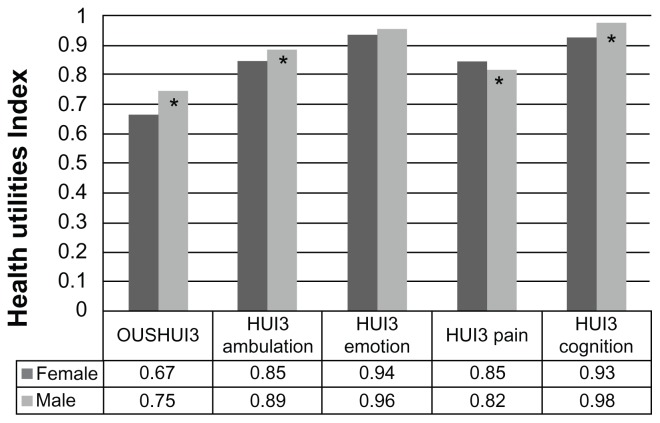
Results: Two hundred and fourteen lung transplant recipients of whom 61% were male with a mean age of 52 (19-75) years were included in the study. Chronic obstructive pulmonary disease and cystic fibrosis patients displayed moderate disability, while pulmonary fibrosis and pulmonary arterial hypertension patients displayed severe disability. Patients with chronic obstructive pulmonary disease had the worst pain level, whereas patients with pulmonary fibrosis had the worst emotion and cognition levels. A random-effect model confirmed that development of broncholitis obliterans syndrome was the most important determinant of health status (P = 0.03) compared to other variables, such as cytomegalovirus infections and underlying diagnoses.
Conclusion: Descriptions of patients' HRQL among different diagnosis groups could be used by clinicians to assist individualized patient care.
Keywords: health utilities index; health-related quality of life measures; patient-reported outcomes; underlying diagnoses in lung transplant recipients.
Figures
References
-
- Orens JB, Garrity ER. General overview of lung transplantation and review of organ allocation. Proc Am Thorac Soc. 2009;6(1):13–19. - PubMed
-
- Velikova G, Wright EP, Smith AB, et al. Automated collection of quality of life data: a comparison of paper and computer touch-screen questionnaires. J Clin Oncol. 1999;17(3):998–1007. - PubMed
-
- Furlong W, Feeny D, Torrance G, Barr R. The Health Utilities Index (HUI®) system for assessing health-related quality of life in clinical studies. Ann Med. 2001;33(5):375–384. - PubMed
-
- Feeny D, Furlong W, Torrance G, et al. Multi-attribute and single-attribute utility functions for the Health Utilities Index Mark 3 system. Med Care. 2002;40(2):113–128. - PubMed
-
- Horsman J, Furlong W, Feeny D, Torrance G. The Health Utilities Index (HUI®): concepts, measurement properties and applications. 2003. [Accessed May 2012]. Available from: http://www.hqol.com/content/1/1/54. - PMC - PubMed
LinkOut - more resources
Full Text Sources
