


Global review of national ambient air quality standards for PM(10) and SO(2) (24 h)
- PMID: 23205158
- PMCID: PMC3505502
- DOI: 10.1007/s11869-010-0131-2
Global review of national ambient air quality standards for PM(10) and SO(2) (24 h)
Abstract
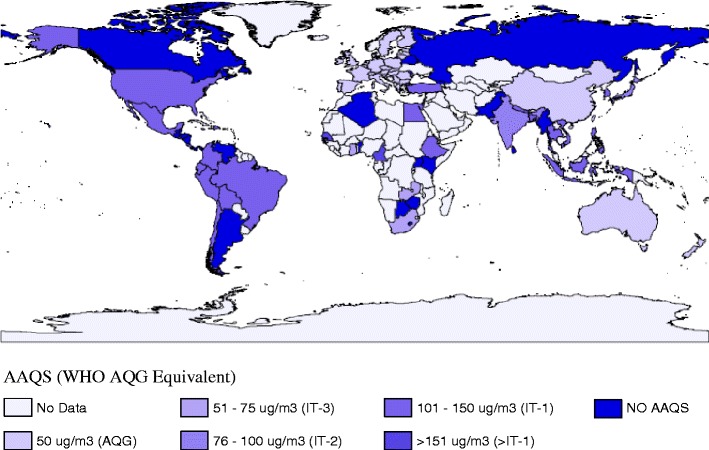
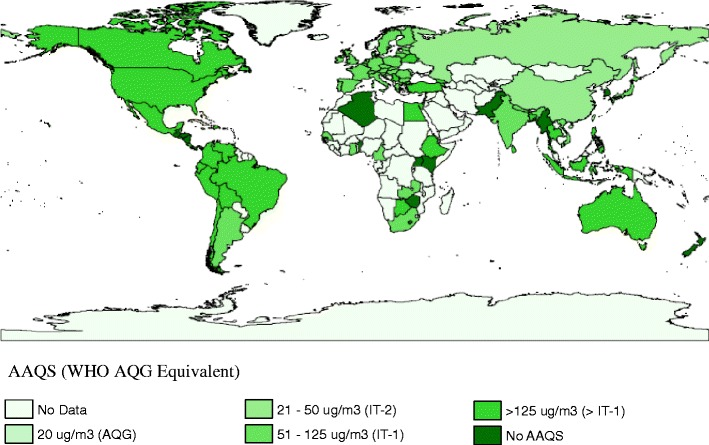
Literature comparing national ambient air quality standards (AAQSs) globally is scattered and sparse. Twenty-four hour AAQSs for particulate matter <10 μm in aerodynamic diameter (PM(10)) and sulfur dioxide (SO(2)) in 96 countries were identified through literature review, an international survey, and querying an international legal database. Eighty three percent, of the 96 countries with information on the presence or absence of AAQSs, have 24-h AAQSs for either PM(10) or SO(2). Slightly more countries have 24-h AAQSs for SO(2) (76 countries) than PM(10) (69 countries). The average 24-h AAQSs for PM(10) and SO(2) are 95 μg/m(3) (95% confidence interval [CI], 82-108 μg/m(3), n = 68) and 182 μg/m(3) (95% CI, 158-205 μg/m(3), n = 73). The population-weighted average AAQS for PM(10) is 98 and 155 μg/m(3) for SO(2). The average AAQS for both PM(10) and SO(2) are substantially higher than the recommended World Health Organization Air Quality Guideline (WHO AQG) value. Several countries have promulgated AAQSs at the WHO AQG value for PM(10), but none for SO(2). Further examination in selected countries found that air quality monitoring data, existing AAQSs in other countries, environmental epidemiology studies, and the WHO AQGs are considered the most often in establishing or revising AAQSs. ELECTRONIC SUPPLEMENTARY MATERIAL: The online version of this article (doi:10.1007/s11869-010-0131-2) contains supplementary material, which is available to authorized users.
Figures
References
-
- Archer G, Davidson RD. In: GEMS/AIR: air quality management and assessment capabilities in 20 major cities. Williams W, editor. London: Monitoring and Assessment Center (MARC); 1996.
-
- Elsom D, Longhurst J, editors. Regional and local aspects of air quality management. Southampton: WIT; 2004.
-
- International Union of Air Pollution Prevention Associations . In: Clean air around the world: national and international approaches to air pollution control. 2. Murley L, editor. Brighton: International Union of Air Pollution Prevention Associations; 1991.
-
- Krzyzanowski M, Cohen A. Update of WHO air quality guidelines. Air Qual Atmos Health. 2008;1:7–13. doi: 10.1007/s11869-008-0008-9. - DOI
-
- Maggioria CD, Lopez-Silva JA (2006) Vulnerability to Air Pollution in Latin America and the Caribbean Region. Latin America and Caribbean Region Sustainable Development Working Paper 28. The World Bank
LinkOut - more resources
Full Text Sources