


doi: 10.1055/s-0031-1293517.
The use of a Kirschner wire in the treatment of a comminuted le fort I fracture: a case report
Affiliations
- PMID: 23205174
- PMCID: PMC3314255
- DOI: 10.1055/s-0031-1293517
Item in Clipboard
The use of a Kirschner wire in the treatment of a comminuted le fort I fracture: a case report
Craniomaxillofac Trauma Reconstr.
2011 Dec.
Abstract
Simultaneous fracture of the maxilla and cervical vertebrae rarely occurs in bicycling accidents. The following case report describes a simple technique for closed reduction of a severely comminuted maxillary fracture with shattering of the dentoalveolar process. The combination of a rigid external distractor halo frame on the skull, a Kirschner wire through the maxilla, and an intermaxillary wire fixation resulted in stable vertical and sagittal correction of the fragmented maxilla with adequate access and minimal manipulation and without necessitating removal of the cervical collar.
Keywords: Kirschner wire; Le Fort I fracture; RED halo frame.
Figures

Preoperative computed tomography 3-D reconstruction (A), axial view (B), and coronal view (C) showing comminuted Le Fort I fracture.

Sagittal (A) and anteroposterior (B) illustration of the Kirschner wire position.

Perioperative images (A to D) of the Kirschner wire and rigid external distractor frame in place.
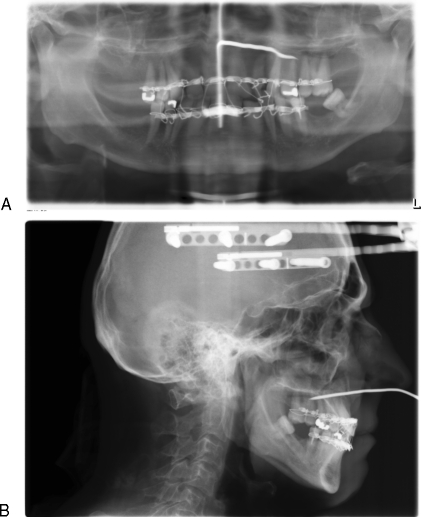
Panoramic radiograph (A) and lateral cephalometric radiograph (B) 6 days postoperative.

Clinical photographs of the patient 1 year after treatment with normal range of opening (A) and normal occlusion (B).

Clinical photograph of the patient before (A) and 1 year after (B) treatment. A cone beam computed tomography 1 year after treatment to document bone healing in axial view (C), coronal view (D), and sagittal view (E).
References
-
- Gassner R, Tuli T, Emshoff R, Waldhart E. Mountainbiking—a dangerous sport: comparison with bicycling on oral and maxillofacial trauma. Int J Oral Maxillofac Surg. 1999;28:188–191. - PubMed
-
- Elahi M ME, Brar M S, Ahmed N, Howley D B, Nishtar S, Mahoney J L. Cervical spine injury in association with craniomaxillofacial fractures. Plast Reconstr Surg. 2008;121:201–208. - PubMed
-
- Haug R H, Prather J, Indresano A T. An epidemiologic survey of facial fractures and concomitant injuries. J Oral Maxillofac Surg. 1990;48:926–932. - PubMed
-
- Mulligan R P, Mahabir R C. The prevalence of cervical spine injury, head injury, or both with isolated and multiple craniomaxillofacial fractures. Plast Reconstr Surg. 2010;126:1647–1651. - PubMed
-
- Elhammali N, Bremerich A, Rustemeyer J. Demographical and clinical aspects of sports-related maxillofacial and skull base fractures in hospitalized patients. Int J Oral Maxillofac Surg. 2010;39:857–862. - PubMed
LinkOut - more resources
Full Text Sources