


Compatibility of pedigree-based and marker-based relationship matrices for single-step genetic evaluation
- PMID: 23206367
- PMCID: PMC3549765
- DOI: 10.1186/1297-9686-44-37
Compatibility of pedigree-based and marker-based relationship matrices for single-step genetic evaluation
Erratum in
- Genet Sel Evol. 2014;46:20
Abstract
Background: Single-step methods provide a coherent and conceptually simple approach to incorporate genomic information into genetic evaluations. An issue with single-step methods is compatibility between the marker-based relationship matrix for genotyped animals and the pedigree-based relationship matrix. Therefore, it is necessary to adjust the marker-based relationship matrix to the pedigree-based relationship matrix. Moreover, with data from routine evaluations, this adjustment should in principle be based on both observed marker genotypes and observed phenotypes, but until now this has been overlooked. In this paper, I propose a new method to address this issue by 1) adjusting the pedigree-based relationship matrix to be compatible with the marker-based relationship matrix instead of the reverse and 2) extending the single-step genetic evaluation using a joint likelihood of observed phenotypes and observed marker genotypes. The performance of this method is then evaluated using two simulated datasets.
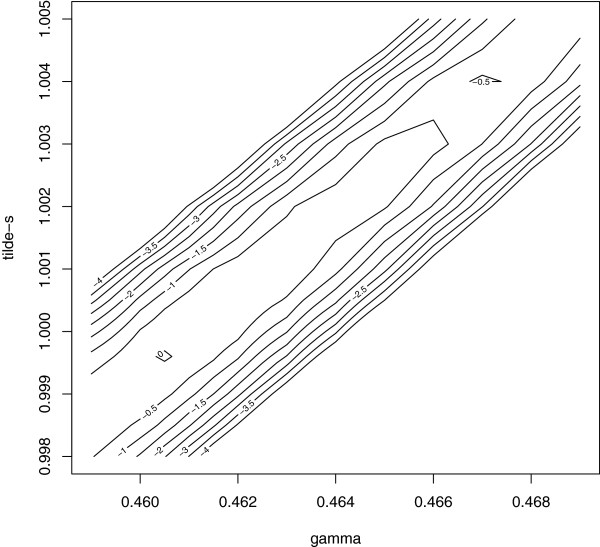
Results: The method derived here is a single-step method in which the marker-based relationship matrix is constructed assuming all allele frequencies equal to 0.5 and the pedigree-based relationship matrix is constructed using the unusual assumption that animals in the base population are related and inbred with a relationship coefficient γ and an inbreeding coefficient γ / 2. Taken together, this γ parameter and a parameter that scales the marker-based relationship matrix can handle the issue of compatibility between marker-based and pedigree-based relationship matrices. The full log-likelihood function used for parameter inference contains two terms. The first term is the REML-log-likelihood for the phenotypes conditional on the observed marker genotypes, whereas the second term is the log-likelihood for the observed marker genotypes. Analyses of the two simulated datasets with this new method showed that 1) the parameters involved in adjusting marker-based and pedigree-based relationship matrices can depend on both observed phenotypes and observed marker genotypes and 2) a strong association between these two parameters exists. Finally, this method performed at least as well as a method based on adjusting the marker-based relationship matrix.
Conclusions: Using the full log-likelihood and adjusting the pedigree-based relationship matrix to be compatible with the marker-based relationship matrix provides a new and interesting approach to handle the issue of compatibility between the two matrices in single-step genetic evaluation.
Figures
References
Publication types
MeSH terms
Substances
LinkOut - more resources
Full Text Sources
