


Reward circuit connectivity relates to delay discounting in children with attention-deficit/hyperactivity disorder
- PMID: 23206930
- PMCID: PMC3581744
- DOI: 10.1016/j.euroneuro.2012.10.015
Reward circuit connectivity relates to delay discounting in children with attention-deficit/hyperactivity disorder
Abstract
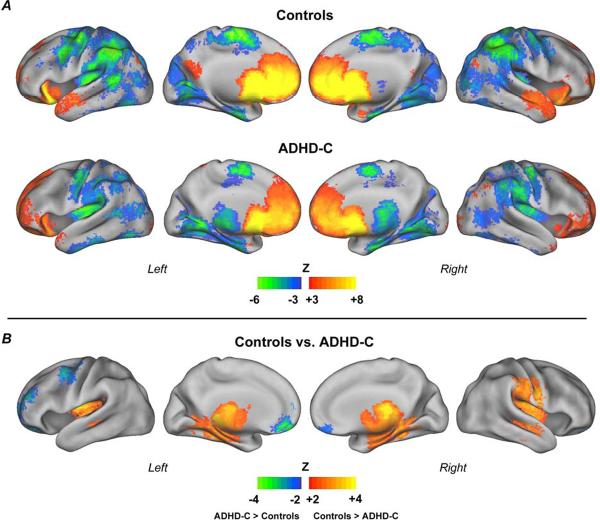
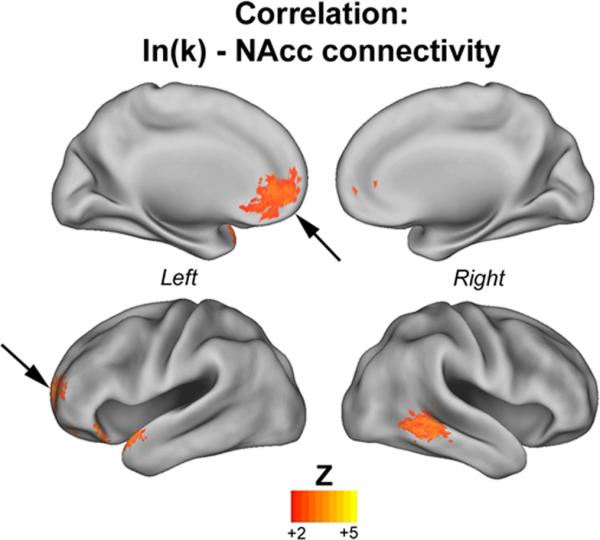
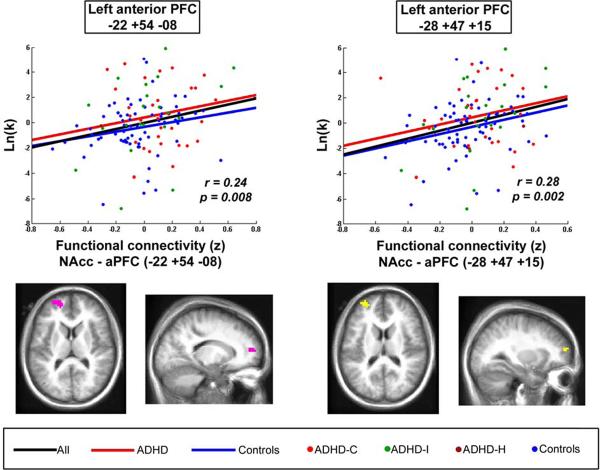
Attention-deficit/hyperactivity disorder (ADHD) is a prevalent psychiatric disorder that has poor long-term outcomes and remains a major public health concern. Recent theories have proposed that ADHD arises from alterations in multiple neural pathways. Alterations in reward circuits are hypothesized as one core dysfunction, leading to altered processing of anticipated rewards. The nucleus accumbens (NAcc) is particularly important for reward processes; task-based fMRI studies have found atypical activation of this region while the participants performed a reward task. Understanding how reward circuits are involved with ADHD may be further enhanced by considering how the NAcc interacts with other brain regions. Here we used the technique of resting-state functional connectivity MRI (rs-fcMRI) to examine the alterations in the NAcc interactions and how they relate to impulsive decision making in ADHD. Using rs-fcMRI, this study: examined differences in functional connectivity of the NAcc between children with ADHD and control children; correlated the functional connectivity of NAcc with impulsivity, as measured by a delay discounting task; and combined these two initial segments to identify the atypical NAcc connections that were associated with impulsive decision making in ADHD. We found that functional connectivity of NAcc was atypical in children with ADHD and the ADHD-related increased connectivity between NAcc and the prefrontal cortex was associated with greater impulsivity (steeper delayed-reward discounting). These findings are consistent with the hypothesis that atypical signaling of the NAcc to the prefrontal cortex in ADHD may lead to excessive approach and failure in estimating future consequences; thus, leading to impulsive behavior.
Copyright © 2012 Elsevier B.V. and ECNP. All rights reserved.
Figures
References
-
- American Psychiatric Association . Diagnostic and statistical manual of mental disorders. 4th ed. American Psychiatric Association; Washington, DC: 2000.
-
- Biswal B, Yetkin FZ, Haughton VM, Hyde JS. Functional connectivity in the motor cortex of resting human brain using echo-planar MRI. Magn.Reson.Med. 1995;34:537–541. - PubMed
-
- Buckner RL, Andrews-Hanna JR, Schacter DL. The brain's default network: anatomy, function, and relevance to disease. Ann.N.Y.Acad.Sci. 2008;1124:1–38. - PubMed
-
- Castellanos FX, Margulies DS, Kelly C, Uddin LQ, Ghaffari M, Kirsch A, Shaw D, Shehzad Z, Di Martino A, Biswal B, Sonuga-Barke EJ, Rotrosen J, Adler LA, Milham MP. Cingulate-precuneus interactions: a new locus of dysfunction in adult attention-deficit/hyperactivity disorder. Biol.Psychiatry. 2008;63:332–337. - PMC - PubMed
Publication types
MeSH terms
Grants and funding
LinkOut - more resources
Full Text Sources
Other Literature Sources
Medical
