Review
. 2012 Dec 3;4(12):3468-93.
doi: 10.3390/v4123468.

Development of a murine model for aerosolized ebolavirus infection using a panel of recombinant inbred mice

Affiliations
Review

Development of a murine model for aerosolized ebolavirus infection using a panel of recombinant inbred mice

Elizabeth E Zumbrun et al. Viruses. .

Abstract

Countering aerosolized filovirus infection is a major priority of biodefense research. Aerosol models of filovirus infection have been developed in knock-out mice, guinea pigs and non-human primates; however, filovirus infection of immunocompetent mice by the aerosol route has not been reported. A murine model of aerosolized filovirus infection in mice should be useful for screening vaccine candidates and therapies. In this study, various strains of wild-type and immunocompromised mice were exposed to aerosolized wild-type (WT) or mouse-adapted (MA) Ebola virus (EBOV). Upon exposure to aerosolized WT-EBOV, BALB/c, C57BL/6 (B6), and DBA/2 (D2) mice were unaffected, but 100% of severe combined immunodeficiency (SCID) and 90% of signal transducers and activators of transcription (Stat1) knock-out (KO) mice became moribund between 7-9 days post-exposure (dpe). Exposure to MA-EBOV caused 15% body weight loss in BALB/c, but all mice recovered. In contrast, 10-30% lethality was observed in B6 and D2 mice exposed to aerosolized MA-EBOV, and 100% of SCID, Stat1KO, interferon (IFN)-γ KO and Perforin KO mice became moribund between 7-14 dpe. In order to identify wild-type, inbred, mouse strains in which exposure to aerosolized MA-EBOV is uniformly lethal, 60 BXD (C57BL/6 crossed with DBA2) recombinant inbred (RI) and advanced RI (ARI) mouse strains were exposed to aerosolized MA-EBOV, and monitored for disease severity. A complete spectrum of disease severity was observed. All BXD strains lost weight but many recovered. However, infection was uniformly lethal within 7 to 12 days post-exposure in five BXD strains. Aerosol exposure of these five BXD strains to 10-fold less MA-EBOV resulted in lethality ranging from 0% in two strains to 90-100% lethality in two strains. Analysis of post-mortem tissue from BXD strains that became moribund and were euthanized at the lower dose of MA-EBOV, showed liver damage in all mice as well as lung lesions in two of the three strains. The two BXD strains that exhibited 90-100% mortality, even at a low dose of airborne MA-EBOV will be useful mouse models for testing vaccines and therapies. Additionally, since disease susceptibility is affected by complex genetic traits, a systems genetics approach was used to identify preliminary gene loci modulating disease severity among the panel BXD strains. Preliminary quantitative trait loci (QTLs) were identified that are likely to harbor genes involved in modulating differential susceptibility to Ebola infection.

Keywords: Ebola, ebolavirus, filovirus, aerosol, mouse, BXD, recombinant inbred.


Figures
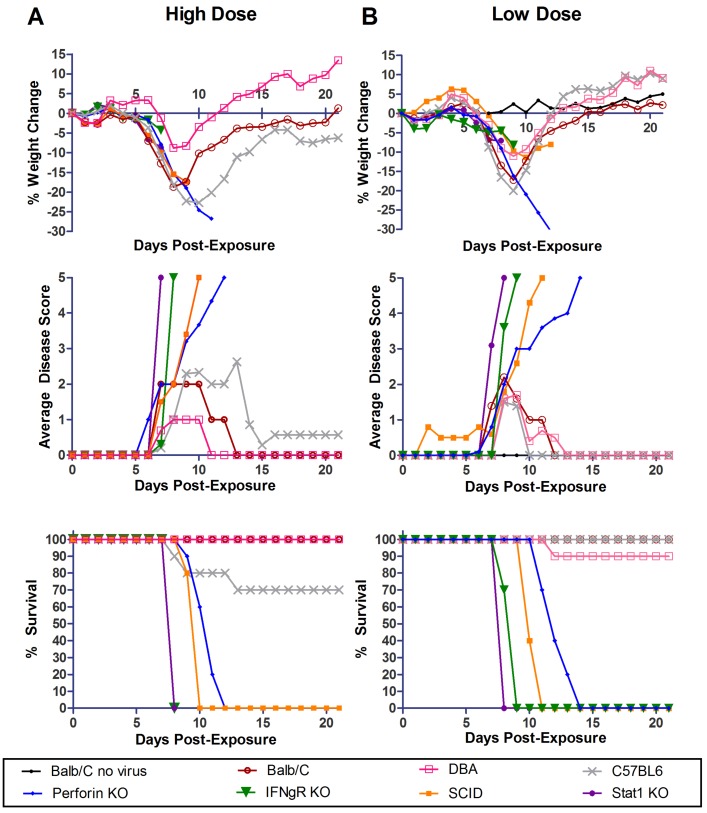
Figure 1
Figure 1
Exposure of WT and immunocompromised mice to aerosolized WT & MA-EBOV (high dose). Percent weight loss, clinical disease score and survival of BALB/c, DBA-2, C57BL/6, Perforin KO, IFNγR KO, SCID and Stat1 KO mice are shown for 0-21 dpe (n = 10 per mouse strain) following high 2461 ± 201 pfu (A) or low 228 ± 26 pfu (B) dose aerosol exposures. A BALB/c no virus control was included in the low dose challenge experiment only.
Figure 2
Figure 2
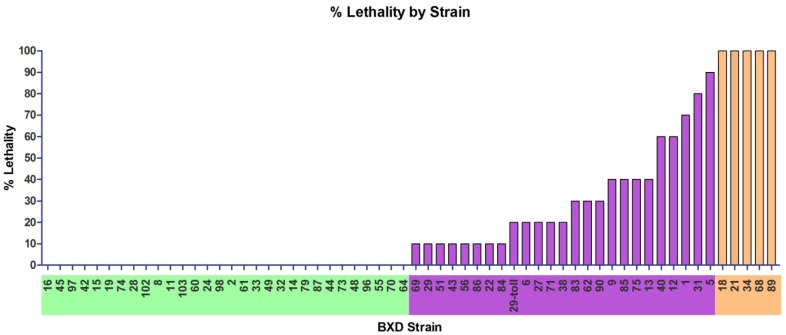
A range of susceptibility among BXD strains exposed to a high dose of aerosolized MA-EBOV. BXD strains fell into three groups based on the percent lethality following exposure to 1608 ± 549 pfu airborne MA-EBOV: resistant (green), intermediate susceptibility (purple) and susceptible (orange). Within each group, strains were ordered by survival (if applicable), percent of animals displaying clinical signs and percent weight loss corresponding to Table 1.
Figure 3
Figure 3
Exposure of susceptible BXD strains to high (a) and low (b) doses of aerosolized MA-EBOV. Weight loss, clinical disease score and survival are shown for BXD18, BXD21, BXD34, and BXD68 exposed to high (1345-2408 pfu) or low (52 pfu) doses. BXD89 was exposed to a high dose only (n = 10 per mouse strain).
Figure 4
Figure 4
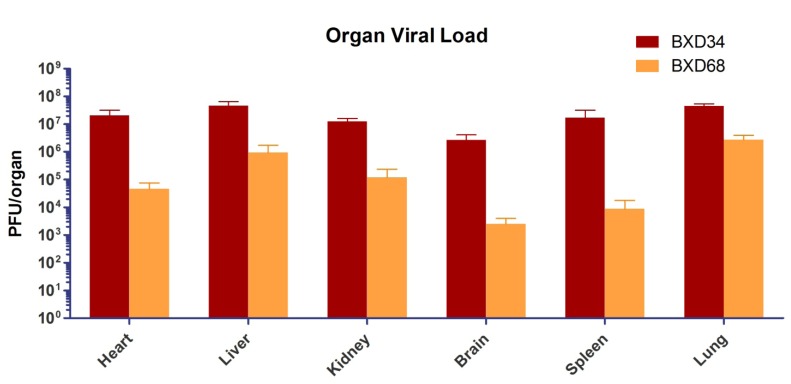
Average organ viral loads for the two most susceptible BXD strains, BXD34 (n = 5) and BXD68 (n = 4) after aerosol exposure to MA-EBOV. Organs were taken after humane euthanasia of moribund mice (7–9 dpe). The pfu/tissue represents the viral load within the entire organ, since the entire organ was homogenized for each data-point.
Figure 5
Figure 5
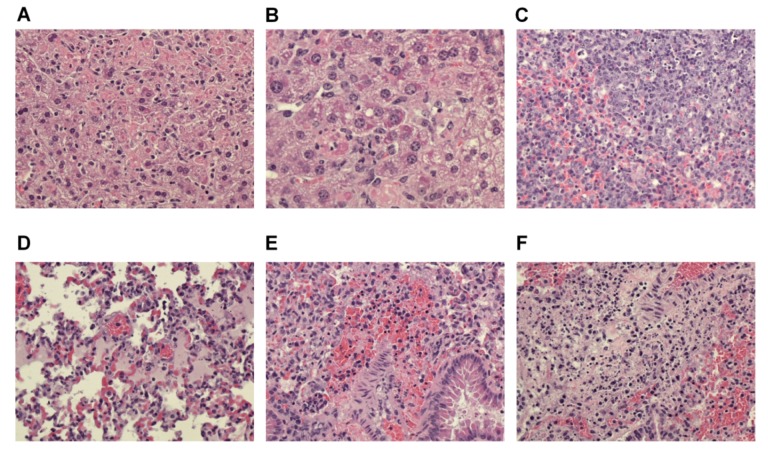
Histopathology in tissues of most susceptible BXD strains after aerosol exposure to a low dose of MA-EBOV. Hematoxylin and eosin (H&E) stained tissues were examined from moribund BXD34 (n = 5) and BXD68 (n = 5) mice. Representative images are shown. (a) Section of liver with multiple pale-staining necrotic hepatocytes accompanied by infiltrates of occasional neutrophils. (b) Higher magnification of liver showing that, adjacent to areas of necrosis, many hepatocytes contain one or more dark-red intracytoplasmic inclusion bodies. (c) Spleen with foci of necrosis in the red pulp (lower left) and white pulp (upper right). Photos D-F are from strain BXD68 lung. (d) Pulmonary congestion and edema with scattered necrotic cells within alveolar lumina and lining alveoli. (e) Higher magnification showing necrosis of alveolar septa with hemorrhage into the small airways. (f) Focus of more extensive alveolar septal necrosis with hemorrhage and low numbers of neutrophils.
Figure 6
Figure 6
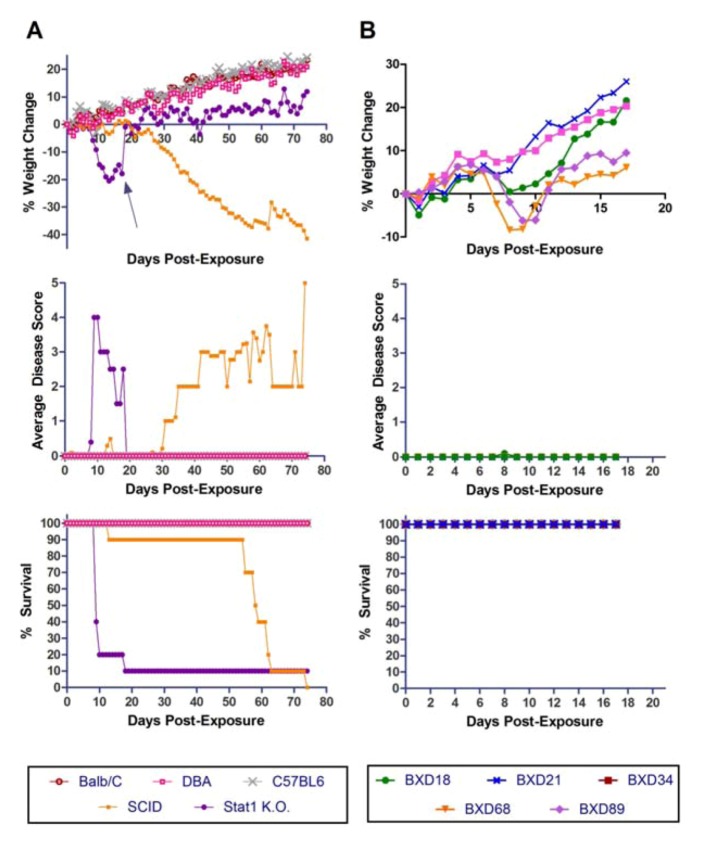
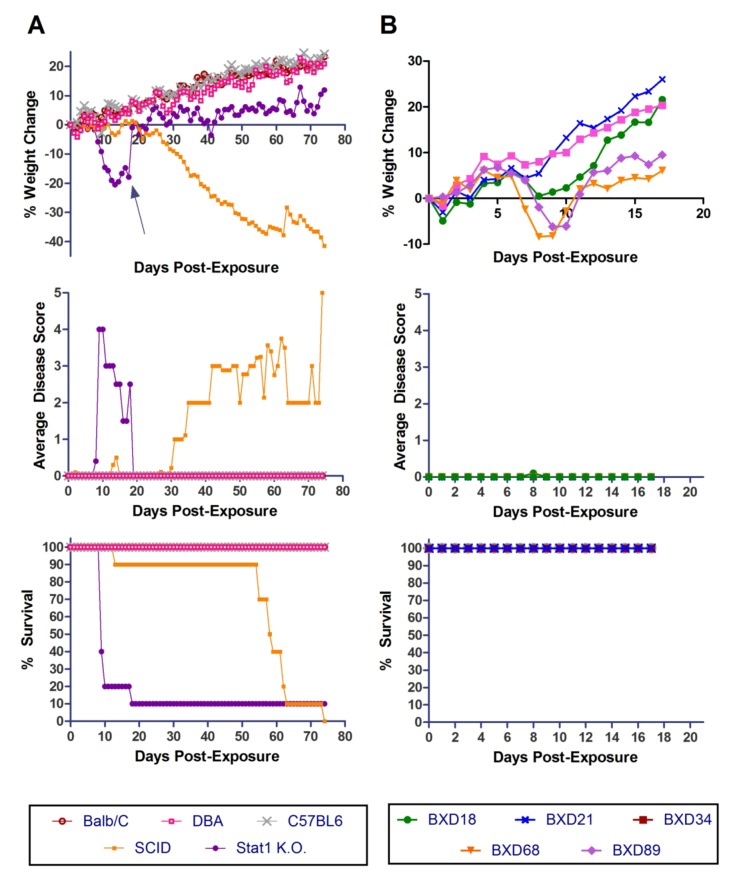
Exposure of mouse strains to aerosolized WT-EBOV. (a) BALB/c, DBA/2, C57BL/6, SCID and Stat1 KO mice and (b) BXD18, BXD21, BXD34, and BXD68 and BXD89 mice were exposed to non-adapted EBOV by the aerosol route and monitored for % weight change, disease score and survival for 17–80 days (n = 10 per mouse strain).
Figure 7
Figure 7
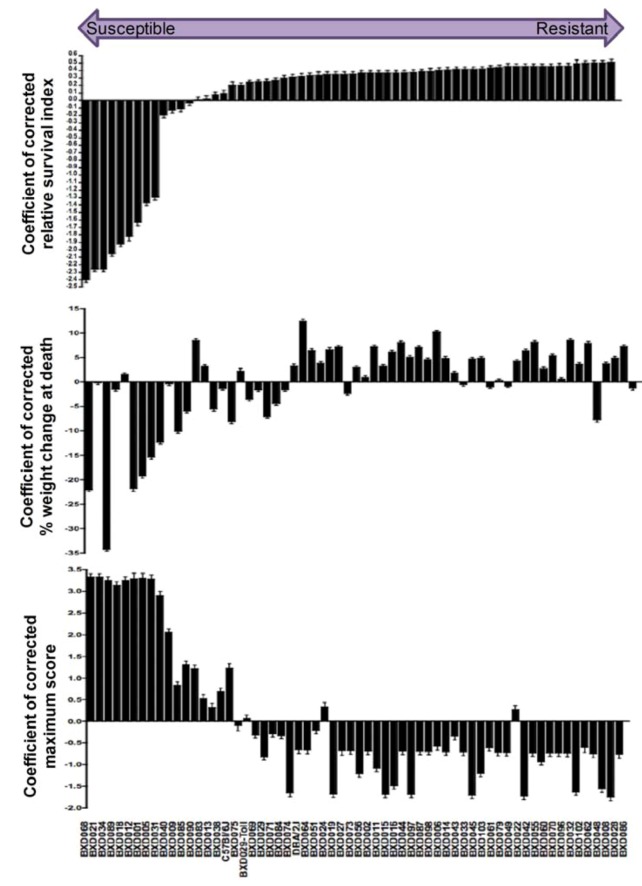
Differential susceptibility of recombinant and advanced recombinant inbred BXD strains & their parental strains post-exposure to aerosolized MA-EBOV. Rank-ordered bar chart of differential survival of 60 BXD strains and their parental strains (n= 586 mice) expressed as coefficient of mean corrected relative survival index. Top panel: Strains are arranged from highly susceptible on the left-hand side to intermediate and finally highly resistant on right-hand side. Middle Panel: Variation in percent of body weight loss at death. Bar chart showing coefficient of mean corrected percent of body weight loss at death arranged in order of differential survival. Bottom Panel: Variation in maximum clinical disease score. Bar chart shows coefficient of mean corrected maximum score arranged in order of differential survival. Error bars represent standard error of the coefficient. Total number of mice used per strain is indicated in Table S1 (Supplemental Information). Statistical test used is two-way ANOVA with correction to covariates as detailed in methods section.
Figure 8
Figure 8
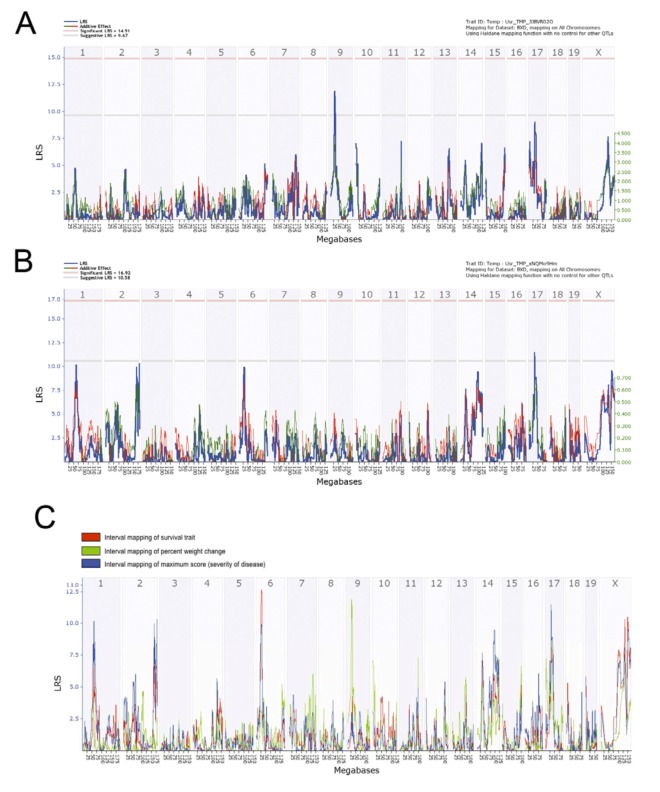
Comparison of preliminary genome-wide QTL mapped traits associated with differential response of BXD strains to aerosolized MA-EBOV. Interval mapping of percent weight loss at death (a) and maximum disease score (b) of BXD strains post-exposure to aerosolized MA-EBOV. Suggestive preliminarily QTLs were mapped. Proximal chromosome 9 is associated with percent weight loss at death (a) and proximal Chromosome 17 is associated with maximum disease score (b). (c) Preliminary QTL comparison of the three mapped traits associated with differential response to EBOV across BXD strains used. Chromosomes 17 and X are preliminary QTLs common for all three traits; chromosome 6 is most significant and associated with both differential survival and maximum disease score; chromosome 9 is associated with percent weight loss at death. Mouse chromosomes are depicted on the upper X-axis, and a physical map of each chromosome on lower X-axis (expressed in mega bases). The Y-axis shows significance of phenotype to genotype association expressed as LRS computed by WebQTL suite of GeneNetwork platform using 2000 permutation tests.
Figure 9
Figure 9
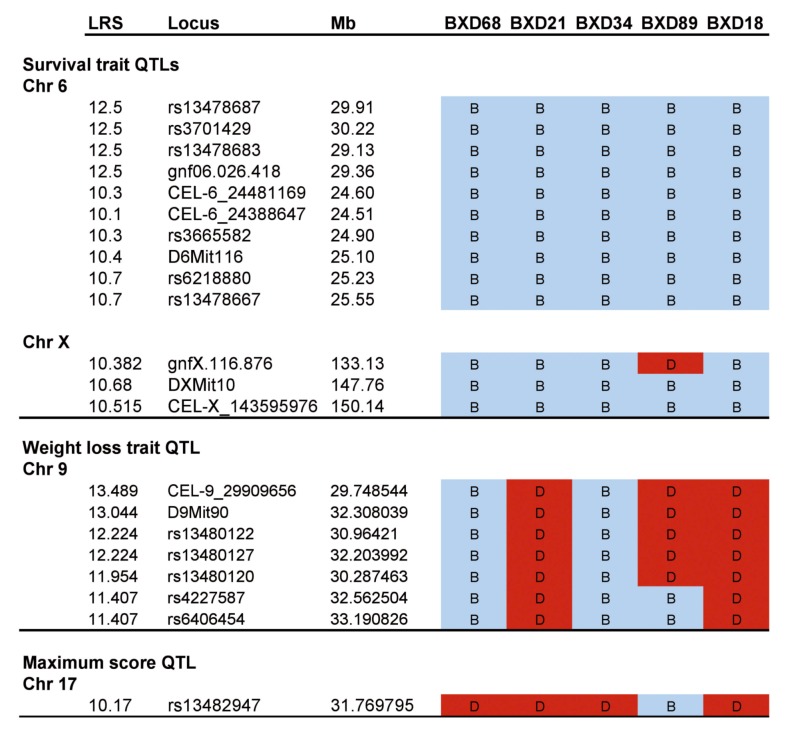
Linkage analysis and haplotype mapping of preliminary survival QTLs. (a) Linkage analysis of QTLs associated with differential response post-exposure to aerosolized MA-EBOV. Linkage analysis of highest LRS of QTLs associated with differential survival, percent weight loss and maximum score. For each mapped trait, haplotypes of BXD strains showing highest lethality post-exposure to MA-EBOV (BXD68, BXD21, BXD34, BXD89 and BXD18) are analyzed. (b) Strain distribution patterns (SDP) and haplotype map of all available BXD strains at the most promising QTL mapped on chromosome 6. “B” = allele from C57BL/6 and “D” = allele from DBA/2 .

References

    1. Kuhn J.H., Becker S., Ebihara H., Geisbert T.W., Johnson K.M., Kawaoka Y., Lipkin W.I., Negredo A.I., Netesov S.V., Nichol S.T., et al. Proposal for a revised taxonomy of the family Filoviridae: Classification, names of taxa and viruses, and virus abbreviations. Arch. Virol. 2010;155:2083–2103. doi: 10.1007/s00705-010-0814-x. - DOI - PMC - PubMed
    1. Leffel E.K., Reed D.S. Marburg and Ebola viruses as aerosol threats. Biosecur. Bioterror. 2004;2:186–191. doi: 10.1089/bsp.2004.2.186. - DOI - PubMed
    1. Reed D.S., Lackemeyer M.G., Garza N.L., Sullivan L.J., Nichols D.K. Aerosol exposure to Zaire ebolavirus in three nonhuman primate species: Differences in disease course and clinical pathology. Microb. Infect. 2011;13:930–936. doi: 10.1016/j.micinf.2011.05.002. - DOI - PubMed
    1. Alves D.A., Glynn A.R., Steele K.E., Lackemeyer M.G., Garza N.L., Buck J.G., Mech C., Reed D.S. Aerosol exposure to the angola strain of marburg virus causes lethal viral hemorrhagic Fever in cynomolgus macaques. Vet. Pathol. 2010;47:831–851. doi: 10.1177/0300985810378597. - DOI - PubMed
    1. Zumbrun E.E., Bloomfield H.A., Dye J.M., Hunter T.C., Dabisch P.A., Garza N.L., Bramel N.R., Baker R.J., Williams R.D., Nichols D.K., et al. A Characterization of aerosolized sudan Ebolavirus infection in African Green Monkeys, Cynomolgus Macaques, and rhesus macaques. Viruses. 2012;4:2115–2136. doi: 10.3390/v4102115. - DOI - PMC - PubMed

Publication types