Randomized Controlled Trial
. 2013 Jul;120(7):1069-81.
doi: 10.1007/s00702-012-0925-5. Epub 2012 Dec 4.

Rotigotine transdermal system for long-term treatment of patients with advanced Parkinson's disease: results of two open-label extension studies, CLEOPATRA-PD and PREFER

Collaborators, Affiliations
Randomized Controlled Trial

Rotigotine transdermal system for long-term treatment of patients with advanced Parkinson's disease: results of two open-label extension studies, CLEOPATRA-PD and PREFER

Peter A LeWitt et al. J Neural Transm (Vienna). 2013 Jul.

Abstract

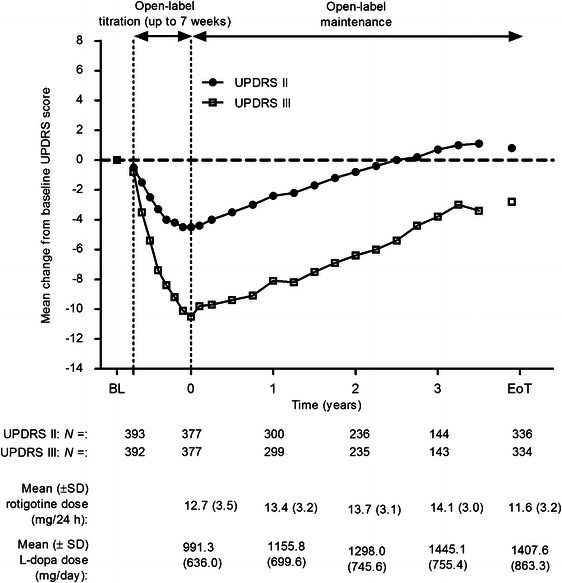
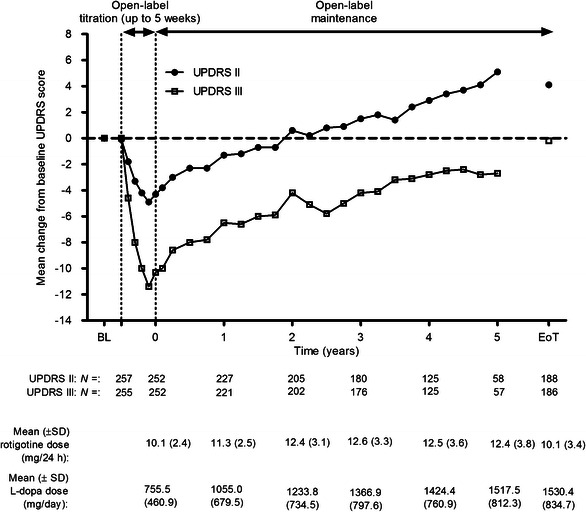
Open-label extensions [studies SP516 (NCT00501969) and SP715 (NCT00594386)] of the CLEOPATRA-PD and PREFER studies were conducted to evaluate the safety, tolerability and efficacy of the dopaminergic agonist, rotigotine, over several years of follow-up in patients with advanced Parkinson's disease (PD). Eligible subjects completing the double-blind trials received open-label adjunctive rotigotine (≤16 mg/24 h) for up to 4 and 6 years in Studies SP516 and SP715, respectively. Safety and tolerability were assessed using adverse events, vital signs and laboratory parameters, and efficacy assessed using the unified Parkinson's disease rating scale (UPDRS). Of the 395 and 258 patients enrolled in the SP516 and SP715 studies, 48 and 45 % completed, respectively. Adverse events were typically dopaminergic effects [e.g., somnolence (18-25 %/patient-year), insomnia (5-7 %/patient-year), dyskinesias (4-8 %/patient-year) and hallucinations (4-8 %/patient-year)], or related to the transdermal application of a patch (application site reactions: 14-15 %/patient-year). There were no clinically relevant changes in vital signs or laboratory parameters in either study. Mean UPDRS part II (activities of daily living) and part III (motor function) total scores improved from double-blind baseline during dose titration, then gradually declined over the maintenance period. In study SP516, mean UPDRS part II and III total scores were 0.8 points above and 2.8 points below double-blind baseline, respectively, at end of treatment. In study SP715, mean UPDRS part II and III total scores were 4.1 points above and 0.2 points below baseline, respectively, at end of treatment. In these open-label studies, adjunctive rotigotine was efficacious with an acceptable safety and tolerability profile in patients with advanced PD for up to 6 years.


Figures
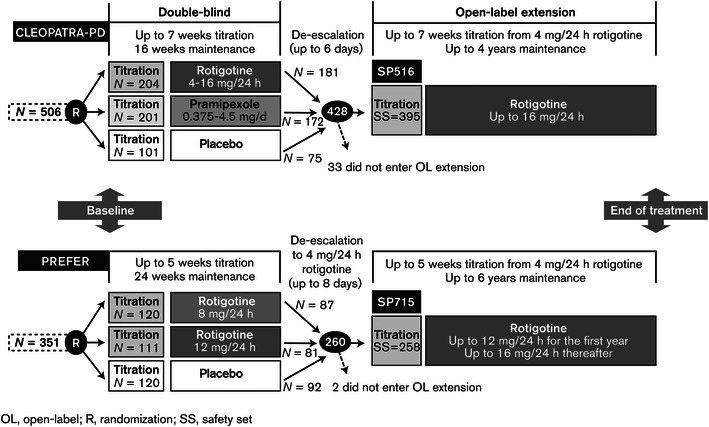
Fig. 1
Fig. 1
Design of open-label extension studies for participants from the CLEOPATRA-PD and PREFER studies
Fig. 2
Fig. 2
Change from baseline (visit two of double-blind study) in UPDRS part II (ADL) and part III (motor function) scores during open-label treatment in study SP516; safety set, observed cases. Mean rotigotine and l-dopa doses shown by timepoint. ADL activities of daily living, BL double-blind baseline, EoT end of treatment, l- dopa levodopa, SD standard deviation, UPDRS united Parkinson’s disease rating scale. Patients were followed for up to 4 years; data are not shown beyond 3.5 years due to <50 patients with measurements at these timepoints
Fig. 3
Fig. 3
Change from baseline (visit two of double-blind study) UPDRS part II (ADL) and part III (motor function) scores during open-label treatment in SP715; safety set, observed cases. Mean rotigotine and l-dopa doses shown by timepoint. ADL activities of daily living, BL double-blind baseline, EoT end of treatment, l- dopa levodopa, SD standard deviation, UPDRS united Parkinson’s disease rating scale. Patients were followed for up to 4 years; data are not shown beyond 3.5 years due to <50 patients with measurements at these timepoints

References

    1. Antonini A, Tolosa E, Mizuno Y, Yamamoto M, Poewe WH. A reassessment of risks and benefits of dopamine agonists in Parkinson’s disease. Lancet Neurol. 2009;8:929–937. doi: 10.1016/S1474-4422(09)70225-X. - DOI - PubMed
    1. Boroojerdi B, Wolff HM, Braun M, Scheller DK. Rotigotine transdermal patch for the treatment of Parkinson’s disease and restless legs syndrome. Drugs Today (Barc) 2010;46:483–505. doi: 10.1358/dot.2010.46.7.1463530. - DOI - PubMed
    1. Giladi N, Boroojerdi B, Korczyn AD, Burn DJ, Clarke CE, Schapira AH, SP513 investigators Rotigotine transdermal patch in early Parkinson’s disease: a randomized, double-blind, controlled study versus placebo and ropinirole. Mov Disord. 2007;22:2398–2404. doi: 10.1002/mds.21741. - DOI - PubMed
    1. Hauser RA, Rascol O, Korczyn AD, Jon Stoessl A, Watts RL, Poewe W, De Deyn PP, Lang AE. Ten-year follow-up of Parkinson’s disease patients randomized to initial therapy with ropinirole or levodopa. Mov Disord. 2007;22:2409–2417. doi: 10.1002/mds.21743. - DOI - PubMed
    1. Holloway RG, Shoulson I, Fahn S, et al. Pramipexole vs levodopa as initial treatment for Parkinson disease: a 4-year randomized controlled trial. Arch Neurol. 2004;61:1044–1053. doi: 10.1001/archneur.61.7.1044. - DOI - PubMed

Publication types

MeSH terms