Review
. 2012 Dec 1;4(12):a013193.
doi: 10.1101/cshperspect.a013193.

The endoplasmic reticulum-associated degradation pathways of budding yeast

Affiliations
Review

The endoplasmic reticulum-associated degradation pathways of budding yeast

Guillaume Thibault et al. Cold Spring Harb Perspect Biol. .

Abstract

Protein misfolding is a common cellular event that can produce intrinsically harmful products. To reduce the risk, quality control mechanisms are deployed to detect and eliminate misfolded, aggregated, and unassembled proteins. In the secretory pathway, it is mainly the endoplasmic reticulum-associated degradation (ERAD) pathways that perform this role. Here, specialized factors are organized to monitor and process the folded states of nascent polypeptides. Despite the complex structures, topologies, and posttranslational modifications of client molecules, the ER mechanisms are the best understood among all protein quality-control systems. This is the result of convergent and sometimes serendipitous discoveries by researchers from diverse fields. Although major advances in ER quality control and ERAD came from all model organisms, this review will focus on the discoveries culminating from the simple budding yeast.


Figures
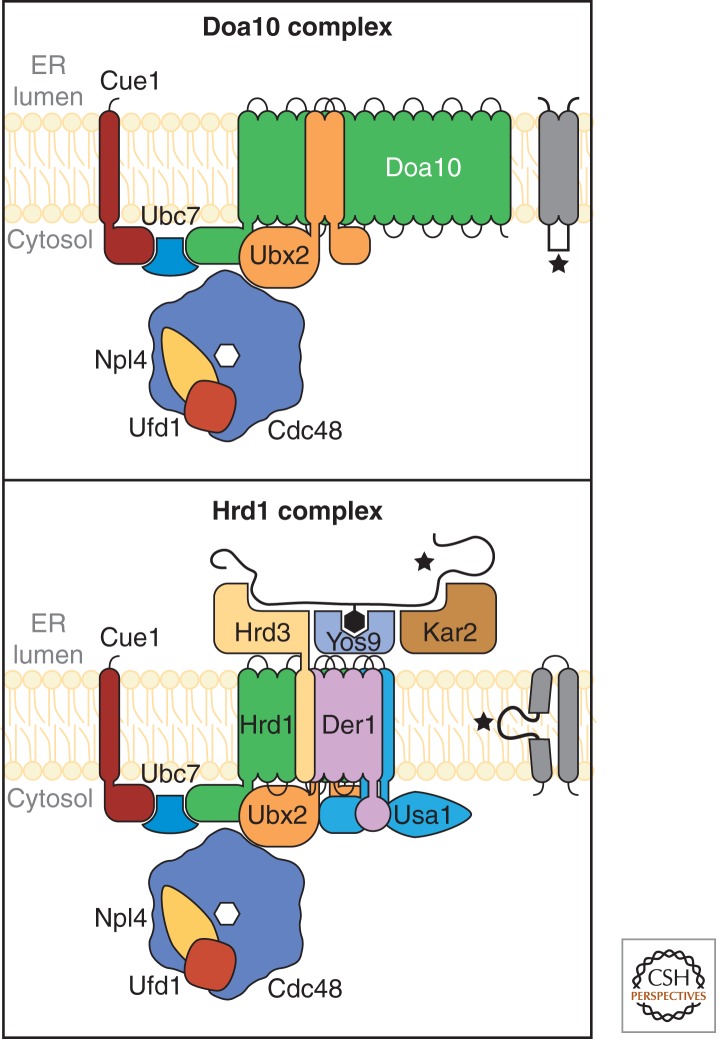
Figure 1.
Figure 1.
Schematic representation of Hrd1 and Doa10 complexes. Individual subunits of each complex are depicted with their known partners. (Top) The Doa10 complex monitors the folding state of cytosolic domains of membrane proteins (ERAD-C). (Bottom) The Hrd1 complex recognizes lesions of luminal domains of membrane and soluble proteins (ERAD-L) and of lesions within transmembrane domains (ERAD-M).
Figure 2.
Figure 2.
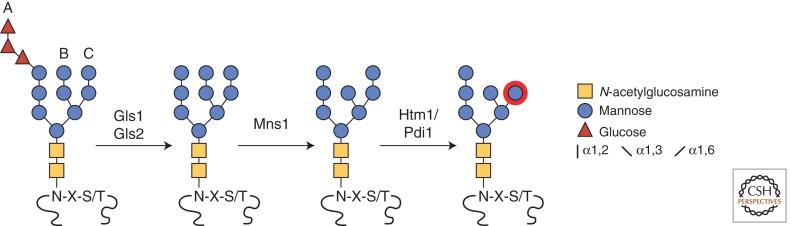
Targeting glycoproteins for degradation. The core GlcNAc2-Man9-Glc3 glycan is rapidly added to the side-chain nitrogen of Asn (N) residues part of the consensus sequence Asn-X-Ser/Thr (N-X-S/T). This posttranslational modification occurs as soon as polypeptides enter the endoplasmic reticulum through the translocon. Subsequently, the three glucoses of branch A are trimmed consecutively by the glucosidase I (Gls1) and glucosidase II (Gls2) to generate GlcNAc2-Man9. Mannosidase I (Mns1) cleaves the α1,2-linked mannose of branch B to produce GlcNAc2-Man8. At this stage, folded and glycosylated proteins may leave the ER. However, glycosylated proteins failing to fold are recognized by Htm1/Pdi1, which cleaves the α1,2-linked mannose of branch C to yield the terminal α1,6-linked mannose residue as the Yos9 ligand (red circle).
Figure 3.
Figure 3.
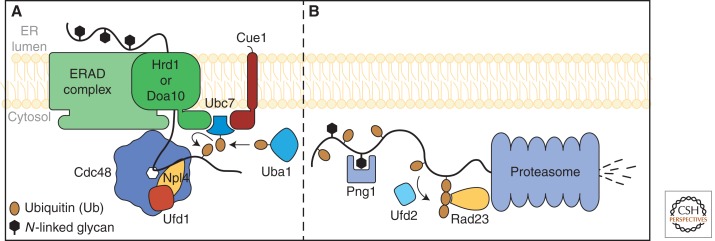
Retrotranslocation and degradation of ERAD substrates. (A) Proteins targeted for degradation by ERAD complex are retrotranslocated through a “retrotranlocon” (Hrd1, Doa10, and Sec61 are proposed to serve this role but only the E3s are shown for simplicity) with the mechanical force provided by the Cdc48-Npl4-Ufd1 AAA-ATPase complex. Polypeptides are subsequently ubiquitinated as depicted. (B) In the cytosol, Png1 removes N-linked glycans from substrates. Ufd2 can lengthen ubiquitin chains for some substrates. Polyubiquitinated species are recognized by Rad23p and passed to the proteasome for degradation.

References

    1. Ahner A, Nakatsukasa K, Zhang H, Frizzell RA, Brodsky JL 2007. Small heat-shock proteins select ΔF508-CFTR for endoplasmic reticulum-associated degradation. Mol Biol Cell 18: 806–814 - PMC - PubMed
    1. Alberts SM, Sonntag C, Schafer A, Wolf DH 2009. Ubx4 modulates cdc48 activity and influences degradation of misfolded proteins of the endoplasmic reticulum. J Biol Chem 284: 16082–16089 - PMC - PubMed
    1. Baek GH, Kim I, Rao H 2011. The Cdc48 ATPase modulates the interaction between two proteolytic factors Ufd2 and Rad23. Proc Natl Acad Sci 108: 13558–13563 - PMC - PubMed
    1. Bays NW, Gardner RG, Seelig LP, Joazeiro CA, Hampton RY 2001a. Hrd1p/Der3p is a membrane-anchored ubiquitin ligase required for ER-associated degradation. Nat Cell Biol 3: 24–29 - PubMed
    1. Bays NW, Wilhovsky SK, Goradia A, Hodgkiss-Harlow K, Hampton RY 2001b. HRD4/NPL4 is required for the proteasomal processing of ubiquitinated ER proteins. Mol Biol Cell 12: 4114–4128 - PMC - PubMed

Publication types

MeSH terms

Substances

LinkOut - more resources